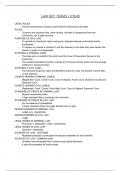
LAW KEY TERMS / IDEAS
LEGAL RULES:
- Formal mechanisms of social control that are enforced by the state.
RULES:
- Customs and practices that, when broken, will lead to disapproval from the
community, not a legal sanction.
PURPOSE OF CIVIL LAW:
- To uphold an individual's rights and govern disputes between individuals and/or
businesses.
- To resolve or reverse a situation to put the claimant in the state they were before the
breach of rights; to compensate.
STARTING A CRIMINAL CASE:
- The state acts on behalf of the victim and the Crown Prosecution Service is the
prosecutor.
- The arrested individual is held in custody for 24 hours until the police can find enough
evidence to prosecute them.
STARTING A CIVIL CASE:
- The claimant brings the claim and therefore starts the case, the burden of proof falls
on the claimant.
COURTS HEARING CRIMINAL CASES:
- Magistrates' Court, Crown Court, Court of Appeal, Youth Court, Divisional Courts and
Supreme Court.
COURTS HEARING CIVIL CASES:
- Magistrates’ Court, County Court High Court, Court of Appeal, Supreme Court.
STANDARD OF PROOF IN CRIMINAL LAW:
- Beyond reasonable doubt.
- A high standard that is necessary for conviction.
STANDARD OF PROOF IN CIVIL LAW:
- On the balance of probabilities.
- A lower standard where the judge decides who is right.
DECISION MAKER IN CRIMINAL LAW:
- Judge, jury, magistrates.
DECISION MAKER IN CIVIL LAW:
- Judge.
LEGAL NAMES IN CRIMINAL LAW:
- Prosecutor v defendant / victim v perpetrator.
LEGAL NAMES IN CIVIL LAW:
- Claimant v defendant.
SOURCES OF LAW - CUSTOMS:
- Repeated practices or principles that became identified as law overtime.
SOURCES OF LAW - COMMON LAW:
- Unwritten and developed from customs and judicial decisions.
- It sets the precedent for future cases.
,SOURCES OF LAW - STATUTE/LEGISLATION:
- Acts of Parliament.
- Useful for new developments (Criminal Justice Act 1988).
- Can bring together whole areas of law in one go.
- Can change or revoke laws.
- A limitation is that it creates laws based on the common law that already exists today
(Theft Act 1968).
ADVOCACY:
- Speaking in court on behalf of another; conducting a case in court as the legal
representative.
, STATUTORY INTERPRETATION
THE COURT’S ROLE IN STATUTORY INTERPRETATION:
- The court’s role is to interpret the law in a way that avoids an absurd outcome.
- These interpretations are not binding but are useful for new developments (Data
Protection Act).
WHY WE NEED STATUTORY INTERPRETATION:
- To define general terms (Interpretation Act).
- To define broad terms (Dangerous Dogs Act).
- To provide language clarity.
- To make the law easier to enforce.
THE LITERAL RULE:
- Judges interpret the law by giving terms their dictionary definition, even if it provides
an absurd outcome.
- Whiteley v Chappell.
ADVANTAGES OF THE LITERAL RULE:
- Easy to predict how judges will interpret the law.
- Follows the wording of parliament.
- Certainty in the law.
DISADVANTAGES OF THE LITERAL RULE:
- Provides an absurd outcome.
- Not all acts are perfectly drafted.
- Some words have more than one meaning.
THE GOLDEN RULE:
- Judges interpret the law in a way that avoids an absurd outcome.
- Re Sigsworth.
ADVANTAGES OF THE GOLDEN RULE:
- Avoids the problems of the literal rule.
- Allows judges to choose the most sensible interpretation.
- Respects the wording of parliament.
DISADVANTAGES OF THE GOLDEN RULE:
- Can only be used in limited circumstances.
- It is not easy to predict how judges will interpret the law.
- Zander: it is a ‘feeble parachute’.
THE MISCHIEF RULE:
- Judges look back at gaps in the law and interpret the law in a way that fills these
gaps.
- Smith v Hughes.
ADVANTAGES OF THE MISCHIEF RULE:
- Fills the gaps in the law.
- Promotes the purpose of the law.
- Produces a ‘just’ result.
DISADVANTAGES OF THE MISCHIEF RULE:
- Relies on looking back at previous case law.
- Creates uncertainty in the law.
LEGAL RULES:
- Formal mechanisms of social control that are enforced by the state.
RULES:
- Customs and practices that, when broken, will lead to disapproval from the
community, not a legal sanction.
PURPOSE OF CIVIL LAW:
- To uphold an individual's rights and govern disputes between individuals and/or
businesses.
- To resolve or reverse a situation to put the claimant in the state they were before the
breach of rights; to compensate.
STARTING A CRIMINAL CASE:
- The state acts on behalf of the victim and the Crown Prosecution Service is the
prosecutor.
- The arrested individual is held in custody for 24 hours until the police can find enough
evidence to prosecute them.
STARTING A CIVIL CASE:
- The claimant brings the claim and therefore starts the case, the burden of proof falls
on the claimant.
COURTS HEARING CRIMINAL CASES:
- Magistrates' Court, Crown Court, Court of Appeal, Youth Court, Divisional Courts and
Supreme Court.
COURTS HEARING CIVIL CASES:
- Magistrates’ Court, County Court High Court, Court of Appeal, Supreme Court.
STANDARD OF PROOF IN CRIMINAL LAW:
- Beyond reasonable doubt.
- A high standard that is necessary for conviction.
STANDARD OF PROOF IN CIVIL LAW:
- On the balance of probabilities.
- A lower standard where the judge decides who is right.
DECISION MAKER IN CRIMINAL LAW:
- Judge, jury, magistrates.
DECISION MAKER IN CIVIL LAW:
- Judge.
LEGAL NAMES IN CRIMINAL LAW:
- Prosecutor v defendant / victim v perpetrator.
LEGAL NAMES IN CIVIL LAW:
- Claimant v defendant.
SOURCES OF LAW - CUSTOMS:
- Repeated practices or principles that became identified as law overtime.
SOURCES OF LAW - COMMON LAW:
- Unwritten and developed from customs and judicial decisions.
- It sets the precedent for future cases.
,SOURCES OF LAW - STATUTE/LEGISLATION:
- Acts of Parliament.
- Useful for new developments (Criminal Justice Act 1988).
- Can bring together whole areas of law in one go.
- Can change or revoke laws.
- A limitation is that it creates laws based on the common law that already exists today
(Theft Act 1968).
ADVOCACY:
- Speaking in court on behalf of another; conducting a case in court as the legal
representative.
, STATUTORY INTERPRETATION
THE COURT’S ROLE IN STATUTORY INTERPRETATION:
- The court’s role is to interpret the law in a way that avoids an absurd outcome.
- These interpretations are not binding but are useful for new developments (Data
Protection Act).
WHY WE NEED STATUTORY INTERPRETATION:
- To define general terms (Interpretation Act).
- To define broad terms (Dangerous Dogs Act).
- To provide language clarity.
- To make the law easier to enforce.
THE LITERAL RULE:
- Judges interpret the law by giving terms their dictionary definition, even if it provides
an absurd outcome.
- Whiteley v Chappell.
ADVANTAGES OF THE LITERAL RULE:
- Easy to predict how judges will interpret the law.
- Follows the wording of parliament.
- Certainty in the law.
DISADVANTAGES OF THE LITERAL RULE:
- Provides an absurd outcome.
- Not all acts are perfectly drafted.
- Some words have more than one meaning.
THE GOLDEN RULE:
- Judges interpret the law in a way that avoids an absurd outcome.
- Re Sigsworth.
ADVANTAGES OF THE GOLDEN RULE:
- Avoids the problems of the literal rule.
- Allows judges to choose the most sensible interpretation.
- Respects the wording of parliament.
DISADVANTAGES OF THE GOLDEN RULE:
- Can only be used in limited circumstances.
- It is not easy to predict how judges will interpret the law.
- Zander: it is a ‘feeble parachute’.
THE MISCHIEF RULE:
- Judges look back at gaps in the law and interpret the law in a way that fills these
gaps.
- Smith v Hughes.
ADVANTAGES OF THE MISCHIEF RULE:
- Fills the gaps in the law.
- Promotes the purpose of the law.
- Produces a ‘just’ result.
DISADVANTAGES OF THE MISCHIEF RULE:
- Relies on looking back at previous case law.
- Creates uncertainty in the law.