

Page |1
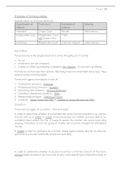
Principles of Criminal Liability
Classifi cation of Criminal Off ences
Classification of Trial Court Examples of Severity
Offence offence
Indictable Crown Court Murder Most serious
Triable either way Magistrates Court Theft
OR Crown Court
Summary Magistrates Court Common Assault Least serious
Actus Reus
The actus reus is the physical part of a crime, the guilty act. It can be:
• An act
• A failure to act (an omission)
• A state of affairs (possessing a weapon) Hill V Baxter – D must act voluntarily.
If D has no control over their actions, then they have not committed actus reus. They
should not be criminally liable.
There are 6 types of omissions in the UK:
1. Contractual omission – Pittwood
2. Professional duty omission – Dytham
3. Voluntary care omission – Stone & Dobinson
4. Creating a dangerous situation – Miller
5. Relationship omission – Gibbins & Proctor
6. A statute – Road Traffic Act 1998 or Children & Young Persons Act 1933
Causation
There are two types of causation – factual & legal.
In order to determine whether D committed the crime (factual causation) we use the
‘but for’ test as in White. In White, D tried to poison his mother, but she died of an
unrelated heart attack. But for D trying to poison his mother she would have died
anyway. Therefore, D was not guilty of murder but could be charged for attempted
murder.
In Pagett D held his girlfriend as a human shield against police. But for D using his
girlfriend as a human shield she would not have died.
In order to determine whether D caused more than a minimal amount of the harm
Kimsey (legal causation) we must look at who is the operating & substantial cause of
, Page |2
the harm. In Smith, D stabbed V & V was carried to a hospital but was dropped on
the way. The medical staff gave V artificial respiration by pressing on his chest. V
died. However, the stab wound was the operating & substantial cause of V’s death.
In Jordan, V was stabbed by D. V was taken to the hospital, he was healing well but
was given antibiotics that he was allergic to, so the doctors stopped giving him
antibiotics. The next day another doctor gave V a high dosage of this antibiotic &
died. Therefore, D was not the operating & substantial cause of V’s death, the doctor
was.
Legal Chain of Causation
Things that can break the chain of causation:
• A 3rd party can break the chain – Pagett was guilty of s47 as V’s actions were
reasonable & foreseeable (so it did not break the chain).
• V does something unreasonable or unforeseeable – Williams & Davis; V jumped
on D’s car because his wallet was stolen so V’s actions were unreasonable.
• Hospitals providing clearly palpably incompetent medical treatment – Jordan
there was clearly palpably incompetent medical treatment.
Mens Rea
Mens rea is the mental part of the crime, the guilty mind. There are 3 types of
intention:
1. Direct Intent – D meant the injury, ‘a decision made to bring about the
consequences’ Mohan
2. Oblique/Indirect Intent – the injury was virtually certain, & D knew this but
continued anyway Woollin
3. Recklessness – D knew the risk of injury & carried on regardless Cunningham
The Coincidence Rule
The coincidence rule is used when AR & MR do not seem to occur at the same time.
We are looking for a point where they did coincide.
In Fagan, D had AR when he accidentally ran over V’s foot, he had no MR at this
point. V asked D to move but D refused. D now has AR & MR as the tire is still on V’s
foot. This is a continuing act as the AR has continued.
In Thabo-Meli the Ds beat up V & pushed V off a cliff thinking V was dead, V was not.
V died due to overexposure. The Ds had the MR to kill but no AR as they hadn’t killed
V. Beating up & pushing V was one continuing act.
, Page |3
Transf erred Malice
Where the MR transfers from the IV to the AV. MR can transfer from person →
person & property → property but not person → property.
Latimer – D fought IV in pub with a belt, D hit AV with the belt instead - TM
Pembliton – D threw stones into a crowd to disperse them but broke a window – not
TM
Mitchell – D tried to jump a queue, pushed IV who bumped AV who died - TM
Strict Liability Crimes
SL crimes do not need MR only AR. We have SL crimes to encourage compliance
with the law, prevent defences being raised as an excuse & protects the public. They
are regarded as regulatory offences & not as a real crime.
Harrow LBC v Shah – D sold a lottery ticket to an underage child. This was a matter
of social concern, gambling.
Alphacell Ltd v Woodward – D convicted of causing polluted matter to get into a
river but was unaware. This was a matter of social concern, pollution & safety.
Principles of Criminal Liability
Classifi cation of Criminal Off ences
Classification of Trial Court Examples of Severity
Offence offence
Indictable Crown Court Murder Most serious
Triable either way Magistrates Court Theft
OR Crown Court
Summary Magistrates Court Common Assault Least serious
Actus Reus
The actus reus is the physical part of a crime, the guilty act. It can be:
• An act
• A failure to act (an omission)
• A state of affairs (possessing a weapon) Hill V Baxter – D must act voluntarily.
If D has no control over their actions, then they have not committed actus reus. They
should not be criminally liable.
There are 6 types of omissions in the UK:
1. Contractual omission – Pittwood
2. Professional duty omission – Dytham
3. Voluntary care omission – Stone & Dobinson
4. Creating a dangerous situation – Miller
5. Relationship omission – Gibbins & Proctor
6. A statute – Road Traffic Act 1998 or Children & Young Persons Act 1933
Causation
There are two types of causation – factual & legal.
In order to determine whether D committed the crime (factual causation) we use the
‘but for’ test as in White. In White, D tried to poison his mother, but she died of an
unrelated heart attack. But for D trying to poison his mother she would have died
anyway. Therefore, D was not guilty of murder but could be charged for attempted
murder.
In Pagett D held his girlfriend as a human shield against police. But for D using his
girlfriend as a human shield she would not have died.
In order to determine whether D caused more than a minimal amount of the harm
Kimsey (legal causation) we must look at who is the operating & substantial cause of
, Page |2
the harm. In Smith, D stabbed V & V was carried to a hospital but was dropped on
the way. The medical staff gave V artificial respiration by pressing on his chest. V
died. However, the stab wound was the operating & substantial cause of V’s death.
In Jordan, V was stabbed by D. V was taken to the hospital, he was healing well but
was given antibiotics that he was allergic to, so the doctors stopped giving him
antibiotics. The next day another doctor gave V a high dosage of this antibiotic &
died. Therefore, D was not the operating & substantial cause of V’s death, the doctor
was.
Legal Chain of Causation
Things that can break the chain of causation:
• A 3rd party can break the chain – Pagett was guilty of s47 as V’s actions were
reasonable & foreseeable (so it did not break the chain).
• V does something unreasonable or unforeseeable – Williams & Davis; V jumped
on D’s car because his wallet was stolen so V’s actions were unreasonable.
• Hospitals providing clearly palpably incompetent medical treatment – Jordan
there was clearly palpably incompetent medical treatment.
Mens Rea
Mens rea is the mental part of the crime, the guilty mind. There are 3 types of
intention:
1. Direct Intent – D meant the injury, ‘a decision made to bring about the
consequences’ Mohan
2. Oblique/Indirect Intent – the injury was virtually certain, & D knew this but
continued anyway Woollin
3. Recklessness – D knew the risk of injury & carried on regardless Cunningham
The Coincidence Rule
The coincidence rule is used when AR & MR do not seem to occur at the same time.
We are looking for a point where they did coincide.
In Fagan, D had AR when he accidentally ran over V’s foot, he had no MR at this
point. V asked D to move but D refused. D now has AR & MR as the tire is still on V’s
foot. This is a continuing act as the AR has continued.
In Thabo-Meli the Ds beat up V & pushed V off a cliff thinking V was dead, V was not.
V died due to overexposure. The Ds had the MR to kill but no AR as they hadn’t killed
V. Beating up & pushing V was one continuing act.
, Page |3
Transf erred Malice
Where the MR transfers from the IV to the AV. MR can transfer from person →
person & property → property but not person → property.
Latimer – D fought IV in pub with a belt, D hit AV with the belt instead - TM
Pembliton – D threw stones into a crowd to disperse them but broke a window – not
TM
Mitchell – D tried to jump a queue, pushed IV who bumped AV who died - TM
Strict Liability Crimes
SL crimes do not need MR only AR. We have SL crimes to encourage compliance
with the law, prevent defences being raised as an excuse & protects the public. They
are regarded as regulatory offences & not as a real crime.
Harrow LBC v Shah – D sold a lottery ticket to an underage child. This was a matter
of social concern, gambling.
Alphacell Ltd v Woodward – D convicted of causing polluted matter to get into a
river but was unaware. This was a matter of social concern, pollution & safety.


