Judicial Precedent
JUDICIAL PRECEDENT:
Judicial Precedent:
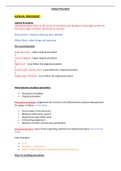
Judicial precedent refers to the source of law where past decisions of the judges create law
for future judges to follow, also known as case law.
Stare Decisis = Stand by what has been decided
Obiter Dicta = other things said and done
The court hierarchy:
Supreme Court – makes original precedent
Court of Appeal - makes original precedent
High Court – must follow the original precedent
Crown Court/ County court - must follow the original precedent
Magistrates/ Tribunals - must follow the original precedent
Main features of judicial precedent:
Persuasive precedent
Original precedent
Persuasive precedent: judgements do not have to be followed but could provide good law
for judges to follow, not binding:
Courts lower in the hierarchy
Decisions of the privy council
Statements made obiter dicta
A dissenting judgement
Decisions of other common law jurisdictions
Original precedent: areas of law originating entirely from judicial precedent, law made by
judges
Case examples:
RvR
Donoghue v Stevenson
Gillick v West Norfolk and Wisbech Area Health Authority
Ways of avoiding precedents:
, 1. Overrule - Higher courts can overrule lower courts
Candler v Crane Christmas & co, Hedley Byrne v Heller & Partners
2. Reverse - On appeal, a higher court may change the decision of a lower court
Re Pinochet
3. Distinguish - Where a lower court is able to point to material differences that justify
the application of different principles
Balfour v Balfour, Merritt v Merritt
Exceptions:
Court of Appeal is bound by the decisions of the supreme court or HOL, but also its own
previous decisions except in conditions laid down in Young v Bristol Aeroplane:
Where there are 2 conflicting decisions
Where a previous decision has been overturned by a later hol/supreme court
decision
Where the previous decision was wrongly decided
Practice Statement:
Supreme court + Precedent
House of Lords was bound by its own previous decisions as held in London Tramways
v LCC
Lord Chancellor issued the practice statement allowing the House of Lords to depart
from their previous decision ' where it appears right to do so'
Case examples:
Pepper v Hart
R v Shivpuri
Impact of the human rights act 1998 s.2
Requires all judges to consider the case law of the European court of human rights. This
creates a new source of case law.
Case example:
Vinter v UK - Article 3 rights breached due to sentence of 'whole life order'
Advantages + Disadvantages of Judicial Precedent:
JUDICIAL PRECEDENT:
Judicial Precedent:
Judicial precedent refers to the source of law where past decisions of the judges create law
for future judges to follow, also known as case law.
Stare Decisis = Stand by what has been decided
Obiter Dicta = other things said and done
The court hierarchy:
Supreme Court – makes original precedent
Court of Appeal - makes original precedent
High Court – must follow the original precedent
Crown Court/ County court - must follow the original precedent
Magistrates/ Tribunals - must follow the original precedent
Main features of judicial precedent:
Persuasive precedent
Original precedent
Persuasive precedent: judgements do not have to be followed but could provide good law
for judges to follow, not binding:
Courts lower in the hierarchy
Decisions of the privy council
Statements made obiter dicta
A dissenting judgement
Decisions of other common law jurisdictions
Original precedent: areas of law originating entirely from judicial precedent, law made by
judges
Case examples:
RvR
Donoghue v Stevenson
Gillick v West Norfolk and Wisbech Area Health Authority
Ways of avoiding precedents:
, 1. Overrule - Higher courts can overrule lower courts
Candler v Crane Christmas & co, Hedley Byrne v Heller & Partners
2. Reverse - On appeal, a higher court may change the decision of a lower court
Re Pinochet
3. Distinguish - Where a lower court is able to point to material differences that justify
the application of different principles
Balfour v Balfour, Merritt v Merritt
Exceptions:
Court of Appeal is bound by the decisions of the supreme court or HOL, but also its own
previous decisions except in conditions laid down in Young v Bristol Aeroplane:
Where there are 2 conflicting decisions
Where a previous decision has been overturned by a later hol/supreme court
decision
Where the previous decision was wrongly decided
Practice Statement:
Supreme court + Precedent
House of Lords was bound by its own previous decisions as held in London Tramways
v LCC
Lord Chancellor issued the practice statement allowing the House of Lords to depart
from their previous decision ' where it appears right to do so'
Case examples:
Pepper v Hart
R v Shivpuri
Impact of the human rights act 1998 s.2
Requires all judges to consider the case law of the European court of human rights. This
creates a new source of case law.
Case example:
Vinter v UK - Article 3 rights breached due to sentence of 'whole life order'
Advantages + Disadvantages of Judicial Precedent: