
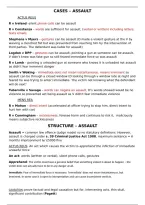
CASES – ASSAULT
ACTUS REUS
R v Ireland -silent phone calls can be assault
R v Constanza – words are sufficient for assault, (verbal or written) including letters,
texts emails
Stephens v Myers – gestures can be assault (D made a violent gesture at the V by
waiving a clenched fist but was prevented from reaching him by the intervention of
third parties. The defendant was liable for assault)
Logdon v DPP – gestures can be assault, pointing a gun at someone can be assault,
V didn’t know was fake gun so still feared immediate force so was assault
R v Lamb – pointing a unloaded gun at someone who knows it is unloaded not assault
as didn’t fear imminent danger
Smith v Woking – immediate does not mean instantaneous, means imminent so
assault can be through a closed window (D looking through v window late at night and
feared he was trying to enter) immediate- ‘the victim not knowing what the defendant
will do next’
Tuberville v Savage – words can negate an assault, D’s words showed would be no
violence so prevented act being assault as V didn’t fear immediate violence
MENS REA
R v Mohan – direct intent (accelerated at officer trying to stop him, direct intent to
hurt him with car)
R v Cunningham – recklessness, foresee harm and continues to risk it, maliciously
means subjective recklessness
STRUCTURE – ASSAULT
Assault = common law offence (judge made) so no statutory definitions. However,
assault is charged under s. 39 Criminal Justice Act 1988, maximum sentence = 6
months imprisonment &/ £5000 fine
ACTUS REUS: An act which causes the victim to apprehend the infliction of immediate
unlawful force
An act: words (written or verbal), silent phone calls, gestures
Apprehend: The victim must have a genuine belief that something violent is about to happen – the
victim does not actually have to be in any danger at all.
Immediate: Fear of immediate force is necessary. ‘Immediate’ does not mean instantaneous, but
imminent. In some case it is open to interpretation and can cause inconsistent verdicts.
CAUSATION: prove factual and legal causation but for, intervening acts, thin skull,
significant contribution (Pagett)
, MENS REA: intention or recklessness as to cause another fear of immediate unlawful force
1) Direct intention: D’s main aim or purpose was to cause V to apprehend immediate unlawful force
(Mohan)
2) Recklessness: D knew there was a risk of causing V to apprehend immediate unlawful force
because of his actions but continued to take the risk (Cunningham)
May need to state rule on transferred malice- if a defendant intends to harm one person but accidentally
harms another, the original intent transfers to the actual victim (Latimer) or rule on coincidence of actus
reus and mens rea - actus reus (guilty act) and mens rea (guilty mind) must exist at the same time for a
crime to be committed (Fagan)
SUGGESTED EXAM STRUCTURE: ASSAULT
INTRO: IDENTIFY OFFENCE
D can be charged with an assault against V under s.39 Criminal Justice Act 1988. This is a common
law offence and has been criticised for creating confusion due to not being defined in a statute.
ACTUS REUS
State the actus reus (define act, apprehend, immediate) supporting this with relevant case law
(approx. 2-3 cases) – always include Smith and any relevant A03 point
Apply the actus reus, considering the following:
What act did D do? What clues in your scenario indicate that the V apprehended immediate force?
How did they react to the D’s actions?
CAUSATION
State: Factual and legal causation must be proven (go straight into application)
Apply: ‘But for…’ (Pagett). ‘There are no intervening acts that could break the chain of causation so
therefore D has made a significant contribution …(Pagett).’ (UNLIKELY TO BE AN INTERVENING ACT)
MENS REA
State the mens rea of assault
State direct intention test (Mohan) and recklessness test (Cunningham)
Apply: was it D’s main aim or purpose to cause V to apprehend immediate unlawful force? If so,
how? AND/OR did D know there is a risk of causing V to apprehend immediate unlawful force
because of his actions but continue to take the risk?
NOTE: You may need to state and apply the rule on transferred malice (Latimer) or the rule on
coincidence of actus reus and mens rea (Fagan)
ACTUS REUS
R v Ireland -silent phone calls can be assault
R v Constanza – words are sufficient for assault, (verbal or written) including letters,
texts emails
Stephens v Myers – gestures can be assault (D made a violent gesture at the V by
waiving a clenched fist but was prevented from reaching him by the intervention of
third parties. The defendant was liable for assault)
Logdon v DPP – gestures can be assault, pointing a gun at someone can be assault,
V didn’t know was fake gun so still feared immediate force so was assault
R v Lamb – pointing a unloaded gun at someone who knows it is unloaded not assault
as didn’t fear imminent danger
Smith v Woking – immediate does not mean instantaneous, means imminent so
assault can be through a closed window (D looking through v window late at night and
feared he was trying to enter) immediate- ‘the victim not knowing what the defendant
will do next’
Tuberville v Savage – words can negate an assault, D’s words showed would be no
violence so prevented act being assault as V didn’t fear immediate violence
MENS REA
R v Mohan – direct intent (accelerated at officer trying to stop him, direct intent to
hurt him with car)
R v Cunningham – recklessness, foresee harm and continues to risk it, maliciously
means subjective recklessness
STRUCTURE – ASSAULT
Assault = common law offence (judge made) so no statutory definitions. However,
assault is charged under s. 39 Criminal Justice Act 1988, maximum sentence = 6
months imprisonment &/ £5000 fine
ACTUS REUS: An act which causes the victim to apprehend the infliction of immediate
unlawful force
An act: words (written or verbal), silent phone calls, gestures
Apprehend: The victim must have a genuine belief that something violent is about to happen – the
victim does not actually have to be in any danger at all.
Immediate: Fear of immediate force is necessary. ‘Immediate’ does not mean instantaneous, but
imminent. In some case it is open to interpretation and can cause inconsistent verdicts.
CAUSATION: prove factual and legal causation but for, intervening acts, thin skull,
significant contribution (Pagett)
, MENS REA: intention or recklessness as to cause another fear of immediate unlawful force
1) Direct intention: D’s main aim or purpose was to cause V to apprehend immediate unlawful force
(Mohan)
2) Recklessness: D knew there was a risk of causing V to apprehend immediate unlawful force
because of his actions but continued to take the risk (Cunningham)
May need to state rule on transferred malice- if a defendant intends to harm one person but accidentally
harms another, the original intent transfers to the actual victim (Latimer) or rule on coincidence of actus
reus and mens rea - actus reus (guilty act) and mens rea (guilty mind) must exist at the same time for a
crime to be committed (Fagan)
SUGGESTED EXAM STRUCTURE: ASSAULT
INTRO: IDENTIFY OFFENCE
D can be charged with an assault against V under s.39 Criminal Justice Act 1988. This is a common
law offence and has been criticised for creating confusion due to not being defined in a statute.
ACTUS REUS
State the actus reus (define act, apprehend, immediate) supporting this with relevant case law
(approx. 2-3 cases) – always include Smith and any relevant A03 point
Apply the actus reus, considering the following:
What act did D do? What clues in your scenario indicate that the V apprehended immediate force?
How did they react to the D’s actions?
CAUSATION
State: Factual and legal causation must be proven (go straight into application)
Apply: ‘But for…’ (Pagett). ‘There are no intervening acts that could break the chain of causation so
therefore D has made a significant contribution …(Pagett).’ (UNLIKELY TO BE AN INTERVENING ACT)
MENS REA
State the mens rea of assault
State direct intention test (Mohan) and recklessness test (Cunningham)
Apply: was it D’s main aim or purpose to cause V to apprehend immediate unlawful force? If so,
how? AND/OR did D know there is a risk of causing V to apprehend immediate unlawful force
because of his actions but continue to take the risk?
NOTE: You may need to state and apply the rule on transferred malice (Latimer) or the rule on
coincidence of actus reus and mens rea (Fagan)


