

Assault Battery
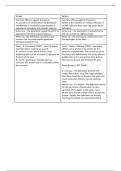
Non-fatal offences against the person. Non-fatal offences against the person.
An assault is committed when the defendant Battery is the intention or reckless infliction of
intentionally or recklessly causes another to unlawful physical force upon the victim by the
apprehend immediate and unlawful violence. defendant.
Actus reus – the defendant caused the victim to Actus reus – the application of unlawful force,
apprehend imminent unlawful violence. this can include the slightest touch.
Mens rea – the defendant intended or was Mens rea – the intention or recklessness as to
reckless that the victim would apprehend the application of the force.
imminent unlawful force.
Cases – R v Constanza (1997) – court of appeal Cases – Collins v Wilcock (1984) – two police
held that letters could be an assault. officers saw a woman n the streets for the
R v Ireland – It was held that even silent purposes of prostitution. She refused to talk to
telephone calls can be an assault. It depends on the police and walked away. One of the officers
the facts of the case. grabbed her arm to prevent her from leaving.
R v Lamb – pointing an unloaded gun at She became abusive and scratched his arm.
someone who knows that it is unloaded cannot
be an assault. Wood (Fraser) v DPP (2008) –
R v Thomas – the defendant touched and
rubbed the victim’s skirt. The judges decided
that there should be no dispute, that when you
touch someone’s clothes, you are touching
them.
Indirect Act – R v Martin – the defendant placed
an iron bar across a theatre door, he then
switched off the lights. In the panic, many
people were injured as they tried to escape the
theatre. Despite the defendant not actually
touching the victims, he committed battery.
Non-fatal offences against the person. Non-fatal offences against the person.
An assault is committed when the defendant Battery is the intention or reckless infliction of
intentionally or recklessly causes another to unlawful physical force upon the victim by the
apprehend immediate and unlawful violence. defendant.
Actus reus – the defendant caused the victim to Actus reus – the application of unlawful force,
apprehend imminent unlawful violence. this can include the slightest touch.
Mens rea – the defendant intended or was Mens rea – the intention or recklessness as to
reckless that the victim would apprehend the application of the force.
imminent unlawful force.
Cases – R v Constanza (1997) – court of appeal Cases – Collins v Wilcock (1984) – two police
held that letters could be an assault. officers saw a woman n the streets for the
R v Ireland – It was held that even silent purposes of prostitution. She refused to talk to
telephone calls can be an assault. It depends on the police and walked away. One of the officers
the facts of the case. grabbed her arm to prevent her from leaving.
R v Lamb – pointing an unloaded gun at She became abusive and scratched his arm.
someone who knows that it is unloaded cannot
be an assault. Wood (Fraser) v DPP (2008) –
R v Thomas – the defendant touched and
rubbed the victim’s skirt. The judges decided
that there should be no dispute, that when you
touch someone’s clothes, you are touching
them.
Indirect Act – R v Martin – the defendant placed
an iron bar across a theatre door, he then
switched off the lights. In the panic, many
people were injured as they tried to escape the
theatre. Despite the defendant not actually
touching the victims, he committed battery.


