



Newest Unit 18 - Database Design summaries


Essay
Unit 18 - Database Design - D1
BTEC IT Level 3 - Unit 18 - Database Design
 akj

Essay
Unit 18 - Database Design - P7
BTEC IT Level 3 - Unit 18 - Database Design
akj

Essay
Unit 18 - Database Design - D2
BTEC IT Level 3 - Unit 18 - Database Design
akj

Essay
Unit 18 - Database Design - P2
BTEC IT Level 3 - Unit 18 - Database Design
akj

Essay
Unit 18 - Assignment 2 - P2, P4
Unit 18 Database Design. Designing a relational database. All criteria achieved, P2, P4.
leoJBlack

Essay
Unit 18 - Assignment 1 - P1, M1, D1
Unit 18 Database Design. Introduction to relational Databases. All criteria achieved, P1, M1 and D1.
leoJBlack
Essay
Unit 18 Database Design Assignment 3 Report
Full written Unit 18 Database Design Assignment 3 Report (all criteria achieved)
drj44

Essay
Unit 18 Database Design Assignment 2 Report
Full written Unit 18 Database Design Assignment 2 Report (all criteria achieved)
drj44

Essay
Unit 18 Database Design Assignment 1 Report
Full written Unit 18 Database Design Assignment 1 Report (all criteria achieved)
drj44


Essay
BTEC LEVEL 3 - Unit 18- Database Design
P1,P2,P3,P4,P5,P6,M1,M2,M3,D1,D2 Includes over 6,000 words in assignment.
xeon
Essay
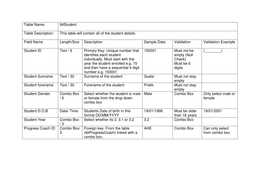
P2- Design a relational database for a specified user need Data Dictionary
For P2, learners must design a relational database containing at least five tables for a specified user need. Learners must provide evidence of appropriate normalisation and database design. Documentation such as ERDs, data dictionaries, DFDs, structured English etc will provide the evidence.
 topqualityworka

Essay
D2- Evaluate a database against the specified user need.
D2 requires learners to evaluate their databases’ success in meeting user need. Learners should not only discuss strengths and weaknesses, but justify the features and functions they have used and make suggestions for improvements.
topqualityworka

Essay
D1- Discuss how potential errors in the design and construction of a database can be avoided
D1 is an opportunity for users to identify and explain a range of common errors in database design and construction, explaining how these types of errors can be avoided. As an example, learners could discuss the impact of errors such as the accidental deletion of a field in a query or report, the renaming of a field, changing data types etc.
topqualityworka
Essay
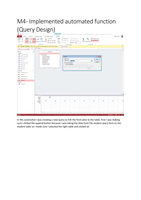
M4- Implement an automated function.
For M4, learners are required to implement one of the automated functions suggested in the unit content.
topqualityworka
Essay
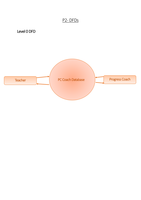
P2- Design a relational database for a specified user need DFD
For P2, learners must design a relational database containing at least five tables for a specified user need. Learners must provide evidence of appropriate normalisation and database design. Documentation such as ERDs, data dictionaries, DFDs, structured English etc will provide the evidence.
topqualityworka

Essay
M3- Export data to an external source
M3 requires learners to export the results of either a query or report to another application. To evidence this, learners could provide a screen print of a directory containing the exported data in a suitable file format or a print of the data in its new format. Alternatively, for M2 and M3, an appropriately documented demonstration of learners exporting and importing data would be appropriate. The tutor could ask for a particular set of data to be exported to a particular application.
topqualityworka
Essay
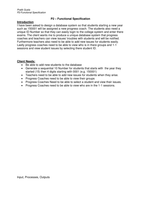
P2- Design a relational database for a specified user need Functional Specification
For P2, learners must design a relational database containing at least five tables for a specified user need. Learners must provide evidence of appropriate normalisation and database design. Documentation such as ERDs, data dictionaries, DFDs, structured English etc will provide the evidence.
topqualityworka

Essay
M2- Import data from an external source
M2 requires learners to import data from an external source (this could be from a text file, spreadsheet, word-processed table or another database package). The data could, for example, be used to form one of the tables required in the database.
topqualityworka
Essay
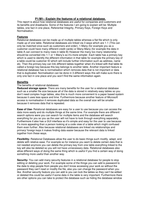
P1- Explain the features of a relational database
For P1, they must explain the features of a relational database. Evidence for this could be, for example, a written report, a presentation or a written discussion. Note that the features include benefits and learners need to be able to quote aspects that relate to the efficiency of storage of information with a minimum of data redundancy and also the ease by which information can be extracted from the database as required.
topqualityworka

Essay
M1- Explain referential integrity and the purpose of primary keys in building the relationships between tables
For M1, learners should show evidence that they understand the concept of referential integrity and the mechanisms that exist to support the enforcement of referential integrity within a database package. They should also be able to explain the purpose of primary keys and how they are used to build the relationships between tables. Reference should also be made to foreign keys.
topqualityworka