

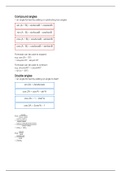
Compound angles
= an angle formed by adding or subtracting two angles
sin (A + B) = sinAcosB + cosAsinB
sin (A - B) = sinAcosB - cosAsinB
cos (A + B) = cosAcosB - sinAsinB
cos (A - B) = cosAcosB + sinAsinB
Formulae can be used to expand:
e.g. cos (θ + 10°)
= cosθcos10° - sinθsin10°
Formulae can be used to contract:
e.g. sinxcos40° + cosxsin40°
= sin (x + 40°)
Double angles
= an angle formed by adding an angle to itself
sin 2A = 2sinAcosA
cos 2A = cos2A – sin2A
cos 2A = 1 – 2sin2A
cos 2A = 2cos2A – 1
cos 2𝑎
e.g. cos 𝑎−𝑠𝑖𝑛𝑎
𝑐𝑜𝑠2 𝑎−𝑠𝑖𝑛2 𝑎
= cos 𝑎−𝑠𝑖𝑛𝑎
(cos 𝑎−𝑠𝑖𝑛𝑎)(cos 𝑎+𝑠𝑖𝑛𝑎)
= cos 𝑎−𝑠𝑖𝑛𝑎
= cosa + sina
sin 2𝑏
e.g. 𝑠𝑖𝑛𝑏
2𝑠𝑖𝑛𝑏𝑐𝑜𝑠𝑏
= 𝑠𝑖𝑛𝑏
= 2cosb
, Formulas in an alternative format:
(cos a – sin a)2 = 1 - sin 2a
(sin a - cos a)2 = 1 - sin 2a
1
sinacosa = 2 sin 2a
Question types:
- Expanding
e.g. sin 75°
= sin (45° + 30°)
= sin45°cos30° + cos45°sin30°
√2 √3 √2 1
=( 2
x 2
)+( 2
x2 )
- Pythagoras
- Contacting
e.g. sin100°cos 20° – cos280°sin 160°
= sin(180 - 80°)cos 20° – cos(360 - 80°)sin(180 - 20°)
= sin 80°cos 20° – cos 80°sin 20°
= sin (80° - 20°)
= sin 60°
- Double angles
5
e.g. cos x = 13 find sin 2x (0° < 2x < 360°)
sin 2x = 2sinxcosx
12 5
= 2( )( )
13 13
120
= 169
- Half angles
√2
e.g. cos 45° = find sin (22.5°)
2
cos 45° = cos ( 2 x 22.5°)
√2
2
= 1 - 2sin2(22.5°)
2sin2(22.5°) = 2 - √2
√(2−√2)
sin(22.5°) = 2
Note: When dealing with half angles within Pythagoras type questions, always start with the full
. angle and work back.
= an angle formed by adding or subtracting two angles
sin (A + B) = sinAcosB + cosAsinB
sin (A - B) = sinAcosB - cosAsinB
cos (A + B) = cosAcosB - sinAsinB
cos (A - B) = cosAcosB + sinAsinB
Formulae can be used to expand:
e.g. cos (θ + 10°)
= cosθcos10° - sinθsin10°
Formulae can be used to contract:
e.g. sinxcos40° + cosxsin40°
= sin (x + 40°)
Double angles
= an angle formed by adding an angle to itself
sin 2A = 2sinAcosA
cos 2A = cos2A – sin2A
cos 2A = 1 – 2sin2A
cos 2A = 2cos2A – 1
cos 2𝑎
e.g. cos 𝑎−𝑠𝑖𝑛𝑎
𝑐𝑜𝑠2 𝑎−𝑠𝑖𝑛2 𝑎
= cos 𝑎−𝑠𝑖𝑛𝑎
(cos 𝑎−𝑠𝑖𝑛𝑎)(cos 𝑎+𝑠𝑖𝑛𝑎)
= cos 𝑎−𝑠𝑖𝑛𝑎
= cosa + sina
sin 2𝑏
e.g. 𝑠𝑖𝑛𝑏
2𝑠𝑖𝑛𝑏𝑐𝑜𝑠𝑏
= 𝑠𝑖𝑛𝑏
= 2cosb
, Formulas in an alternative format:
(cos a – sin a)2 = 1 - sin 2a
(sin a - cos a)2 = 1 - sin 2a
1
sinacosa = 2 sin 2a
Question types:
- Expanding
e.g. sin 75°
= sin (45° + 30°)
= sin45°cos30° + cos45°sin30°
√2 √3 √2 1
=( 2
x 2
)+( 2
x2 )
- Pythagoras
- Contacting
e.g. sin100°cos 20° – cos280°sin 160°
= sin(180 - 80°)cos 20° – cos(360 - 80°)sin(180 - 20°)
= sin 80°cos 20° – cos 80°sin 20°
= sin (80° - 20°)
= sin 60°
- Double angles
5
e.g. cos x = 13 find sin 2x (0° < 2x < 360°)
sin 2x = 2sinxcosx
12 5
= 2( )( )
13 13
120
= 169
- Half angles
√2
e.g. cos 45° = find sin (22.5°)
2
cos 45° = cos ( 2 x 22.5°)
√2
2
= 1 - 2sin2(22.5°)
2sin2(22.5°) = 2 - √2
√(2−√2)
sin(22.5°) = 2
Note: When dealing with half angles within Pythagoras type questions, always start with the full
. angle and work back.


