
COMMUNICATION
Communication = interaction
We always communicate even non-verbal
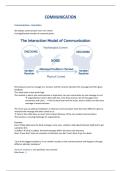
A straightforward model of communication:
Normally you send a message to a receiver and the receiver decodes this message and then gives
feedback
The noise level is here quite high.
The context in which you communicate is important; can you concentrate on one message or not
→ organizations have to deal with this a lot; they receive a lot of messages from
consumers and users,… = how to stand out from the noise, how to make sure that your
message is heard and seen
The more you use abstract mediators or abstract communication tools the more difficult it gets to
interpret the message the other sends to us.
→ face to face talks have so much more impact because of the non-verbal communication
This became a very big challenge for organizations.
Example:
Every Friday afternoon the bank manager came over, simply to talk about financial stuff and to get
cash from him.
It shifted → all of a sudden, the bank manager didn’t do house calls anymore.
Now → you don’t even see someone in the bank, you don’t even have to go to a bank.
“one of the biggest problems in our modern society is that communication only happens through
different abstract mediators”
Abstract mediators: not specified, not concrete.
(the cloud,…)
,You pay your bills online but you don’t have to physically give money
→ A bank is not a fiscal institution anymore which makes it difficult to compete or be compared
with others
It is difficult to attract new customers and make a difference if no one visits your bank or your shop
anymore. There is no face attached, no personal connotation anymore.
It is also easier to make mistakes than with face-to-face communication
Recent trends/evolution in communication management
The conversation becomes more and more important, you have to start a dialogue with your clients
to create confidence, trust, and a connection with the people you talk to and you want to know what
they want, have to be empathic.
Ego communication: you decide what is important to you as a company and you don’t listen to your
target audience
→ sometimes organizations send out what they want without thinking about what their
potential clients or target audience wants.
Characteristics digitalization
- we have no patience anymore, and we expect an immediate response
- We talk to a global audience, distance doesn't matter anymore
- you have to know the audience because it can now be easily distributed to
anyone who’s not your target
- limiting costs: communicating digitally is less expensive than in real life →
not true because every company now has a social media manager,… = you
have to spend an even amount of manhours
,Media shifts: the place doesn’t matter anymore
Format shift: companies put a lot of time into making sure that all the information is being received
across every kind of social media platform (quality the same on a laptop as on a phone)
Experience economy: we want to use our senses; scan a QR code, you can decide in programs who
wins,… → you have to do something to get the information
Effects of digitalization
- Globalization gets a 24/7 character.
o the process by which businesses or other organizations develop international
influence or start operating on an international scale.
- Individualization and alliances on our conditions
o the act of making something different to suit the needs of a particular person, place,
etc.
o The new generation has become less social but people on social media platforms
make new sometimes short-term connections based on the same interests.
- Hierarchy disappears looking for similarities instead of differences.
o You can get the impression that there is no distance anymore between your idols, …
- Trust-connection: new keywords
Trends in professional communication due to societal changes and evolutions
Main thing/ starting point: the identity of the organization
- Identity
o what does the organization stand for
o vision
DNA of the organization
o mission
o core values
, The way you act to other people should reflect your identity if so people will know the real you but
most people don’t, they put up a front
Same for companies → companies that reflect the best values, their mission and so their identity will
have a long-term possibility to position themselves on the market
Trend 1: From offline to online
(from fixed internet to mobile devices/ more available data/ more interaction and participation)
If you see something nice or funny, you easily share it with your friends
So messages not intended for you will find you anyway
Trend 2: trust issue
Example: Volkswagen told their stakeholders year after year that their cars were ecological, and that
the emission was low. Then it was discovered it was a lie.
→ how can you trust the managers of these companies, they only want to make a profit.
Accountability: you have to take on your responsibility
How to create trust:
- market-oriented products and services
- consistent policy
- accountability
= essential for every organization
However: no guarantee to survive, because a license to operate is a matter of a sense of justice from
‘trust me’ to ‘show me’
It is important to not only do what your audience wants but to listen to the feedback you get. You
must make sure you know what is going on in the world, and in society.
Communication = interaction
We always communicate even non-verbal
A straightforward model of communication:
Normally you send a message to a receiver and the receiver decodes this message and then gives
feedback
The noise level is here quite high.
The context in which you communicate is important; can you concentrate on one message or not
→ organizations have to deal with this a lot; they receive a lot of messages from
consumers and users,… = how to stand out from the noise, how to make sure that your
message is heard and seen
The more you use abstract mediators or abstract communication tools the more difficult it gets to
interpret the message the other sends to us.
→ face to face talks have so much more impact because of the non-verbal communication
This became a very big challenge for organizations.
Example:
Every Friday afternoon the bank manager came over, simply to talk about financial stuff and to get
cash from him.
It shifted → all of a sudden, the bank manager didn’t do house calls anymore.
Now → you don’t even see someone in the bank, you don’t even have to go to a bank.
“one of the biggest problems in our modern society is that communication only happens through
different abstract mediators”
Abstract mediators: not specified, not concrete.
(the cloud,…)
,You pay your bills online but you don’t have to physically give money
→ A bank is not a fiscal institution anymore which makes it difficult to compete or be compared
with others
It is difficult to attract new customers and make a difference if no one visits your bank or your shop
anymore. There is no face attached, no personal connotation anymore.
It is also easier to make mistakes than with face-to-face communication
Recent trends/evolution in communication management
The conversation becomes more and more important, you have to start a dialogue with your clients
to create confidence, trust, and a connection with the people you talk to and you want to know what
they want, have to be empathic.
Ego communication: you decide what is important to you as a company and you don’t listen to your
target audience
→ sometimes organizations send out what they want without thinking about what their
potential clients or target audience wants.
Characteristics digitalization
- we have no patience anymore, and we expect an immediate response
- We talk to a global audience, distance doesn't matter anymore
- you have to know the audience because it can now be easily distributed to
anyone who’s not your target
- limiting costs: communicating digitally is less expensive than in real life →
not true because every company now has a social media manager,… = you
have to spend an even amount of manhours
,Media shifts: the place doesn’t matter anymore
Format shift: companies put a lot of time into making sure that all the information is being received
across every kind of social media platform (quality the same on a laptop as on a phone)
Experience economy: we want to use our senses; scan a QR code, you can decide in programs who
wins,… → you have to do something to get the information
Effects of digitalization
- Globalization gets a 24/7 character.
o the process by which businesses or other organizations develop international
influence or start operating on an international scale.
- Individualization and alliances on our conditions
o the act of making something different to suit the needs of a particular person, place,
etc.
o The new generation has become less social but people on social media platforms
make new sometimes short-term connections based on the same interests.
- Hierarchy disappears looking for similarities instead of differences.
o You can get the impression that there is no distance anymore between your idols, …
- Trust-connection: new keywords
Trends in professional communication due to societal changes and evolutions
Main thing/ starting point: the identity of the organization
- Identity
o what does the organization stand for
o vision
DNA of the organization
o mission
o core values
, The way you act to other people should reflect your identity if so people will know the real you but
most people don’t, they put up a front
Same for companies → companies that reflect the best values, their mission and so their identity will
have a long-term possibility to position themselves on the market
Trend 1: From offline to online
(from fixed internet to mobile devices/ more available data/ more interaction and participation)
If you see something nice or funny, you easily share it with your friends
So messages not intended for you will find you anyway
Trend 2: trust issue
Example: Volkswagen told their stakeholders year after year that their cars were ecological, and that
the emission was low. Then it was discovered it was a lie.
→ how can you trust the managers of these companies, they only want to make a profit.
Accountability: you have to take on your responsibility
How to create trust:
- market-oriented products and services
- consistent policy
- accountability
= essential for every organization
However: no guarantee to survive, because a license to operate is a matter of a sense of justice from
‘trust me’ to ‘show me’
It is important to not only do what your audience wants but to listen to the feedback you get. You
must make sure you know what is going on in the world, and in society.


