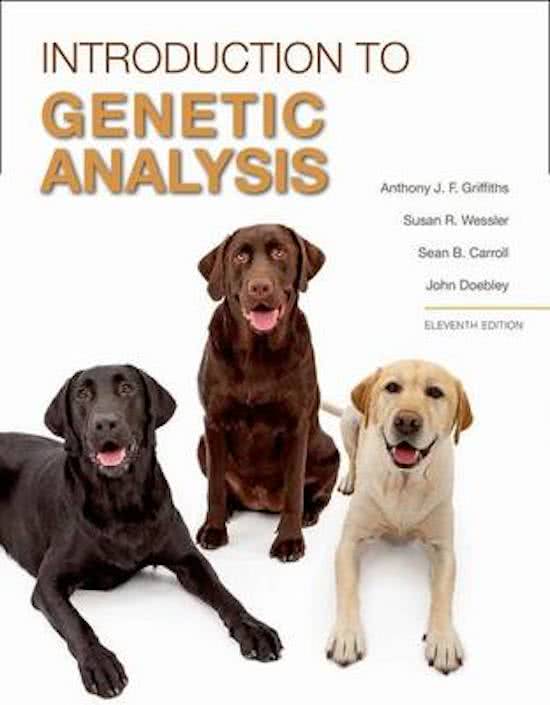
TEST BANK
Introduction to Genetic Analysis
Anthony J.F. Griffiths, John Doebley, Catherine Peichel, and David A.
Wassarman
12th Edition
FULL TEST BANK!!!
,Table of Contents
Chapter 01 The Genetics Revolution 1
Chapter 02 Single Gene Inheritance 6
Chapter 03 Independent Assortment of Genes 26
Chapter 04 Mapping Eukaryote Chromosomes by Recombination 43
Chapter 05 Gene Interaction 63
Chapter 06 The Genetics of Bacteria and Their Viruses 84
Chapter 07 DNA Structure and Replication 104
Chapter 08 RNA Transcription Processing and Decay 117
Chapter 09 Proteins and Their Synthesis 130
Chapter 10 Gene Isolation and Manipulation 141
Chapter 11 Regulation of Gene Expression in Bacteria and Their Viruses 160
Chapter 12 Regulation of Gene Expression in Eukaryotes 175
Chapter 13 The Genetic Control of Development 184
Chapter 14 Genomes and Genomics 192
Chapter 15 DNA Damage Repair and Recombination 197
Chapter 16 The Dynamic Genome Transposable Elements 216
Chapter 17 Large Scale Chromosomal Changes 225
Chapter 18 Population Genetics 243
Chapter 19 The Inheritance of Complex Traits 258
Chapter 20 Evolution of Genes and Traits 270
, Test Bank - Introduction to Genetic Analysis, 12th Edition (Griffiths, 2021)
Chapter 01: The Genetics Revolution
1. The early 1900s was an important period for genetics due to which of the following major events?
a. the rediscovery of Gregor Mendel's scientific findings
b. Watson and Crick solving the structure of DNA
c. Walter Sutton and Theodore Boveri hypothesizing that chromosomes are the hereditary elements
d. the rediscovery of Gregor Mendel's scientific findings and Walter Sutton and Theodore
Boveri hypothesizing that chromosomes are the hereditary elements
e. All of the Answer options are correct.
ANSWER: e
2. A sample of normal double-stranded DNA was found to have a guanine content of 18%. What is the
expected proportion of adenine?
a. 9%
b. 32%
c. 36%
d. 68%
e. 82%
ANSWER: b
3. In one strand of DNA, the nucleotide sequence is 5'-ATGC-3'. The complementary sequence in
the other strand must be
a. 3'-ATGC-5'.
b. 3'-TACG-5'.
c. 5'-ATCG-3'.
d. 5'-CGTA-3'.
e. 5'-TACG-3'.
ANSWER: b
4. How many different DNA molecules that are eight-nucleotide-pairs long are theoretically possible?
a. 24
b. 32
c. 64
d. 256
e. 65,536
ANSWER: e
, Test Bank - Introduction to Genetic Analysis, 12th Edition (Griffiths, 2021)
5. Which of the following is/are TRUE about genes?
a. Genes are located on chromosomes.
b. Genes come in variants known as alleles.
c. Genes usually encode protein products.
d. All of the Answer options are correct.
e. None of the Answer options is correct.
ANSWER: d
1 |Page
Introduction to Genetic Analysis
Anthony J.F. Griffiths, John Doebley, Catherine Peichel, and David A.
Wassarman
12th Edition
FULL TEST BANK!!!
,Table of Contents
Chapter 01 The Genetics Revolution 1
Chapter 02 Single Gene Inheritance 6
Chapter 03 Independent Assortment of Genes 26
Chapter 04 Mapping Eukaryote Chromosomes by Recombination 43
Chapter 05 Gene Interaction 63
Chapter 06 The Genetics of Bacteria and Their Viruses 84
Chapter 07 DNA Structure and Replication 104
Chapter 08 RNA Transcription Processing and Decay 117
Chapter 09 Proteins and Their Synthesis 130
Chapter 10 Gene Isolation and Manipulation 141
Chapter 11 Regulation of Gene Expression in Bacteria and Their Viruses 160
Chapter 12 Regulation of Gene Expression in Eukaryotes 175
Chapter 13 The Genetic Control of Development 184
Chapter 14 Genomes and Genomics 192
Chapter 15 DNA Damage Repair and Recombination 197
Chapter 16 The Dynamic Genome Transposable Elements 216
Chapter 17 Large Scale Chromosomal Changes 225
Chapter 18 Population Genetics 243
Chapter 19 The Inheritance of Complex Traits 258
Chapter 20 Evolution of Genes and Traits 270
, Test Bank - Introduction to Genetic Analysis, 12th Edition (Griffiths, 2021)
Chapter 01: The Genetics Revolution
1. The early 1900s was an important period for genetics due to which of the following major events?
a. the rediscovery of Gregor Mendel's scientific findings
b. Watson and Crick solving the structure of DNA
c. Walter Sutton and Theodore Boveri hypothesizing that chromosomes are the hereditary elements
d. the rediscovery of Gregor Mendel's scientific findings and Walter Sutton and Theodore
Boveri hypothesizing that chromosomes are the hereditary elements
e. All of the Answer options are correct.
ANSWER: e
2. A sample of normal double-stranded DNA was found to have a guanine content of 18%. What is the
expected proportion of adenine?
a. 9%
b. 32%
c. 36%
d. 68%
e. 82%
ANSWER: b
3. In one strand of DNA, the nucleotide sequence is 5'-ATGC-3'. The complementary sequence in
the other strand must be
a. 3'-ATGC-5'.
b. 3'-TACG-5'.
c. 5'-ATCG-3'.
d. 5'-CGTA-3'.
e. 5'-TACG-3'.
ANSWER: b
4. How many different DNA molecules that are eight-nucleotide-pairs long are theoretically possible?
a. 24
b. 32
c. 64
d. 256
e. 65,536
ANSWER: e
, Test Bank - Introduction to Genetic Analysis, 12th Edition (Griffiths, 2021)
5. Which of the following is/are TRUE about genes?
a. Genes are located on chromosomes.
b. Genes come in variants known as alleles.
c. Genes usually encode protein products.
d. All of the Answer options are correct.
e. None of the Answer options is correct.
ANSWER: d
1 |Page