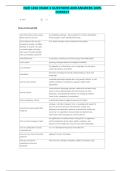
NUR 1010 EXAM 3 QUESTIONS AND ANSWERS 100%
CORRECT
Save
Terms in this set (43)
what is the transcultural nursing by Madeleine Leininger... allows patients to continue their beliefs
theory and who is it by? in the hospital, which will help them heal.
True or false: by law you are True. Family members cannot translate for the patient.
required to provide a certified
translator to anyone who does
not speak English (including
ASL), even if a family member
who can translate is present?
what is ethnicity? a subculture, members of an ethnic group with similar beliefs.
what is race? grouping of people based on biological similarities.
The adoption of cultural traits, such as language, by one group
acculturation
under the influence of another.
the process of taking in and fully understanding a culture and
assimilation
language.
vulnerable population (people born with genetic defects, or with
what is a sub-culture? health conditions), homelessness, gender, LGBTQ, older
population.
communication (language, gestures, verbal and nonverbal cues),
space (in US we typically keep 18 inches between us), time
what is culture?
orientation, social organization (family unit), biological variation
(color of skin, metabolism of medications).
what is healthcare culture? scientific/biomedical, religious/supernatural, holistic.
Leininger. culturally congruent care - knowledge and respect for
your own and your and your PTs would view, culture, and
what is the Sunrise Model? Who
preferred care expressions, patterns, and practices. healthcare
made it?
encounter is a negotiation where provider and patient learn
about each other and agree on common ground.
the application of evidence-based nursing that is in agreement
what is cultural congruent care? with the preferred cultural values, beliefs, worldview, and
practices of the healthcare consumer and other stakeholders
can you quickly learn cultural no. it is a developmental process that takes time.
competence?
when must you have a translator signing of consent, discharge.
present?
who says we need to ANA (must be culturally competent), QSEN (PT centered care).
understand culture and
ethnicity?
, bias
ethnocentrism (tendency to believe that your beliefs are the only
what are the barriers to cultural beliefs)
and competent care? cultural stereotypes
prejudice
discrimation
o What is your condition CALLED?
o What do you think CAUSED your problem?
4 C's to culture
o How do you COPE with your condition?
o What CONCERNS do you have?
o Assess their culture and beliefs, pain tolerance, etc.
o Plan to educate health illiteracy, if they speak a different
ADPIE culture and ethnicity language provide a translator, be aware of your resources for
PT's
o Implementation - translators
what is bioethics? application of ethical principles to every aspect of healthcare.
ethical questions that arise from nursing practice (i.e. turning off a
what is nursing ethics?
vent).
o So we can be prepared to make informed decisions because
we're knowledgeable of the ethics involved.
why do we need to know o It will allow you to give input in complex ethical situations
ethics? o Makes you legally competent when making decisions.
o Allows you to be a PT advocate and make educated decisions
on behalf of your patient.
o Societal factors - patients need to know their options. Patients
have access to the internet now and have more knowledge.
sources of ethical problem? o Nature of nursing work
o Nature of nursing profession - you don't have quality time due
to workload.
o Altruism - Concern for the welfare and well-being of others
o Autonomy - The right to self-determination—to choose and act
on that choice.
Per the AACN (american
association of colleges of
o Human dignity - Respect for the inherent worth and uniqueness
nursing) - what are the 5 values
of individuals and populations.
essential for the professional
nurse?
o Integrity - Acting in accordance with an appropriate code of
ethics and accepted standards of practice. Includes honesty.
o Social justice - Treating others fairly no matter what.
Founded by the american hospital association in 2003. When
patients are admitted to hospitals or to extended care facilities,
they are entitled to specific rights in terms of their treatment—the
Patient Care Partnership right to:
- Make their own decisions.
- Be active partners in the treatment process.
- Be treated with dignity and respect.
CORRECT
Save
Terms in this set (43)
what is the transcultural nursing by Madeleine Leininger... allows patients to continue their beliefs
theory and who is it by? in the hospital, which will help them heal.
True or false: by law you are True. Family members cannot translate for the patient.
required to provide a certified
translator to anyone who does
not speak English (including
ASL), even if a family member
who can translate is present?
what is ethnicity? a subculture, members of an ethnic group with similar beliefs.
what is race? grouping of people based on biological similarities.
The adoption of cultural traits, such as language, by one group
acculturation
under the influence of another.
the process of taking in and fully understanding a culture and
assimilation
language.
vulnerable population (people born with genetic defects, or with
what is a sub-culture? health conditions), homelessness, gender, LGBTQ, older
population.
communication (language, gestures, verbal and nonverbal cues),
space (in US we typically keep 18 inches between us), time
what is culture?
orientation, social organization (family unit), biological variation
(color of skin, metabolism of medications).
what is healthcare culture? scientific/biomedical, religious/supernatural, holistic.
Leininger. culturally congruent care - knowledge and respect for
your own and your and your PTs would view, culture, and
what is the Sunrise Model? Who
preferred care expressions, patterns, and practices. healthcare
made it?
encounter is a negotiation where provider and patient learn
about each other and agree on common ground.
the application of evidence-based nursing that is in agreement
what is cultural congruent care? with the preferred cultural values, beliefs, worldview, and
practices of the healthcare consumer and other stakeholders
can you quickly learn cultural no. it is a developmental process that takes time.
competence?
when must you have a translator signing of consent, discharge.
present?
who says we need to ANA (must be culturally competent), QSEN (PT centered care).
understand culture and
ethnicity?
, bias
ethnocentrism (tendency to believe that your beliefs are the only
what are the barriers to cultural beliefs)
and competent care? cultural stereotypes
prejudice
discrimation
o What is your condition CALLED?
o What do you think CAUSED your problem?
4 C's to culture
o How do you COPE with your condition?
o What CONCERNS do you have?
o Assess their culture and beliefs, pain tolerance, etc.
o Plan to educate health illiteracy, if they speak a different
ADPIE culture and ethnicity language provide a translator, be aware of your resources for
PT's
o Implementation - translators
what is bioethics? application of ethical principles to every aspect of healthcare.
ethical questions that arise from nursing practice (i.e. turning off a
what is nursing ethics?
vent).
o So we can be prepared to make informed decisions because
we're knowledgeable of the ethics involved.
why do we need to know o It will allow you to give input in complex ethical situations
ethics? o Makes you legally competent when making decisions.
o Allows you to be a PT advocate and make educated decisions
on behalf of your patient.
o Societal factors - patients need to know their options. Patients
have access to the internet now and have more knowledge.
sources of ethical problem? o Nature of nursing work
o Nature of nursing profession - you don't have quality time due
to workload.
o Altruism - Concern for the welfare and well-being of others
o Autonomy - The right to self-determination—to choose and act
on that choice.
Per the AACN (american
association of colleges of
o Human dignity - Respect for the inherent worth and uniqueness
nursing) - what are the 5 values
of individuals and populations.
essential for the professional
nurse?
o Integrity - Acting in accordance with an appropriate code of
ethics and accepted standards of practice. Includes honesty.
o Social justice - Treating others fairly no matter what.
Founded by the american hospital association in 2003. When
patients are admitted to hospitals or to extended care facilities,
they are entitled to specific rights in terms of their treatment—the
Patient Care Partnership right to:
- Make their own decisions.
- Be active partners in the treatment process.
- Be treated with dignity and respect.