

To understand lung pathology, it helps to think of the lungs as a pump. Obstructive disease is a
"pipes" problem (the air can't get out), while Restrictive disease is a "container" problem (the lungs
can't expand to let air in).
1. Definitions
Obstructive Lung Disease: Characterized by increased resistance to airflow due to partial or
complete obstruction at any level. The hallmark is difficulty exhaling air rapidly.
Examples: Asthma, COPD (Emphysema & Chronic Bronchitis), Bronchiectasis, Cystic Fibrosis.
Restrictive Lung Disease: Characterized by reduced expansion of lung parenchyma, leading to
decreased total lung capacity. The hallmark is reduced lung "compliance" (stiffness).
Examples: Pulmonary Fibrosis (Intrinsic), Obesity/Scoliosis (Extrinsic), Myasthenia Gravis
(Neuromuscular).
Signs & Symptoms
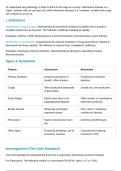
Feature Obstructive Restrictive
Primary Symptom Dyspnea (shortness of Progressive exertional
breath), often wheeze. dyspnea.
Cough Often productive (especially Usually dry, non-productive.
in Bronchitis).
Chest Shape Barrel chest (due to air Often normal, or restricted by
trapping/hyperinflation). deformity (scoliosis).
Breath Sounds Wheezing, prolonged Fine "Velcro" inspiratory
expiratory phase. crackles (in fibrosis).
Percussion Hyper-resonant (too much Dull (less air/stiff tissue).
air).
Other Signs Pursed-lip breathing, use of Cyanosis and clubbing
accessory muscles. (common in IPF).
Investigations (The Gold Standard)
The Gold Standard for distinguishing these two is Spirometry (Pulmonary Function Testing).
For Obstructive: The definitive marker is a decreased FEV1/FVC ratio (< 0.7 or 70%).
"pipes" problem (the air can't get out), while Restrictive disease is a "container" problem (the lungs
can't expand to let air in).
1. Definitions
Obstructive Lung Disease: Characterized by increased resistance to airflow due to partial or
complete obstruction at any level. The hallmark is difficulty exhaling air rapidly.
Examples: Asthma, COPD (Emphysema & Chronic Bronchitis), Bronchiectasis, Cystic Fibrosis.
Restrictive Lung Disease: Characterized by reduced expansion of lung parenchyma, leading to
decreased total lung capacity. The hallmark is reduced lung "compliance" (stiffness).
Examples: Pulmonary Fibrosis (Intrinsic), Obesity/Scoliosis (Extrinsic), Myasthenia Gravis
(Neuromuscular).
Signs & Symptoms
Feature Obstructive Restrictive
Primary Symptom Dyspnea (shortness of Progressive exertional
breath), often wheeze. dyspnea.
Cough Often productive (especially Usually dry, non-productive.
in Bronchitis).
Chest Shape Barrel chest (due to air Often normal, or restricted by
trapping/hyperinflation). deformity (scoliosis).
Breath Sounds Wheezing, prolonged Fine "Velcro" inspiratory
expiratory phase. crackles (in fibrosis).
Percussion Hyper-resonant (too much Dull (less air/stiff tissue).
air).
Other Signs Pursed-lip breathing, use of Cyanosis and clubbing
accessory muscles. (common in IPF).
Investigations (The Gold Standard)
The Gold Standard for distinguishing these two is Spirometry (Pulmonary Function Testing).
For Obstructive: The definitive marker is a decreased FEV1/FVC ratio (< 0.7 or 70%).


