1|Page
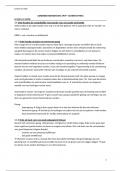
UMASS BCT 353 FINAL EXAM
QUESTIONS WITH VERIFIED ANSWERS
Which of the following is not true for a corporation?
a) the liability is limited to the corp's assets
b) they are subject to double taxation
c) S-corporations are not subject to double taxation
d) death of a stockholder ends a closely held corporation - correct-answer -d)
death of a stockholder ends a closely held corporation
Which is an advantage of forming a corporation?
a) Shareholders have reduced personal liability.
b) Less taxes are paid than in a limited liability corporation.
c) The corporation's value can't go down from its initial purchase price.
d) Quick decision making is possible, especially for large companies. - correct-
answer -a) Shareholders have reduced personal liability.
,2|Page
Which of the following documents determines the zero day of the project for
scheduling purposes?
a) Notice to proceed
b) Proposal Form
c) Formal contract
d) Notice to bidders - correct-answer -a) Notice to proceed
Which delivery method has the most risk for the contractor?
a) Construction Management at risk
b) Integrated project delivery
c) design-bid-build
d) design-build - correct-answer -d) design-build
Based on the paper Empirical Comparison of Design/Build and Design/Bid/Build
Project Delivery Methods
a) DB method is not superior to DBB when used on building projects
b) DB method is superior to DBB when used on building projects.
c) DBB method is superior to DB when used on the buildings projects. - correct-
answer -b) DB method is superior to DBB when used on building projects.
, 3|Page
In this project delivery system, the construction manager earns a fee for
construction management services.
a) IPD
B) CM as agent
C) Multiple prime
D) Design build - correct-answer -B) CM as agent
Construction firms suffer the second highest business failure rate (12% annual
failure rate), following only restaurants. The primary reason this high failure rate
is:
a) Poor management
b) Weather caused delays and losses
c) Government regulation
d) Employee theft - correct-answer -a) Poor management
A type of agreement where the contractor bases the bid on estimated quantities
of work and on the completion of the work in accordance with the contract
documents. a price is given for each unit of work, and contractors are paid based
on actual quantity of work.
UMASS BCT 353 FINAL EXAM
QUESTIONS WITH VERIFIED ANSWERS
Which of the following is not true for a corporation?
a) the liability is limited to the corp's assets
b) they are subject to double taxation
c) S-corporations are not subject to double taxation
d) death of a stockholder ends a closely held corporation - correct-answer -d)
death of a stockholder ends a closely held corporation
Which is an advantage of forming a corporation?
a) Shareholders have reduced personal liability.
b) Less taxes are paid than in a limited liability corporation.
c) The corporation's value can't go down from its initial purchase price.
d) Quick decision making is possible, especially for large companies. - correct-
answer -a) Shareholders have reduced personal liability.
,2|Page
Which of the following documents determines the zero day of the project for
scheduling purposes?
a) Notice to proceed
b) Proposal Form
c) Formal contract
d) Notice to bidders - correct-answer -a) Notice to proceed
Which delivery method has the most risk for the contractor?
a) Construction Management at risk
b) Integrated project delivery
c) design-bid-build
d) design-build - correct-answer -d) design-build
Based on the paper Empirical Comparison of Design/Build and Design/Bid/Build
Project Delivery Methods
a) DB method is not superior to DBB when used on building projects
b) DB method is superior to DBB when used on building projects.
c) DBB method is superior to DB when used on the buildings projects. - correct-
answer -b) DB method is superior to DBB when used on building projects.
, 3|Page
In this project delivery system, the construction manager earns a fee for
construction management services.
a) IPD
B) CM as agent
C) Multiple prime
D) Design build - correct-answer -B) CM as agent
Construction firms suffer the second highest business failure rate (12% annual
failure rate), following only restaurants. The primary reason this high failure rate
is:
a) Poor management
b) Weather caused delays and losses
c) Government regulation
d) Employee theft - correct-answer -a) Poor management
A type of agreement where the contractor bases the bid on estimated quantities
of work and on the completion of the work in accordance with the contract
documents. a price is given for each unit of work, and contractors are paid based
on actual quantity of work.