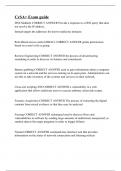
CCRN Adult- 48-Hour Cram Sheet High-Yield Review with Real Retired CCRN
Questions (2024)
Cardiovascular Review
The cardiovascular system is the most heavily weighted section of the CCRN exam. The
exam tests physiology and clinical reasoning rather than memorization. Cardiac output
(CO) is the product of heart rate and stroke volume. Stroke volume is determined by
preload, afterload, and contractility. Preload reflects ventricular filling and is estimated
by CVP on the right side and PAOP on the left. Afterload correlates with systemic
vascular resistance (SVR), while contractility reflects myocardial performance.
Shock differentiation is a core CCRN concept. Hypovolemic shock presents with low
preload and high SVR. Cardiogenic shock is caused by pump failure and presents with
elevated filling pressures and reduced CO. Distributive shock, most commonly septic
shock, presents with low SVR and normal or high CO early. Obstructive shock results
from impaired venous return due to mechanical obstruction such as cardiac tamponade,
tension pneumothorax, or massive pulmonary embolism.
Valvular disease and dysrhythmias are frequently tested. Mitral stenosis causes left atrial
enlargement, pulmonary congestion, and atrial fibrillation with high embolic risk. Aortic
stenosis produces fixed cardiac output and intolerance to hypotension. Aortic
regurgitation causes widened pulse pressure. Atrial fibrillation reduces cardiac output by
eliminating atrial kick and increases embolic risk. Ventricular dysrhythmias are managed
based on stability and presence of a pulse.
Post–cardiac surgery complications are classic CCRN scenarios. Cardiac tamponade
presents with hypotension, tachycardia, jugular venous distention, and muffled heart
sounds. Sudden decompensation after pacing wire removal is tamponade until proven
otherwise. Echocardiography is the diagnostic test of choice.
Pulmonary Artery Waveform Interpretation: a wave = atrial contraction (absent in AF), c
wave = ventricular contraction, v wave = venous filling. Large v waves indicate acute
mitral regurgitation. PAOP reflects left-sided preload and is not interchangeable with
CVP.
Post-Myocardial Infarction Mechanical Complications (2–7 days): Papillary muscle
rupture causes acute mitral regurgitation and flash pulmonary edema. Ventricular septal
rupture causes acute VSD and cardiogenic shock. Free wall rupture leads to
hemopericardium and tamponade.
,Exam Pearls
- Mitral valve opens when LA pressure exceeds LV pressure
- AFib + mitral stenosis = very high embolic risk
- Post-op hypotension + JVD = tamponade until proven otherwise
- Obstructive shock impairs venous return
- End-tidal CO₂ best reflects CPR effectiveness
Cardiovascular Practice Questions (CV-1 to CV-20)
CV-1. The mitral valve opens when which pressure relationship exists?
A. LV pressure exceeds aortic pressure
B. LA pressure exceeds LV pressure
C. RV pressure exceeds pulmonary pressure
D. RA pressure exceeds RV pressure
Correct Answer: B
Rationale: Atrioventricular valves open when atrial pressure exceeds ventricular pressure.
CV-2. A patient with chronic mitral stenosis is at greatest risk for:
A. Ventricular tachycardia
B. Atrial fibrillation
C. Complete heart block
D. Sinus bradycardia
Correct Answer: B
Rationale: Left atrial enlargement predisposes to atrial fibrillation and embolic events.
CV-3. Three days after valve surgery, a patient becomes hypotensive shortly after
epicardial pacing wire removal. The priority diagnostic test is:
A. Chest CT
B. 12-lead ECG
C. Echocardiogram
D. Troponin level
Correct Answer: C
Rationale: Sudden decompensation after pacing wire removal suggests acute cardiac
tamponade.
CV-4. Which hemodynamic profile is consistent with cardiogenic shock?
A. ↓ CVP, ↓ PAOP, ↑ SVR
,B. ↑ CVP, ↑ PAOP, ↓ CO
C. ↓ SVR, ↑ CO
D. Normal PAOP, ↓ SVR
Correct Answer: B
Rationale: Pump failure causes elevated filling pressures and reduced cardiac output.
CV-5. Which finding is most characteristic of obstructive shock?
A. High PAOP
B. Low SVR
C. Decreased venous return
D. Increased preload
Correct Answer: C
Rationale: Mechanical obstruction impairs venous return.
CV-6. A widened pulse pressure is most commonly seen in:
A. Cardiac tamponade
B. Hypovolemia
C. Aortic regurgitation
D. Pulmonary embolism
Correct Answer: C
Rationale: Regurgitant flow increases systolic and decreases diastolic pressure.
CV-7. Which parameter best reflects coronary perfusion during CPR?
A. Heart rate
B. Blood pressure
C. End-tidal CO₂
D. Oxygen saturation
Correct Answer: C
Rationale: End-tidal CO₂ reflects quality of chest compressions.
CV-8. A patient in septic shock has an SvO₂ of 85%. This suggests:
A. Adequate perfusion
B. Hypovolemia
C. Impaired oxygen extraction
, D. Cardiogenic shock
Correct Answer: C
Rationale: High SvO₂ in sepsis reflects impaired cellular oxygen utilization.
CV-9. Which medication is contraindicated in cardiogenic shock?
A. Dobutamine
B. Norepinephrine
C. Dopamine
D. Beta-blockers
Correct Answer: D
Rationale: Beta-blockers reduce contractility and worsen pump failure.
CV-10. Beck’s triad includes hypotension, muffled heart sounds, and:
A. Tachypnea
B. Jugular venous distention
C. Pulmonary edema
D. Widened pulse pressure
Correct Answer: B
Rationale: JVD reflects impaired venous return in tamponade.
CV-11. Nitroglycerin improves myocardial oxygen balance primarily by:
A. Increasing heart rate
B. Increasing contractility
C. Decreasing preload
D. Increasing afterload
Correct Answer: C
Rationale: Venodilation reduces preload and myocardial oxygen demand.
CV-12. Which rhythm requires immediate synchronized cardioversion?
A. Stable atrial fibrillation
B. Ventricular fibrillation
C. Pulseless VT
D. Unstable supraventricular tachycardia
Questions (2024)
Cardiovascular Review
The cardiovascular system is the most heavily weighted section of the CCRN exam. The
exam tests physiology and clinical reasoning rather than memorization. Cardiac output
(CO) is the product of heart rate and stroke volume. Stroke volume is determined by
preload, afterload, and contractility. Preload reflects ventricular filling and is estimated
by CVP on the right side and PAOP on the left. Afterload correlates with systemic
vascular resistance (SVR), while contractility reflects myocardial performance.
Shock differentiation is a core CCRN concept. Hypovolemic shock presents with low
preload and high SVR. Cardiogenic shock is caused by pump failure and presents with
elevated filling pressures and reduced CO. Distributive shock, most commonly septic
shock, presents with low SVR and normal or high CO early. Obstructive shock results
from impaired venous return due to mechanical obstruction such as cardiac tamponade,
tension pneumothorax, or massive pulmonary embolism.
Valvular disease and dysrhythmias are frequently tested. Mitral stenosis causes left atrial
enlargement, pulmonary congestion, and atrial fibrillation with high embolic risk. Aortic
stenosis produces fixed cardiac output and intolerance to hypotension. Aortic
regurgitation causes widened pulse pressure. Atrial fibrillation reduces cardiac output by
eliminating atrial kick and increases embolic risk. Ventricular dysrhythmias are managed
based on stability and presence of a pulse.
Post–cardiac surgery complications are classic CCRN scenarios. Cardiac tamponade
presents with hypotension, tachycardia, jugular venous distention, and muffled heart
sounds. Sudden decompensation after pacing wire removal is tamponade until proven
otherwise. Echocardiography is the diagnostic test of choice.
Pulmonary Artery Waveform Interpretation: a wave = atrial contraction (absent in AF), c
wave = ventricular contraction, v wave = venous filling. Large v waves indicate acute
mitral regurgitation. PAOP reflects left-sided preload and is not interchangeable with
CVP.
Post-Myocardial Infarction Mechanical Complications (2–7 days): Papillary muscle
rupture causes acute mitral regurgitation and flash pulmonary edema. Ventricular septal
rupture causes acute VSD and cardiogenic shock. Free wall rupture leads to
hemopericardium and tamponade.
,Exam Pearls
- Mitral valve opens when LA pressure exceeds LV pressure
- AFib + mitral stenosis = very high embolic risk
- Post-op hypotension + JVD = tamponade until proven otherwise
- Obstructive shock impairs venous return
- End-tidal CO₂ best reflects CPR effectiveness
Cardiovascular Practice Questions (CV-1 to CV-20)
CV-1. The mitral valve opens when which pressure relationship exists?
A. LV pressure exceeds aortic pressure
B. LA pressure exceeds LV pressure
C. RV pressure exceeds pulmonary pressure
D. RA pressure exceeds RV pressure
Correct Answer: B
Rationale: Atrioventricular valves open when atrial pressure exceeds ventricular pressure.
CV-2. A patient with chronic mitral stenosis is at greatest risk for:
A. Ventricular tachycardia
B. Atrial fibrillation
C. Complete heart block
D. Sinus bradycardia
Correct Answer: B
Rationale: Left atrial enlargement predisposes to atrial fibrillation and embolic events.
CV-3. Three days after valve surgery, a patient becomes hypotensive shortly after
epicardial pacing wire removal. The priority diagnostic test is:
A. Chest CT
B. 12-lead ECG
C. Echocardiogram
D. Troponin level
Correct Answer: C
Rationale: Sudden decompensation after pacing wire removal suggests acute cardiac
tamponade.
CV-4. Which hemodynamic profile is consistent with cardiogenic shock?
A. ↓ CVP, ↓ PAOP, ↑ SVR
,B. ↑ CVP, ↑ PAOP, ↓ CO
C. ↓ SVR, ↑ CO
D. Normal PAOP, ↓ SVR
Correct Answer: B
Rationale: Pump failure causes elevated filling pressures and reduced cardiac output.
CV-5. Which finding is most characteristic of obstructive shock?
A. High PAOP
B. Low SVR
C. Decreased venous return
D. Increased preload
Correct Answer: C
Rationale: Mechanical obstruction impairs venous return.
CV-6. A widened pulse pressure is most commonly seen in:
A. Cardiac tamponade
B. Hypovolemia
C. Aortic regurgitation
D. Pulmonary embolism
Correct Answer: C
Rationale: Regurgitant flow increases systolic and decreases diastolic pressure.
CV-7. Which parameter best reflects coronary perfusion during CPR?
A. Heart rate
B. Blood pressure
C. End-tidal CO₂
D. Oxygen saturation
Correct Answer: C
Rationale: End-tidal CO₂ reflects quality of chest compressions.
CV-8. A patient in septic shock has an SvO₂ of 85%. This suggests:
A. Adequate perfusion
B. Hypovolemia
C. Impaired oxygen extraction
, D. Cardiogenic shock
Correct Answer: C
Rationale: High SvO₂ in sepsis reflects impaired cellular oxygen utilization.
CV-9. Which medication is contraindicated in cardiogenic shock?
A. Dobutamine
B. Norepinephrine
C. Dopamine
D. Beta-blockers
Correct Answer: D
Rationale: Beta-blockers reduce contractility and worsen pump failure.
CV-10. Beck’s triad includes hypotension, muffled heart sounds, and:
A. Tachypnea
B. Jugular venous distention
C. Pulmonary edema
D. Widened pulse pressure
Correct Answer: B
Rationale: JVD reflects impaired venous return in tamponade.
CV-11. Nitroglycerin improves myocardial oxygen balance primarily by:
A. Increasing heart rate
B. Increasing contractility
C. Decreasing preload
D. Increasing afterload
Correct Answer: C
Rationale: Venodilation reduces preload and myocardial oxygen demand.
CV-12. Which rhythm requires immediate synchronized cardioversion?
A. Stable atrial fibrillation
B. Ventricular fibrillation
C. Pulseless VT
D. Unstable supraventricular tachycardia