
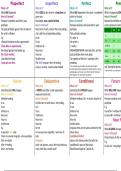
Pluperfect Imperfect Perfect Pres
What is it? What is it? What is it? What is it?
What HAD happened. What USED to be- done for a long time but What HAD happened in the past- a completed What is happening NOW
How is it formed? gone now. action in the past. How is it formed?
Pronoun+ imperfect avoir/être+ past Description over a period of time. How is it formed? Remove the infinitive en
participle How is it formed? Pronoun+auxiliary verb (avoir/être)+ past correct pronoun’s endin
The past participle agrees if être is taken or Nous form of verb, remove the nous ending (- participle. -ER -RE
the verb is reflexive. ons), add the corresponding ending. Past participle endings: Je e s
E.g. Je-ais -Er verbs- é
Tu es s
I (female) had been to the supermarket: Tu-ais -Re verbs- u
J’étais allée au supermarché. Il/elle/on-ait -Ir verbs- I Il/elle/on e -
We (mixed gender) had woken up: Nous-ions MRSVANDERTRAMP verbs take être, and the Nous ons ons
On s’était reveilles. Vous-iez past participles here must agree. Vous ez ez
I had taken his book. Ils/elles-aient J’ai regardé un film hier- I watched a film
Ils/elles ent ent
J’avais pris son livre. The ONLY irregular- être= ét+ending. yesterday.
Je jouais au foot- I used to play football. *Les chausettes que j’ai achetées- the shoes that I bought. T USE THIS WITH DEPUIS.
he direct object pronoun (chausettes) is feminine plural, so the past
*If the verb ends –yer, replace the ‘y
participle agrees as the ‘que’ means that the fact the shoes have
been bought by ‘me’ has become an adjective.
Future Subjunctive Conditional Future P
What is it? What is it? What is it? What is it?
Something that WILL happen. A MOOD used after certain expressions Something that WOULD happen. What WILL HAVE happe
How is it formed? (expresses doubt etc) How is it formed? How is it formed?
Infinitive+ending How is it formed? Infinitive+endings ( for –re verbs, drop the e) Pronoun+auxiliary verb
Je-ai Ils/elles form of verb minus –ent+ending. Je-ais participle.
Tu-as Je-e Tu-ais E.g.
Il/elle/on-a Tu-es Il/elle/on-ait J’aurai fini- I will have fin
Nous-ons Il/elle/on-e Nous-ions Je serai allé- I will have b
Vous-ez Nous-ions Vous-iez Near F
Ils/elles-ont Vous-iez Ils/elles-aient What is it?
E.g. Ils-ent Irregular verbs are the same as those for the What IS GOING to happ
Je jouerai- I WILL play. Je veux que vous regardiez- I want you to future tense. How is it formed?
There are several irregualrs- a few examples: look. Conditional Perfect: Present tense of aller w
Être- ser+endin Irregulars: Same as the future perfect but with the E.g.
Aller- ir+ending Avoir- aie/ay(nous, vous), être-sois/soy(nous, conditional in place of the future. Je vais voir- I am going t
Avoir- aur+ending vous), faire-fass, vouloir-veuill Should have/ought to- j’aurais dû.
What is it? What is it? What is it? What is it?
What HAD happened. What USED to be- done for a long time but What HAD happened in the past- a completed What is happening NOW
How is it formed? gone now. action in the past. How is it formed?
Pronoun+ imperfect avoir/être+ past Description over a period of time. How is it formed? Remove the infinitive en
participle How is it formed? Pronoun+auxiliary verb (avoir/être)+ past correct pronoun’s endin
The past participle agrees if être is taken or Nous form of verb, remove the nous ending (- participle. -ER -RE
the verb is reflexive. ons), add the corresponding ending. Past participle endings: Je e s
E.g. Je-ais -Er verbs- é
Tu es s
I (female) had been to the supermarket: Tu-ais -Re verbs- u
J’étais allée au supermarché. Il/elle/on-ait -Ir verbs- I Il/elle/on e -
We (mixed gender) had woken up: Nous-ions MRSVANDERTRAMP verbs take être, and the Nous ons ons
On s’était reveilles. Vous-iez past participles here must agree. Vous ez ez
I had taken his book. Ils/elles-aient J’ai regardé un film hier- I watched a film
Ils/elles ent ent
J’avais pris son livre. The ONLY irregular- être= ét+ending. yesterday.
Je jouais au foot- I used to play football. *Les chausettes que j’ai achetées- the shoes that I bought. T USE THIS WITH DEPUIS.
he direct object pronoun (chausettes) is feminine plural, so the past
*If the verb ends –yer, replace the ‘y
participle agrees as the ‘que’ means that the fact the shoes have
been bought by ‘me’ has become an adjective.
Future Subjunctive Conditional Future P
What is it? What is it? What is it? What is it?
Something that WILL happen. A MOOD used after certain expressions Something that WOULD happen. What WILL HAVE happe
How is it formed? (expresses doubt etc) How is it formed? How is it formed?
Infinitive+ending How is it formed? Infinitive+endings ( for –re verbs, drop the e) Pronoun+auxiliary verb
Je-ai Ils/elles form of verb minus –ent+ending. Je-ais participle.
Tu-as Je-e Tu-ais E.g.
Il/elle/on-a Tu-es Il/elle/on-ait J’aurai fini- I will have fin
Nous-ons Il/elle/on-e Nous-ions Je serai allé- I will have b
Vous-ez Nous-ions Vous-iez Near F
Ils/elles-ont Vous-iez Ils/elles-aient What is it?
E.g. Ils-ent Irregular verbs are the same as those for the What IS GOING to happ
Je jouerai- I WILL play. Je veux que vous regardiez- I want you to future tense. How is it formed?
There are several irregualrs- a few examples: look. Conditional Perfect: Present tense of aller w
Être- ser+endin Irregulars: Same as the future perfect but with the E.g.
Aller- ir+ending Avoir- aie/ay(nous, vous), être-sois/soy(nous, conditional in place of the future. Je vais voir- I am going t
Avoir- aur+ending vous), faire-fass, vouloir-veuill Should have/ought to- j’aurais dû.


