
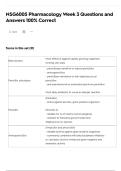
NSG6005 Pharmacology Week 3 Questions and
Answers 100% Correct
Save
Terms in this set (31)
Most effective against rapidly growing organisms
Beta-lactams
forming cell walls
- penicillinase-sensitive or natural penicillins
- aminopenicillins
- penicillase-resistance or anti-staphylococcal
Penicillin subclasses penicillins
- anti-pseudomonal or extended-spectrum penicillins
Most likely antibiotic to cause an allergic reaction
(Penicillin)
- active against aerobic, gram-positive organisms
Penicillin Penicillin G:
- reliable for tx of Listeria monocytogenes
- resistant to Neisseria gonorrhoeae and
Staphylococcus species
(Ampicillin and amoxicillin)
- reliable activity against gram-positive organisms
Aminopenicillins - commonly combined with beta-lactamase inhibitors
or clavulanic acid for enhanced gram-negative and
anaerobic activity
, (Nafcillin, oxacillin, cloxacillin, and dicloxacillin)
Penicillinase-Resistant AKA anti-staphylococcal penicillins
Penicillins - chemically formed, is stable in presence of
penicillinase produced by staphylococci
Anti-Pseudomonal (Piperacillin and ticarcillin)
Penicillins - enhanced activity against gram-negative bacilli
Due to:
1. Inactivation by beta-lactamases
Resistance to penicillins 2. Alteration in target PBPs on the bacterial cell wall
3. A permeability barrier preventing penetration of the
antibiotic to the target cell
Bacterial URI, STI, UTI, pneumonia and wound
Common Penicillin dx
infections
- Differentiate between acute and chronic
- chronic: 2 of 3 (increase sputum volume, sputum
purulence and dyspnea) x3month in 2 consecutive
years
Chronic Bronchitis
First line: amoxicillin/clavulanic acid, macrolides, and
antibiotic tx
double-strength sulfamethoxazole/trimethoprim;
cephalosporins also useful in mild to moderate
Second line: resp. Fluoroquinolone (levofloxacin,
moxifloxacin, gemifloxacin)
Most common dx for antibiotic prescribing in US
AOM dx only if child has middle ear effusion (fluid),
along with pain, redness or swelling
Acute Otitis Media
OME dx is fluid in middle w/o acute illness symptoms
antibiotic tx
Sometimes children can be observed w/o antibiotics
First line: amoxicillin for adults, then
amoxicillin/clavulanate, then ceftriaxone
Answers 100% Correct
Save
Terms in this set (31)
Most effective against rapidly growing organisms
Beta-lactams
forming cell walls
- penicillinase-sensitive or natural penicillins
- aminopenicillins
- penicillase-resistance or anti-staphylococcal
Penicillin subclasses penicillins
- anti-pseudomonal or extended-spectrum penicillins
Most likely antibiotic to cause an allergic reaction
(Penicillin)
- active against aerobic, gram-positive organisms
Penicillin Penicillin G:
- reliable for tx of Listeria monocytogenes
- resistant to Neisseria gonorrhoeae and
Staphylococcus species
(Ampicillin and amoxicillin)
- reliable activity against gram-positive organisms
Aminopenicillins - commonly combined with beta-lactamase inhibitors
or clavulanic acid for enhanced gram-negative and
anaerobic activity
, (Nafcillin, oxacillin, cloxacillin, and dicloxacillin)
Penicillinase-Resistant AKA anti-staphylococcal penicillins
Penicillins - chemically formed, is stable in presence of
penicillinase produced by staphylococci
Anti-Pseudomonal (Piperacillin and ticarcillin)
Penicillins - enhanced activity against gram-negative bacilli
Due to:
1. Inactivation by beta-lactamases
Resistance to penicillins 2. Alteration in target PBPs on the bacterial cell wall
3. A permeability barrier preventing penetration of the
antibiotic to the target cell
Bacterial URI, STI, UTI, pneumonia and wound
Common Penicillin dx
infections
- Differentiate between acute and chronic
- chronic: 2 of 3 (increase sputum volume, sputum
purulence and dyspnea) x3month in 2 consecutive
years
Chronic Bronchitis
First line: amoxicillin/clavulanic acid, macrolides, and
antibiotic tx
double-strength sulfamethoxazole/trimethoprim;
cephalosporins also useful in mild to moderate
Second line: resp. Fluoroquinolone (levofloxacin,
moxifloxacin, gemifloxacin)
Most common dx for antibiotic prescribing in US
AOM dx only if child has middle ear effusion (fluid),
along with pain, redness or swelling
Acute Otitis Media
OME dx is fluid in middle w/o acute illness symptoms
antibiotic tx
Sometimes children can be observed w/o antibiotics
First line: amoxicillin for adults, then
amoxicillin/clavulanate, then ceftriaxone


