ETHC 445 Final Exam with Answers | VERIFIED SOLUTION
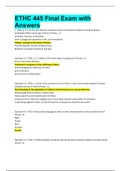
ETHC 445 Final Exam with Answers 1. (TCOs 2, 4, 5, 6) The idea that the assisted suicide of terminally ill patients should be always prohibited reflects what type of ethics? (Points : 5) Aristotle's Doctrine of the Mean Kant's Categorical Imperative in the 1st Formulation) Hobbes' concept of the State of Nature Thomas Aquinas' concept of Natural Law Bentham's principle of pleasure and pain Question 2.2. (TCOs 1, 2, 7) What is the moral ideal of compassion? (Points : 5) Acts of unmerited kindness Sentiment in response to the suffering of others Acknowledging the sufferings of others Acts of altruism Acts contrary to Objectivism Question 3.3. (TCOs 1, 2) One of the common errors in Ethics is that of the double standard. Double standard consists of what? (Points : 5) Discriminating in the application of ethical criteria based on our own preferences Setting aside ethical criteria in special cases Taking steps to avoid condemnation of others Using one set of criteria for judging cases concerning ourselves and another for all others Suspending judgment when concerned that the consequences would be too severe Question 4.4. (TCO 2) Prescriptive language in ethics is often characterized by what common word? (Points : 5) Right Proper Best Possible Should Question 5.5. (TCOs 7, 8) Ethical Egoism proposes that all decisions should be made to promote what? (Points : 5) Our fiduciary responsibilities The good will of others Our self-interests The welfare of the community Stronger relationships Question 6.6. (TCOs 2, 4, 9) John Locke, as a Social Contract theorist, is said to have been the most influential person who was not actually present at the table when what document was written? (Points : 5) The Articles of Confederation The Declaration of Independence The Magna Carta The Constitution The Treaty of Westphalia Question 7.7. (TCOs 3, 6) Animal sentience is demonstrated by all the following except which one? (Points : 5) Consciousness Awareness Response to external painful stimuli Animatedness Emotive response Question 8.8. (TCOs 3, 6, 7) The notion that the only thing good without qualification is a good will is attributed to whom? (Points : 5) St. Thomas Aquinas Socrates John Locke Immanuel Kant Oliver Cromwell Question 9.9. (TCOs 8, 9) John Stuart Mill's theory of Utilitarianism is the most common form of ethics in use today. It is used so commonly because it belongs to which of the Primary Schools of Ethics? (Points : 5) Care-based Ends-based Economy-based Law-based Efficiency-based Question 10.10. (TCOs 3, 6, 7) What is the purpose of proving whether a syllogism of formal logic is “valid”? (Points : 5) To identify the connecting phrase “therefore” or a synonym of it before proceeding further To determine whether the situation described is accurate To determine whether the premises are true before continuing To determine whether the conclusion proceeds from the premises To determine that there are only two premise statements in the syllogism Question 11.11. (TCOs 1, 2) When choosing one course of action while working with a dilemma, the other courses of action are lost and become unavailable. This makes ethical choices in dilemma situations particularly what? (Points : 5) Incoherent Complicated Illogical Painful Cruel Question 12.12. (TCOs 1, 2, 7) What is the role of conscience as Thomas Aquinas sees it? (Points : 5) To teach ethical principles To disclose and build religious faith To enable rational thought about consequences To align personal ethics with those of others To guide actions through a view of right and wrong Question 13.13. (TCOs 2, 8) The single criterion for making decisions in utilitarian ethics is what? (Points : 5) The experience of pleasure Accounting for unintended consequences Fiduciary interests to be honored The amount of happiness produced The principle to be honored Question 14.14. (TCOs 1, 2, 5) Thomas Hobbes' term for the tendency of life in society to be "solitary, poor, nasty, brutish, and short" was called what? (Points : 5) Uncivilized Survival of the fittest Pre-historic The state of nature The veil of ignorance Detail Required: LOW; Urgency: HIGH
Document information
- Uploaded on
- February 20, 2021
- Number of pages
- 4
- Written in
- 2020/2021
- Type
- Exam (elaborations)
- Contains
- Questions & answers