

Allergy
and
Autoimmunity
Lecture
Summary
(November
2013).
Lecture
1:
Introduction,
Immunology
Basics.
Immune
system:
role
in
the
defense
against
invading
pathogens.
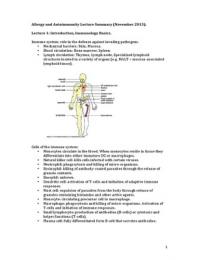
• Mechanical
barriers:
Skin,
Mucosa.
• Blood
circulation:
Bone
marrow,
Spleen.
• Lymph
circulation:
Thymus,
Lymph
node,
Specialized
lymphoid
structures
located
in
a
variety
of
organs
(e.g.
MALT
=
mucosa-‐associated
lymphoid
tissue).
Cells
of
the
immune
system:
• Monocytes
circulate
in
the
blood.
When
monocytes
reside
in
tissue
they
differentiate
into
either
immature
DC
or
macrophages.
• Natural
killer
cell:
kills
cells
infected
with
certain
viruses.
• Neutrophil:
phagocytosis
and
killing
of
micro-‐organisms.
• Eosinophil:
killing
of
antibody-‐coated
parasites
through
the
release
of
granule
contents.
• Basophil:
unkown.
• Dendritic
cell:
activation
of
T-‐cells
and
initiation
of
adaptive
immune
responses.
• Mast
cell:
expulsion
of
parasites
from
the
body
through
release
of
granules
containing
histamine
and
other
active
agents.
• Monocyte:
circulating
precursor
cell
to
macrophage.
• Macrophage:
phagocytosis
and
killing
of
micro-‐organisms.
Activation
of
T-‐cells
and
initiation
of
immune
responses.
• Small
lymphocyte:
production
of
antibodies
(B-‐cells)
or
cytotoxic
and
helper
functions
(T-‐cells).
• Plasma
cell:
fully
differentiated
form
B-‐cell
that
secretes
antibodies.
1
,
Immune
response:
functions
in
the
defense
against
invading
pathogens.
• Innate
immune
responses
-‐>
fast,
not
very
specific.
Adaptive
immune
responses
-‐>
specific,
memory,
self/non-‐self.
Defense
against
pathogens
in
3
steps:
1. Alarm
and
first
defense:
a-‐specific
killing
of
pathogens
(quick
and
dirty),
local
inflammation.
2. Mobilization
of
the
immune
system:
recruitment
of
immune
cells
to
areas
of
infection,
activation
of
adaptive
responses
(specific)
-‐>
antigen
presentation.
3. Specific
defense
and
future
protection:
clonal
selection
of
antigen-‐specific
lymphocytes,
effector
B(plasma)-‐cells
and
T-‐cells,
memory.
Local
Inflammation:
2
, Neutrophils
-‐>
killing:
• Large
reserves
of
neutrophils
are
stored
in
the
bone
marrow
and
are
released
when
needed
to
fight
infection.
• Neutrophils
travel
to
and
enter
the
infected
tissue,
where
they
engulf
and
kill
bacteria.
The
neutrophils
die
in
the
tissue
and
are
engulfed
and
degraded
by
macrophages.
Complement:
• Bacterial
cell
surface
induces
cleavage
and
activation
of
complement.
• One
complement
fragment
covalently
bonds
to
the
bacterium,
the
other
attracts
an
effector
cell.
• The
complement
receptor
on
the
effector
cell
binds
to
the
complement
fragment
on
the
bacterium.
• The
effector
cell
engulfs
the
bacterium,
kills
it
and
breaks
it
down.
Macrophges
initiate
effector
immune
responses
by
activating
T-‐cells:
• Bacteria
binding
to
endocytic
receptors
of
macrophafes
induce
their
engulfment
and
degradation.
• Bacterial
components
binding
to
signaling
receptors
of
macrophages
induce
the
synthesis
of
inflammatory
cytokines.
3
and
Autoimmunity
Lecture
Summary
(November
2013).
Lecture
1:
Introduction,
Immunology
Basics.
Immune
system:
role
in
the
defense
against
invading
pathogens.
• Mechanical
barriers:
Skin,
Mucosa.
• Blood
circulation:
Bone
marrow,
Spleen.
• Lymph
circulation:
Thymus,
Lymph
node,
Specialized
lymphoid
structures
located
in
a
variety
of
organs
(e.g.
MALT
=
mucosa-‐associated
lymphoid
tissue).
Cells
of
the
immune
system:
• Monocytes
circulate
in
the
blood.
When
monocytes
reside
in
tissue
they
differentiate
into
either
immature
DC
or
macrophages.
• Natural
killer
cell:
kills
cells
infected
with
certain
viruses.
• Neutrophil:
phagocytosis
and
killing
of
micro-‐organisms.
• Eosinophil:
killing
of
antibody-‐coated
parasites
through
the
release
of
granule
contents.
• Basophil:
unkown.
• Dendritic
cell:
activation
of
T-‐cells
and
initiation
of
adaptive
immune
responses.
• Mast
cell:
expulsion
of
parasites
from
the
body
through
release
of
granules
containing
histamine
and
other
active
agents.
• Monocyte:
circulating
precursor
cell
to
macrophage.
• Macrophage:
phagocytosis
and
killing
of
micro-‐organisms.
Activation
of
T-‐cells
and
initiation
of
immune
responses.
• Small
lymphocyte:
production
of
antibodies
(B-‐cells)
or
cytotoxic
and
helper
functions
(T-‐cells).
• Plasma
cell:
fully
differentiated
form
B-‐cell
that
secretes
antibodies.
1
,
Immune
response:
functions
in
the
defense
against
invading
pathogens.
• Innate
immune
responses
-‐>
fast,
not
very
specific.
Adaptive
immune
responses
-‐>
specific,
memory,
self/non-‐self.
Defense
against
pathogens
in
3
steps:
1. Alarm
and
first
defense:
a-‐specific
killing
of
pathogens
(quick
and
dirty),
local
inflammation.
2. Mobilization
of
the
immune
system:
recruitment
of
immune
cells
to
areas
of
infection,
activation
of
adaptive
responses
(specific)
-‐>
antigen
presentation.
3. Specific
defense
and
future
protection:
clonal
selection
of
antigen-‐specific
lymphocytes,
effector
B(plasma)-‐cells
and
T-‐cells,
memory.
Local
Inflammation:
2
, Neutrophils
-‐>
killing:
• Large
reserves
of
neutrophils
are
stored
in
the
bone
marrow
and
are
released
when
needed
to
fight
infection.
• Neutrophils
travel
to
and
enter
the
infected
tissue,
where
they
engulf
and
kill
bacteria.
The
neutrophils
die
in
the
tissue
and
are
engulfed
and
degraded
by
macrophages.
Complement:
• Bacterial
cell
surface
induces
cleavage
and
activation
of
complement.
• One
complement
fragment
covalently
bonds
to
the
bacterium,
the
other
attracts
an
effector
cell.
• The
complement
receptor
on
the
effector
cell
binds
to
the
complement
fragment
on
the
bacterium.
• The
effector
cell
engulfs
the
bacterium,
kills
it
and
breaks
it
down.
Macrophges
initiate
effector
immune
responses
by
activating
T-‐cells:
• Bacteria
binding
to
endocytic
receptors
of
macrophafes
induce
their
engulfment
and
degradation.
• Bacterial
components
binding
to
signaling
receptors
of
macrophages
induce
the
synthesis
of
inflammatory
cytokines.
3


