

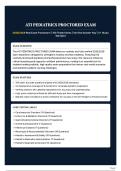
ATI PEDIATRICS PROCTORED EXAM
2025/2026 Real Exam Framework | 100 Tested Items | Verified Answer Key | A+ Study
Standard
EXAM OVERVIEW
The ATI PEDIATRICS PROCTORED EXAM delivers a realistic and fully verified 2025/2026
exam experience designed to strengthen mastery and test readiness. Featuring 100
carefully structured questions and professional-level accuracy, this resource enhances
critical reasoning and supports confident performance, making it an essential tool for
students seeking reliable, high-quality exam preparation that mirrors real-world scenarios
and authentic pediatric nursing challenges.
EXAM FEATURES
• 100 exam-accurate questions aligned with 2025/2026 standards
• Comprehensive coverage of 9 domains for complete pediatric preparation
• Verified answers with detailed explanations for accuracy and understanding
• High-yield content prioritized for efficient study and time management
• Realistic exam simulation to build confidence for success in the ATI Pediatrics Proctored Exam
CORE TESTING AREAS
→ Cardiovascular Disorders (14 Questions)
→ Endocrine & Metabolic Disorders (11 Questions)
→ Gastrointestinal & Renal Disorders (11 Questions)
→ Growth & Development (7 Questions)
→ Infectious Diseases (7 Questions)
→ Neurologic & Musculoskeletal Disorders (16 Questions)
→ Pediatric Assessment & Safety (10 Questions)
→ Pediatric Medication Administration (11 Questions)
→ Pediatric Respiratory Disorders (13 Questions)
Page 1
,Growth & Development (7 Questions)
Question 1
A nurse is assessing an infant's growth pattern. Which of the following growth parameters is
NOT typically monitored in the first year of life?
A. Weight
B. Length
C. Head Circumference
D. Body Mass Index (BMI)
Correct Answer
Body Mass Index (BMI)
Rationale:
In the first year of life, weight, length, and head circumference are the primary growth parameters monitored. BMI is
not typically calculated until the child is at least 2 years old.
Question 2
A child is diagnosed with a growth hormone deficiency. Which of the following growth
principles is most directly affected in this condition?
A. Growth in height
B. Growth in weight
C. Proportional growth
D. Growth velocity
Correct Answer
Growth velocity
Rationale:
Growth hormone deficiency primarily affects growth velocity, leading to a decrease in the rate of growth in height
and weight.
Page 2
,Question 3
A nurse is evaluating the growth and development of a toddler. Which of the following
developmental milestones is typically achieved around 18 months of age?
A. Walking independently
B. Pointing to body parts
C. Using simple sentences
D. Drawing simple shapes
Correct Answer
Walking independently
Rationale:
Toddlers typically achieve the ability to walk independently around 12-14 months of age, but may not master it until
18 months.
Question 4
A child is experiencing a growth spurt. Which of the following physiological changes is most
directly related to this event?
A. Increase in insulin production
B. Increase in growth hormone production
C. Increase in thyroid hormone production
D. Increase in cortisol production
Correct Answer
Increase in growth hormone production
Rationale:
Growth hormone is the primary hormone responsible for growth spurts, stimulating the growth and differentiation of
cells.
Page 3
, Question 5
A nurse is reviewing the laboratory report of a child with a growth disorder. Which of the
following laboratory values would be indicative of hypothyroidism?
A. Elevated T4 levels
B. Elevated TSH levels
C. Decreased T3 levels
D. Decreased T4 levels
Correct Answer
Elevated TSH levels
Rationale:
Hypothyroidism is characterized by elevated TSH levels, indicating the pituitary gland is releasing more TSH in an
attempt to stimulate the thyroid gland.
Question 6
A child is diagnosed with a genetic disorder that affects growth and development. Which of the
following growth methods is most relevant to understanding this condition?
A. Phenotypic growth
B. Genotypic growth
C. Epigenetic growth
D. Environmental growth
Correct Answer
Phenotypic growth
Rationale:
Phenotypic growth refers to the observable physical characteristics of an individual, which can be affected by
genetic disorders.
Page 4
2025/2026 Real Exam Framework | 100 Tested Items | Verified Answer Key | A+ Study
Standard
EXAM OVERVIEW
The ATI PEDIATRICS PROCTORED EXAM delivers a realistic and fully verified 2025/2026
exam experience designed to strengthen mastery and test readiness. Featuring 100
carefully structured questions and professional-level accuracy, this resource enhances
critical reasoning and supports confident performance, making it an essential tool for
students seeking reliable, high-quality exam preparation that mirrors real-world scenarios
and authentic pediatric nursing challenges.
EXAM FEATURES
• 100 exam-accurate questions aligned with 2025/2026 standards
• Comprehensive coverage of 9 domains for complete pediatric preparation
• Verified answers with detailed explanations for accuracy and understanding
• High-yield content prioritized for efficient study and time management
• Realistic exam simulation to build confidence for success in the ATI Pediatrics Proctored Exam
CORE TESTING AREAS
→ Cardiovascular Disorders (14 Questions)
→ Endocrine & Metabolic Disorders (11 Questions)
→ Gastrointestinal & Renal Disorders (11 Questions)
→ Growth & Development (7 Questions)
→ Infectious Diseases (7 Questions)
→ Neurologic & Musculoskeletal Disorders (16 Questions)
→ Pediatric Assessment & Safety (10 Questions)
→ Pediatric Medication Administration (11 Questions)
→ Pediatric Respiratory Disorders (13 Questions)
Page 1
,Growth & Development (7 Questions)
Question 1
A nurse is assessing an infant's growth pattern. Which of the following growth parameters is
NOT typically monitored in the first year of life?
A. Weight
B. Length
C. Head Circumference
D. Body Mass Index (BMI)
Correct Answer
Body Mass Index (BMI)
Rationale:
In the first year of life, weight, length, and head circumference are the primary growth parameters monitored. BMI is
not typically calculated until the child is at least 2 years old.
Question 2
A child is diagnosed with a growth hormone deficiency. Which of the following growth
principles is most directly affected in this condition?
A. Growth in height
B. Growth in weight
C. Proportional growth
D. Growth velocity
Correct Answer
Growth velocity
Rationale:
Growth hormone deficiency primarily affects growth velocity, leading to a decrease in the rate of growth in height
and weight.
Page 2
,Question 3
A nurse is evaluating the growth and development of a toddler. Which of the following
developmental milestones is typically achieved around 18 months of age?
A. Walking independently
B. Pointing to body parts
C. Using simple sentences
D. Drawing simple shapes
Correct Answer
Walking independently
Rationale:
Toddlers typically achieve the ability to walk independently around 12-14 months of age, but may not master it until
18 months.
Question 4
A child is experiencing a growth spurt. Which of the following physiological changes is most
directly related to this event?
A. Increase in insulin production
B. Increase in growth hormone production
C. Increase in thyroid hormone production
D. Increase in cortisol production
Correct Answer
Increase in growth hormone production
Rationale:
Growth hormone is the primary hormone responsible for growth spurts, stimulating the growth and differentiation of
cells.
Page 3
, Question 5
A nurse is reviewing the laboratory report of a child with a growth disorder. Which of the
following laboratory values would be indicative of hypothyroidism?
A. Elevated T4 levels
B. Elevated TSH levels
C. Decreased T3 levels
D. Decreased T4 levels
Correct Answer
Elevated TSH levels
Rationale:
Hypothyroidism is characterized by elevated TSH levels, indicating the pituitary gland is releasing more TSH in an
attempt to stimulate the thyroid gland.
Question 6
A child is diagnosed with a genetic disorder that affects growth and development. Which of the
following growth methods is most relevant to understanding this condition?
A. Phenotypic growth
B. Genotypic growth
C. Epigenetic growth
D. Environmental growth
Correct Answer
Phenotypic growth
Rationale:
Phenotypic growth refers to the observable physical characteristics of an individual, which can be affected by
genetic disorders.
Page 4


