
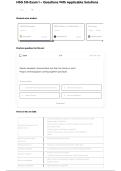
NSG 316 Exam 1 – Questions With Applicable Solutions
Save
Students also studied
INBDE Orthodontics NBDE II Review - Prosthodontics Perio Study
201 terms 69 terms Teacher 78 terms
dong_lee82 Preview melissa_jarvis7 Preview Hunter_Charters
Practice questions for this set
Learn 1 /7 Study with Learn
Papule: elevated, circumscribed, less than 1cm (mole or wart)
Plaque: several papules coming together (psoriasis)
Choose an answer
1 Describe the elements of a general survey 2 second level priority
3 Papule/Plaque 4 episodic database
Don't know?
Terms in this set (138)
-physical appearance (age, sex, consciousness, skin color, facial
features, signs of distress)
-body structure (stature, nutrition, symmetry, posture, position,
Describe the elements of a
build, deformities)
general survey
-mobility (gait, involuntary movements)
-behavior (expression, mood, speech, dress, hygiene)
PBMB
when should you begin the second you see the client
observing
health assessment collection of data about the patient's health state
complete database full health history and physical examination (family practice)
limited or short term problem
episodic database
concerns 1 problem or complex or system (urgent care)
status of pervious problem at regular scheduled intervals
follow-up database
(doctors office)
emergency database rapid collection of data (ER)
, health history and complete physical examination, usually
comprehensive assessment
conducted when a patient first enters a health care setting
assessment conducted to assess a specific problem; focuses on
focused assessment
pertinent history and body regions
what the person says about himself or herself during history
subjective data
taking
information that is seen, heard, felt, or smelled by an observer;
objective data
signs
first level priority Emergent, life threatening, and immediate (ABCs)
Next in urgency, requiring attention so as to avoid further
second level priority
deterioration
Important to patient's health but can be addressed after more
third level priority
urgent problems are addressed
-basis for care planning, goal setting, and discharge planning
functional assessment -self care (ADLs)
components -self maintenance (IADLs)
-physical mobility
collecting subjective data for information about health problem
the ill person
-subjective data
-biographical data (name,DOB,sex,race,ethnic origin)
-source of history (themselves or family?)
-reason for seeking care (signs/symptoms)
-present health/illness (location, severity, timing, setting,
obtaining an accurate and
relieving factors)
current health history
-past health (childhood illness, hospitalizations, operations,
immunizations, allergies, current meds)
-family history
-review of systems
-functional assessment (ADLs, IADLs, AADLs)
An understanding of how a patient's cultural background shapes
cultural competence his beliefs, values, and expectations for therapy; established
through knowing your own culture first
-begins when you first see the patient
inspection -first examine as a whole and then systems
-good lighting, exposure, and instruments
-examine by touch
-doctor does this, if nurses do this it will be light
-fingertips (skin texture, swelling, pulsation, lumps)
palpation
-fingers/thumb (position, shape, consistency of organ/mass)
-dorsa of hand/fingers (temperature)
-base of fingers (vibration)
direct percussion striking hand directly contacts body wall
using both hands, striking hand contacts stationary hand fixed on
indirect percussion
patient's skin
-listening to body sounds
-bell (low-frequency sounds: extra heart sounds or murmurs)
Auscultation
-diaphragm (high-frequency sounds: breaths, bowels, normal
heart sounds)
-short term
-fast onset
acute pain
-predictable trajectory
-goes away after injury heals
incident acute pain happens with movement
Save
Students also studied
INBDE Orthodontics NBDE II Review - Prosthodontics Perio Study
201 terms 69 terms Teacher 78 terms
dong_lee82 Preview melissa_jarvis7 Preview Hunter_Charters
Practice questions for this set
Learn 1 /7 Study with Learn
Papule: elevated, circumscribed, less than 1cm (mole or wart)
Plaque: several papules coming together (psoriasis)
Choose an answer
1 Describe the elements of a general survey 2 second level priority
3 Papule/Plaque 4 episodic database
Don't know?
Terms in this set (138)
-physical appearance (age, sex, consciousness, skin color, facial
features, signs of distress)
-body structure (stature, nutrition, symmetry, posture, position,
Describe the elements of a
build, deformities)
general survey
-mobility (gait, involuntary movements)
-behavior (expression, mood, speech, dress, hygiene)
PBMB
when should you begin the second you see the client
observing
health assessment collection of data about the patient's health state
complete database full health history and physical examination (family practice)
limited or short term problem
episodic database
concerns 1 problem or complex or system (urgent care)
status of pervious problem at regular scheduled intervals
follow-up database
(doctors office)
emergency database rapid collection of data (ER)
, health history and complete physical examination, usually
comprehensive assessment
conducted when a patient first enters a health care setting
assessment conducted to assess a specific problem; focuses on
focused assessment
pertinent history and body regions
what the person says about himself or herself during history
subjective data
taking
information that is seen, heard, felt, or smelled by an observer;
objective data
signs
first level priority Emergent, life threatening, and immediate (ABCs)
Next in urgency, requiring attention so as to avoid further
second level priority
deterioration
Important to patient's health but can be addressed after more
third level priority
urgent problems are addressed
-basis for care planning, goal setting, and discharge planning
functional assessment -self care (ADLs)
components -self maintenance (IADLs)
-physical mobility
collecting subjective data for information about health problem
the ill person
-subjective data
-biographical data (name,DOB,sex,race,ethnic origin)
-source of history (themselves or family?)
-reason for seeking care (signs/symptoms)
-present health/illness (location, severity, timing, setting,
obtaining an accurate and
relieving factors)
current health history
-past health (childhood illness, hospitalizations, operations,
immunizations, allergies, current meds)
-family history
-review of systems
-functional assessment (ADLs, IADLs, AADLs)
An understanding of how a patient's cultural background shapes
cultural competence his beliefs, values, and expectations for therapy; established
through knowing your own culture first
-begins when you first see the patient
inspection -first examine as a whole and then systems
-good lighting, exposure, and instruments
-examine by touch
-doctor does this, if nurses do this it will be light
-fingertips (skin texture, swelling, pulsation, lumps)
palpation
-fingers/thumb (position, shape, consistency of organ/mass)
-dorsa of hand/fingers (temperature)
-base of fingers (vibration)
direct percussion striking hand directly contacts body wall
using both hands, striking hand contacts stationary hand fixed on
indirect percussion
patient's skin
-listening to body sounds
-bell (low-frequency sounds: extra heart sounds or murmurs)
Auscultation
-diaphragm (high-frequency sounds: breaths, bowels, normal
heart sounds)
-short term
-fast onset
acute pain
-predictable trajectory
-goes away after injury heals
incident acute pain happens with movement


