

Lecture 1 – Van der Zee 1,2
Chapter 1
Chapter 7 (180-193)
Notes
Some MISCONCEPTIONS about the brain:
1. We only use a part of the brain —> nonsense, long-term inactive neurons die due to a lack of
neurotrophic factors.
2. Starting at the age of 25 neurons die progressively; at high age large number of neurons are
gone —> incorrect, in case of healthy, non-demented elderly only limited loss of neurons
occurs.
3. After birth and the first years of brain development no new neurons are being born in the
brain —> incorrect, in at least three regions production of new neurons (neurogenesis) still
takes place at all ages.
The central and peripheral nervous system
The central nervous system consists of the brain and the spinal cord, the peripheral nervous system
consists of the other parts of the nervous system.
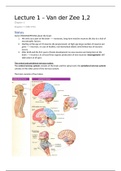
The brain consists of four lobes:
, The gyrus are the “hills” and the sulcus are the “grooves” which make the worm like structure of the
brain. The fissures are the large empty grooves as seen between the frontal- and temporal lobe. A
fissure is also basically a separation line.
Phrenology is a process that involves observing and/or feeling the skull to determine an individual's
psychological attributes. However, this is not reliable because the size/shape doesn’t explain
someone’s capabilities and or personalities.
Modern phrenology uses brain imaging to determine the place in the brain which corresponds with
some kind of behaviour. Broca is an example of localised function in the cerebrum. Another example
is Wernicke’s area:
- Broca’s area —> motor aphasia
o Have problems speaking, but can understand language (can’t speak, can understand)
- Wernicke’s area —> sensory aphasia
o Spoken language sounds fluently, but lacks meaning. They have poor auditory
comprehension (can speak, can’t understand)
There are different brain imaging options:
1. CT scan – major issues, fast observations
2. MRI scan – can see structures, more detail
3. PET scan – indicating brain activity
4. fMRI scan – combines structural information with activity information
Psychopath
Dr. James Falon found that psychopath’s brains have lower activity in the orbital cortex. However, to
conclude someone to be a psychopath, other factors should be included as well.
Sections through the human brain
Mouse and rat as model organisms
The brain structures of humans and rats or mouses are pretty similar. On neuronal level, they are
entirely the same. A rat’s neuron is entirely similar to a human’s neuron.
Chapter 1
Chapter 7 (180-193)
Notes
Some MISCONCEPTIONS about the brain:
1. We only use a part of the brain —> nonsense, long-term inactive neurons die due to a lack of
neurotrophic factors.
2. Starting at the age of 25 neurons die progressively; at high age large number of neurons are
gone —> incorrect, in case of healthy, non-demented elderly only limited loss of neurons
occurs.
3. After birth and the first years of brain development no new neurons are being born in the
brain —> incorrect, in at least three regions production of new neurons (neurogenesis) still
takes place at all ages.
The central and peripheral nervous system
The central nervous system consists of the brain and the spinal cord, the peripheral nervous system
consists of the other parts of the nervous system.
The brain consists of four lobes:
, The gyrus are the “hills” and the sulcus are the “grooves” which make the worm like structure of the
brain. The fissures are the large empty grooves as seen between the frontal- and temporal lobe. A
fissure is also basically a separation line.
Phrenology is a process that involves observing and/or feeling the skull to determine an individual's
psychological attributes. However, this is not reliable because the size/shape doesn’t explain
someone’s capabilities and or personalities.
Modern phrenology uses brain imaging to determine the place in the brain which corresponds with
some kind of behaviour. Broca is an example of localised function in the cerebrum. Another example
is Wernicke’s area:
- Broca’s area —> motor aphasia
o Have problems speaking, but can understand language (can’t speak, can understand)
- Wernicke’s area —> sensory aphasia
o Spoken language sounds fluently, but lacks meaning. They have poor auditory
comprehension (can speak, can’t understand)
There are different brain imaging options:
1. CT scan – major issues, fast observations
2. MRI scan – can see structures, more detail
3. PET scan – indicating brain activity
4. fMRI scan – combines structural information with activity information
Psychopath
Dr. James Falon found that psychopath’s brains have lower activity in the orbital cortex. However, to
conclude someone to be a psychopath, other factors should be included as well.
Sections through the human brain
Mouse and rat as model organisms
The brain structures of humans and rats or mouses are pretty similar. On neuronal level, they are
entirely the same. A rat’s neuron is entirely similar to a human’s neuron.


