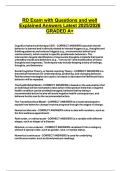
RD Exam with Questions and well
Explained Answers Latest 2025/2026
GRADED A+
Cognitive-behavioral therapy (CBT) - CORRECT ANSWERS assumes that all
behavior is learned and is directly related to internal triggers (e.g., thoughts and
thinking patterns) and external triggers (e.g., environmental stimuli and
reinforcement), which results in specific problematic behaviors. The
intervention targets identification of inaccurate thoughts or beliefs that lead to
unhealthy moods and behaviors (e.g., "I am so fat") and modification of those
thoughts and responses. Techniques may include keeping a diary of feelings,
thoughts, and behaviors.
Social Cognitive Theory, or Social Learning Theory - CORRECT ANSWERS is a
theoretical framework for understanding, predicting, and changing behavior.
Reinforcement strategies are used to increase or decrease the likelihood that a
behavior will be repeated.
The Health Belief Model - CORRECT ANSWERS is based on the assumption that
an individual will be motivated to take action if that person feels that a negative
health condition can be avoided/managed, believes that by taking a
recommended action he/she will avoid negative health consequences, and
believes he/she can do the recommended action.
The Transtheoretical Model - CORRECT ANSWERS is a model developed to
explain how behavior change involves progress through the stages of change.
Numerical discrete - CORRECT ANSWERS refers to data with numbers, such as
the first wellness appointment.
Rank order, or ordinal scale - CORRECT ANSWERS is a variable with different
stages, such as stages of a disease.
Nominal, or non-ordered, - CORRECT ANSWERS variables fit into a category
without a special order, such as gender, race, or marital status.
Numerical continuous - CORRECT ANSWERS is used for underlying
continuous scales, such as blood pressure readings.
,The Behavior Risk Factor Surveillance System (BRFSS) - CORRECT ANSWERS
assesses the prevalence of personal health practices that are related to the
leading causes of death and is used by state health departments to plan,
initiate, and guide health promotion and disease prevention programs, and to
monitor their progress over time.
is a survey under HHS for adults over 18 that collects information on risk
behaviors (height, weight, smoking, alcohol, FFQ, health problems, diabetes).
The National Health and Nutrition Examination Survey (NHANES) II - CORRECT
ANSWERS Mortality Study was conducted from 1976 to 1980 and the purpose
was to establish the vital status of adults who were 30 to 75 years of age at the
time of their baseline NHANES II examination.
The Youth Risk Behavior Surveillance System (YRBSS) - CORRECT ANSWERS
monitors priority health risk behaviors among adolescents through national,
state, and local surveys.
is a survey under HHS for youth in grades 9 to 12 to assess their risk behaviors
(smoking, alcohol, weight changes, exercise, eating habits).
The National Health and Nutrition Examination Survey I Epidemiologic Follow-
up Study (NHEFS) - CORRECT ANSWERS investigates the relationships
between clinical, nutritional, and behavioral factors assessed in NHANES I and
the subsequent morbidity, mortality, and hospital utilization.
The seven steps in the research process are as follows - CORRECT ANSWERS
Identify a relevant and important topic
Develop a research question
Develop a hypothesis
Prepare a research protocol
Organize methods and materials
Collect and analyze data
Study the results
Based on the ADA/A.S.P.E.N. chart of clinical characteristics to support
diagnosis of malnutrition, chronic moderate malnutrition is categorized as -
CORRECT ANSWERS <75% of energy intake for >=1 month, 5% weight loss in 1
month, 7.5% weight loss in 3 months, 10% weight loss in 6 months, and 20%
weight loss in 1 year.
If your food service facility has hard water, what should you do to ensure clean
dishes? - CORRECT ANSWERS Use more detergent
Hard water is water that has a high mineral content, in contrast with soft water.
This makes it more difficult for surfactants to form lather; therefore, you should
use more detergent to compensate and ensure clean dishes.
, Adding a drying agent helps prevent - CORRECT ANSWERS water spots
Decreasing the temperature during the wash cycle leads to - CORRECT
ANSWERS greasy dishes
A low-energy chemical dishwasher saves energy, but requires - CORRECT
ANSWERS even more detergent to clean dishes.
largest contributer to renal solute load - CORRECT ANSWERS The largest
contributor to renal solute load is nitrogenous waste. Renal solute load is the
end waste products of metabolism and mainly measures nitrogen (~60%) and
electrolytes (Na). Other contributors to renal solute load include uric acid,
creatinine, and ammonia (found in smaller amounts).
argued there are ten primary roles that can be used to categorize a manager's
different functions to accomplish work and use skills. - CORRECT ANSWERS
Mintzberg's Management Roles
identified three managerial skills essential to successful management:
technical, human, and conceptual. - CORRECT ANSWERS Katz's Skill
Management
is the process of defining specific objectives within an organization that
management can convey to organization members, then deciding how to
achieve each objective in sequence. - CORRECT ANSWERS Drucker's
Management by Objectives (MBO)
Taylor's Scientific Management - CORRECT ANSWERS is a theory that
analyzes and synthesizes workflows, with the main objective being to improve
economic efficiency, especially labor productivity.
Pheophytin - CORRECT ANSWERS is the olive green pigment found when
chlorophyll is exposed to an acidic medium
chlorophyllin - CORRECT ANSWERS is the bright green pigment found when
chlorophyll is exposed to an alkaline medium.
The aesthetic characteristics of a menu are - CORRECT ANSWERS flavor,
consistency, shape, color, and texture.
Metabolic syndrome is diagnosed when a patient has at least three of the
following five conditions: - CORRECT ANSWERS Fasting glucose ≥100 mg/dL
(hyperglycemia)
Blood pressure ≥130/85 mm Hg (hypertension)
Triglycerides ≥150 mg/dL (hypertriglyceridemia)
Explained Answers Latest 2025/2026
GRADED A+
Cognitive-behavioral therapy (CBT) - CORRECT ANSWERS assumes that all
behavior is learned and is directly related to internal triggers (e.g., thoughts and
thinking patterns) and external triggers (e.g., environmental stimuli and
reinforcement), which results in specific problematic behaviors. The
intervention targets identification of inaccurate thoughts or beliefs that lead to
unhealthy moods and behaviors (e.g., "I am so fat") and modification of those
thoughts and responses. Techniques may include keeping a diary of feelings,
thoughts, and behaviors.
Social Cognitive Theory, or Social Learning Theory - CORRECT ANSWERS is a
theoretical framework for understanding, predicting, and changing behavior.
Reinforcement strategies are used to increase or decrease the likelihood that a
behavior will be repeated.
The Health Belief Model - CORRECT ANSWERS is based on the assumption that
an individual will be motivated to take action if that person feels that a negative
health condition can be avoided/managed, believes that by taking a
recommended action he/she will avoid negative health consequences, and
believes he/she can do the recommended action.
The Transtheoretical Model - CORRECT ANSWERS is a model developed to
explain how behavior change involves progress through the stages of change.
Numerical discrete - CORRECT ANSWERS refers to data with numbers, such as
the first wellness appointment.
Rank order, or ordinal scale - CORRECT ANSWERS is a variable with different
stages, such as stages of a disease.
Nominal, or non-ordered, - CORRECT ANSWERS variables fit into a category
without a special order, such as gender, race, or marital status.
Numerical continuous - CORRECT ANSWERS is used for underlying
continuous scales, such as blood pressure readings.
,The Behavior Risk Factor Surveillance System (BRFSS) - CORRECT ANSWERS
assesses the prevalence of personal health practices that are related to the
leading causes of death and is used by state health departments to plan,
initiate, and guide health promotion and disease prevention programs, and to
monitor their progress over time.
is a survey under HHS for adults over 18 that collects information on risk
behaviors (height, weight, smoking, alcohol, FFQ, health problems, diabetes).
The National Health and Nutrition Examination Survey (NHANES) II - CORRECT
ANSWERS Mortality Study was conducted from 1976 to 1980 and the purpose
was to establish the vital status of adults who were 30 to 75 years of age at the
time of their baseline NHANES II examination.
The Youth Risk Behavior Surveillance System (YRBSS) - CORRECT ANSWERS
monitors priority health risk behaviors among adolescents through national,
state, and local surveys.
is a survey under HHS for youth in grades 9 to 12 to assess their risk behaviors
(smoking, alcohol, weight changes, exercise, eating habits).
The National Health and Nutrition Examination Survey I Epidemiologic Follow-
up Study (NHEFS) - CORRECT ANSWERS investigates the relationships
between clinical, nutritional, and behavioral factors assessed in NHANES I and
the subsequent morbidity, mortality, and hospital utilization.
The seven steps in the research process are as follows - CORRECT ANSWERS
Identify a relevant and important topic
Develop a research question
Develop a hypothesis
Prepare a research protocol
Organize methods and materials
Collect and analyze data
Study the results
Based on the ADA/A.S.P.E.N. chart of clinical characteristics to support
diagnosis of malnutrition, chronic moderate malnutrition is categorized as -
CORRECT ANSWERS <75% of energy intake for >=1 month, 5% weight loss in 1
month, 7.5% weight loss in 3 months, 10% weight loss in 6 months, and 20%
weight loss in 1 year.
If your food service facility has hard water, what should you do to ensure clean
dishes? - CORRECT ANSWERS Use more detergent
Hard water is water that has a high mineral content, in contrast with soft water.
This makes it more difficult for surfactants to form lather; therefore, you should
use more detergent to compensate and ensure clean dishes.
, Adding a drying agent helps prevent - CORRECT ANSWERS water spots
Decreasing the temperature during the wash cycle leads to - CORRECT
ANSWERS greasy dishes
A low-energy chemical dishwasher saves energy, but requires - CORRECT
ANSWERS even more detergent to clean dishes.
largest contributer to renal solute load - CORRECT ANSWERS The largest
contributor to renal solute load is nitrogenous waste. Renal solute load is the
end waste products of metabolism and mainly measures nitrogen (~60%) and
electrolytes (Na). Other contributors to renal solute load include uric acid,
creatinine, and ammonia (found in smaller amounts).
argued there are ten primary roles that can be used to categorize a manager's
different functions to accomplish work and use skills. - CORRECT ANSWERS
Mintzberg's Management Roles
identified three managerial skills essential to successful management:
technical, human, and conceptual. - CORRECT ANSWERS Katz's Skill
Management
is the process of defining specific objectives within an organization that
management can convey to organization members, then deciding how to
achieve each objective in sequence. - CORRECT ANSWERS Drucker's
Management by Objectives (MBO)
Taylor's Scientific Management - CORRECT ANSWERS is a theory that
analyzes and synthesizes workflows, with the main objective being to improve
economic efficiency, especially labor productivity.
Pheophytin - CORRECT ANSWERS is the olive green pigment found when
chlorophyll is exposed to an acidic medium
chlorophyllin - CORRECT ANSWERS is the bright green pigment found when
chlorophyll is exposed to an alkaline medium.
The aesthetic characteristics of a menu are - CORRECT ANSWERS flavor,
consistency, shape, color, and texture.
Metabolic syndrome is diagnosed when a patient has at least three of the
following five conditions: - CORRECT ANSWERS Fasting glucose ≥100 mg/dL
(hyperglycemia)
Blood pressure ≥130/85 mm Hg (hypertension)
Triglycerides ≥150 mg/dL (hypertriglyceridemia)