

Lecture 1: Introduction
What is health
WHO (1964): a state of complete physical, mental, and social
wellbeing and not merely the absence of disease or infirmity.
Huber (2011) changed it to: the ability to adapt and to self-manage,
in the face of social, physical and emotional challenges.
Shift from having a complete wellbeing to being able to change your
behavior (adaptability). From state to capacity. Shift mirrors change that
behavior change has.
- Helping people build skills, habits etc. to stay healthy.
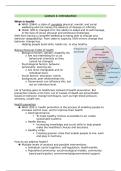
Biopsychosocial model of health
- Biological factors: gender, disability etc.
o Are not interesting for us as
behavioral scientists as they
cannot be changed.
- Psychological factors: behavior,
personality, learning etc.
o Are most changeable and on
individual level.
- Social factors: education, family
background, peer relationships etc.
o Government can influence this, but
not on individual level.
Lot of funding goes to healthcare instead of health prevention. But
prevention means a lot more. Lot of causes of death are preventable
based on behavior change techniques, such as high blood pressure,
smoking, unsafe sex.
Health promotion
WHO (2021): health promotion is the process of enabling people to
increase control over, and to improve their health.
o Good governance.
To make healthy choices accessible to all, create
sustainable systems.
o Health literacy.
Increasing knowledge and social skills to help people
make the healthiest choices and decisions.
o Healthy cities.
Creating greener cities that enable people to live, work
and play in harmony.
How do we address health?
Multiple levels of analysis and possible interventions:
o Individual: social cognition, self-regulation, health beliefs.
o Population/community: social-ecological models, community-
based participation, environmental/governmental support.
, o Health system: system perspectives, environment change
models.
In this course, we focus on the individual only.
Health psychology models
Why use theories/models:
- Clarify why behavior happens.
- Guide intervention (re)design.
- Improve effectiveness and efficiency.
- Enable evaluation and replication.
- Integrate knowledge across context.
- Support ethical, evidence-based practice.
Individual theoretical models
Young people’s health at risk from fall in condom use (how can we use
these models to understand the case).
Health belief model
This model was designed to predict preventive health behaviors and
behavioral responses to treatment.
How does this apply to condom use:
- Perceived susceptibility and severity: play a role in condom use,
people think it isn’t a risk for them, that it won’t happen to them.
- Perceived benefits: it’s better without a condom.
- Cues to action can be: health intervention, with focus on increasing
knowledge and risks of not using condoms.
,Theory of planned behavior
Subjective norm: what other people do.
Perceived behavioral control: are you able to do it.
Model assumes intention directly leads to behavior, but there is a huge
gap between this.
How does this apply to condom use:
- Attitude: it is not relevant for me.
- Subjective norm: others also don’t use it.
- Perceived behavioral control: hard to ask, don’t think about it in the
moment, partner doesn’t accept.
- Possible intervention: focus on perceived control by modelling,
changing norms and attitude.
Social cognitive theory
Role of social and personal factors.
- Self-efficacy: belief about being able to do something.
, - Behavior influences personal and environmental factors.
How does this apply to condom use:
Low efficacy -> people doubt ability to insist on condom use.
Modelling -> less role models that discuss condom use.
Reduced fear because consequences are not relevant.
Possible intervention: modelling correct use, reinforcing communication
skills in bedroom.
Transtheoretical model
Focuses on behavior change.
Provides temporal view of behavioral change.
Focus on predicting.
Gives suggestions for interventions.
How does this apply to condom use:
- Precontemplation: condoms are not comfortable.
- Contemplation: heard of negative effects, should consider it.
- Preparation: preparation for actions.
- Action.
- Maintenance: continued use.
What did all of these models have in common:
- Knowing what to do.
- Wanting to do it.
- Being able to do it.
COM-B model
What is health
WHO (1964): a state of complete physical, mental, and social
wellbeing and not merely the absence of disease or infirmity.
Huber (2011) changed it to: the ability to adapt and to self-manage,
in the face of social, physical and emotional challenges.
Shift from having a complete wellbeing to being able to change your
behavior (adaptability). From state to capacity. Shift mirrors change that
behavior change has.
- Helping people build skills, habits etc. to stay healthy.
Biopsychosocial model of health
- Biological factors: gender, disability etc.
o Are not interesting for us as
behavioral scientists as they
cannot be changed.
- Psychological factors: behavior,
personality, learning etc.
o Are most changeable and on
individual level.
- Social factors: education, family
background, peer relationships etc.
o Government can influence this, but
not on individual level.
Lot of funding goes to healthcare instead of health prevention. But
prevention means a lot more. Lot of causes of death are preventable
based on behavior change techniques, such as high blood pressure,
smoking, unsafe sex.
Health promotion
WHO (2021): health promotion is the process of enabling people to
increase control over, and to improve their health.
o Good governance.
To make healthy choices accessible to all, create
sustainable systems.
o Health literacy.
Increasing knowledge and social skills to help people
make the healthiest choices and decisions.
o Healthy cities.
Creating greener cities that enable people to live, work
and play in harmony.
How do we address health?
Multiple levels of analysis and possible interventions:
o Individual: social cognition, self-regulation, health beliefs.
o Population/community: social-ecological models, community-
based participation, environmental/governmental support.
, o Health system: system perspectives, environment change
models.
In this course, we focus on the individual only.
Health psychology models
Why use theories/models:
- Clarify why behavior happens.
- Guide intervention (re)design.
- Improve effectiveness and efficiency.
- Enable evaluation and replication.
- Integrate knowledge across context.
- Support ethical, evidence-based practice.
Individual theoretical models
Young people’s health at risk from fall in condom use (how can we use
these models to understand the case).
Health belief model
This model was designed to predict preventive health behaviors and
behavioral responses to treatment.
How does this apply to condom use:
- Perceived susceptibility and severity: play a role in condom use,
people think it isn’t a risk for them, that it won’t happen to them.
- Perceived benefits: it’s better without a condom.
- Cues to action can be: health intervention, with focus on increasing
knowledge and risks of not using condoms.
,Theory of planned behavior
Subjective norm: what other people do.
Perceived behavioral control: are you able to do it.
Model assumes intention directly leads to behavior, but there is a huge
gap between this.
How does this apply to condom use:
- Attitude: it is not relevant for me.
- Subjective norm: others also don’t use it.
- Perceived behavioral control: hard to ask, don’t think about it in the
moment, partner doesn’t accept.
- Possible intervention: focus on perceived control by modelling,
changing norms and attitude.
Social cognitive theory
Role of social and personal factors.
- Self-efficacy: belief about being able to do something.
, - Behavior influences personal and environmental factors.
How does this apply to condom use:
Low efficacy -> people doubt ability to insist on condom use.
Modelling -> less role models that discuss condom use.
Reduced fear because consequences are not relevant.
Possible intervention: modelling correct use, reinforcing communication
skills in bedroom.
Transtheoretical model
Focuses on behavior change.
Provides temporal view of behavioral change.
Focus on predicting.
Gives suggestions for interventions.
How does this apply to condom use:
- Precontemplation: condoms are not comfortable.
- Contemplation: heard of negative effects, should consider it.
- Preparation: preparation for actions.
- Action.
- Maintenance: continued use.
What did all of these models have in common:
- Knowing what to do.
- Wanting to do it.
- Being able to do it.
COM-B model


