

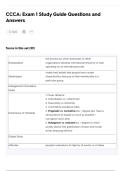
CCCA: Exam 1 Study Guide Questions and
Answers
Save
Terms in this set (39)
the process by which businesses or other
Globalization organizations develop international influence or start
operating on an international scale.
widely held beliefs that people have certain
Stereotypes characteristics because of their membership in a
particular group
Management Orientation
Styles
1. Power distance
2. Individualism vs. collectivism
3. Masculinity vs. femininity
4. Uncertainty avoidance index
5. Pragmatic vs. normativenew = degree ppl. Have a
Dimensions of Hofstede
strong desire to explain as much as possible +
normative/ short-term
6. Indulgence vs. restraintnew = degree to which
society allows free gratification of basic and human
drives (enjoying life/fun)
Global Study
Attitudes people's evaluations of objects, of events, or of ideas
, Family systems- types -
what they represent
Perceptions awareness of objects through any of the five senses
Racism Belief that one race is superior to another
the ideas, beliefs, and attitudes about what is
Values
important that help guide the way you live
- Ethnocentrism is universal
Ethnocentric views
- Ethnocentrism contributes to cultural identity
LEARNED, PASSED ALONG, DYNAMIC, INTEGRATED
Culture is
SYSTEM
Symbols in culture Tie people together
Culture is deeply rooted TRADITION
in....
All parts of a culture are yes
interconnected and
Integrated
- High context cultures
- Employ language in an indirect manner to promote
harmony
Northeast Asian cultures
- Politeness takes precedence over truth
(e.g. China, Korea, Japan)
- Importance of formality and hierarchy
- Opposite of western culture's view of
communication as a way to increase self-esteem
- Language unites and defines greater Arab
community
- Language is a function of history
- Language posses emotional content
Arabic - Indirectness is used to ensure smooth relations
- Repetition and exaggeration is used to appeal to
emotions
- Focus on the present and uncertainty about the
future
Answers
Save
Terms in this set (39)
the process by which businesses or other
Globalization organizations develop international influence or start
operating on an international scale.
widely held beliefs that people have certain
Stereotypes characteristics because of their membership in a
particular group
Management Orientation
Styles
1. Power distance
2. Individualism vs. collectivism
3. Masculinity vs. femininity
4. Uncertainty avoidance index
5. Pragmatic vs. normativenew = degree ppl. Have a
Dimensions of Hofstede
strong desire to explain as much as possible +
normative/ short-term
6. Indulgence vs. restraintnew = degree to which
society allows free gratification of basic and human
drives (enjoying life/fun)
Global Study
Attitudes people's evaluations of objects, of events, or of ideas
, Family systems- types -
what they represent
Perceptions awareness of objects through any of the five senses
Racism Belief that one race is superior to another
the ideas, beliefs, and attitudes about what is
Values
important that help guide the way you live
- Ethnocentrism is universal
Ethnocentric views
- Ethnocentrism contributes to cultural identity
LEARNED, PASSED ALONG, DYNAMIC, INTEGRATED
Culture is
SYSTEM
Symbols in culture Tie people together
Culture is deeply rooted TRADITION
in....
All parts of a culture are yes
interconnected and
Integrated
- High context cultures
- Employ language in an indirect manner to promote
harmony
Northeast Asian cultures
- Politeness takes precedence over truth
(e.g. China, Korea, Japan)
- Importance of formality and hierarchy
- Opposite of western culture's view of
communication as a way to increase self-esteem
- Language unites and defines greater Arab
community
- Language is a function of history
- Language posses emotional content
Arabic - Indirectness is used to ensure smooth relations
- Repetition and exaggeration is used to appeal to
emotions
- Focus on the present and uncertainty about the
future


