

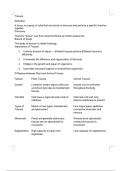
Tissues
Definition
A tissue is a group of cells that are similar in structure and perform a specific function
together.
Discovery
The term “tissue” was first coined by Bichat (a French anatomist).
Branch of Study
The study of tissues is called Histology.
Importance of Tissues
1. It allows division of labour — different tissues perform different functions
efficiently.
2. It increases the efficiency and organization of the body.
3. It helps in the growth and repair of organisms.
4. It provides structural support to multicellular organisms.
Difference between Plant and Animal Tissues
Feature Plant Tissues Animal Tissues
Growth Limited to certain regions (like root Growth occurs uniformly
and shoot tips) due to meristematic throughout the body.
tissues.
Cell Wall Cells have a rigid cell wall made of Cells lack cell wall; only
cellulose. plasma membrane is present.
Types of Mainly of two types: meristematic Four major types: epithelial,
Tissues and permanent. connective, muscular, and
nervous.
Movement Plants are generally stationary; Animals have specialized
tissues are not specialized for contractile tissues for
movement. movement.
Regeneration High capacity to repair and Less capacity for regeneration.
regenerate.
, Plant Tissues
Plant tissues are mainly classified into two groups:
I. Meristematic Tissues
(Also called growing tissues)
II. Permanent Tissues
(Formed when meristematic tissues lose the ability to divide and take a permanent
shape, size, and function.)
I. Meristematic Tissues
Definition
Meristematic tissues are those tissues in which the cells divide continuously and help in
the growth of plants.
Characteristics
● Cells are small and densely packed.
● Cell wall is thin and made of cellulose.
● Nucleus is large and prominent.
● Vacuoles are either very small or absent.
● Intercellular spaces are absent.
Types of Meristematic Tissues (on the basis of position)
Type Location Function
1. Apical Found at the tips of roots and Brings about increase in the
Meristem shoots. length of the plant (primary
growth).
2. Lateral Found on the lateral sides of Causes increase in girth or
Meristem stem and root (example: thickness of the plant (secondary
cambium). growth).
3. Intercalary Present at the base of leaves or Helps in regrowth of parts that
Meristem nodes (e.g. in grasses). are removed or eaten by animals.
Functions of Meristematic Tissues
1. Responsible for growth of the plant (both length and thickness).
2. Form new cells continuously.
Definition
A tissue is a group of cells that are similar in structure and perform a specific function
together.
Discovery
The term “tissue” was first coined by Bichat (a French anatomist).
Branch of Study
The study of tissues is called Histology.
Importance of Tissues
1. It allows division of labour — different tissues perform different functions
efficiently.
2. It increases the efficiency and organization of the body.
3. It helps in the growth and repair of organisms.
4. It provides structural support to multicellular organisms.
Difference between Plant and Animal Tissues
Feature Plant Tissues Animal Tissues
Growth Limited to certain regions (like root Growth occurs uniformly
and shoot tips) due to meristematic throughout the body.
tissues.
Cell Wall Cells have a rigid cell wall made of Cells lack cell wall; only
cellulose. plasma membrane is present.
Types of Mainly of two types: meristematic Four major types: epithelial,
Tissues and permanent. connective, muscular, and
nervous.
Movement Plants are generally stationary; Animals have specialized
tissues are not specialized for contractile tissues for
movement. movement.
Regeneration High capacity to repair and Less capacity for regeneration.
regenerate.
, Plant Tissues
Plant tissues are mainly classified into two groups:
I. Meristematic Tissues
(Also called growing tissues)
II. Permanent Tissues
(Formed when meristematic tissues lose the ability to divide and take a permanent
shape, size, and function.)
I. Meristematic Tissues
Definition
Meristematic tissues are those tissues in which the cells divide continuously and help in
the growth of plants.
Characteristics
● Cells are small and densely packed.
● Cell wall is thin and made of cellulose.
● Nucleus is large and prominent.
● Vacuoles are either very small or absent.
● Intercellular spaces are absent.
Types of Meristematic Tissues (on the basis of position)
Type Location Function
1. Apical Found at the tips of roots and Brings about increase in the
Meristem shoots. length of the plant (primary
growth).
2. Lateral Found on the lateral sides of Causes increase in girth or
Meristem stem and root (example: thickness of the plant (secondary
cambium). growth).
3. Intercalary Present at the base of leaves or Helps in regrowth of parts that
Meristem nodes (e.g. in grasses). are removed or eaten by animals.
Functions of Meristematic Tissues
1. Responsible for growth of the plant (both length and thickness).
2. Form new cells continuously.


