Ecology chapter 1 summary
Deep sea vents
Upon discovery of deep-sea life – depths greater than 275m where sunlight cannot
penetrate- scientists needed to understand how these species could exist. Scientists
hypothesised that tiny particles (known as marine snow) and decaying bodies of large
organisms must be the energy source, this was later rejected by the discoveries showing
great diversity near hydrothermal vents – these vents release hot water with high
concentrations of sulphur compounds and other mineral nutrients.
The bacteria in hydrothermal vents were using chemosynthesis – using the energy in
chemical bonds, combined with carbon dioxide to produce organic compounds. These
bacteria would then be a food source for other organisms or can be used in a symbiotic, for
example with the tube worm.
Ecological systems exist in a hierarchy of organization
An ecological system may be an individual, a population, a community, an ecosystem or
biosphere. An individual is a living being which has a membrane across where it exchanges
energy and materials with its environment. Populations have five distinct properties that are
not exhibited by individuals: geographic range, abundance, density, change in size and
composition. Communities are studied by looking at a subset of the species in the
community as well as the interactions among those species. When there are not distinct
boundary for communities, the scientists researching a certain community will decide the
boundary. At the ecosystem level, we typically focus on the movement of energy and matter
between physical and biological components of the ecosystem. The highest level of the
ecological hierarchy is the biosphere.
Studying ecology at different levels of organisation
The five approached to studying ecology match the different levels of hierarchy: the
individual approach, the population approach, the community approach, the ecosystem
approach and the biosphere approach. Ecologists who use the individual approach are often
interested in adaptations – the characteristics of an organism that make it well-suited to its
environment. Adaptations are the result of evolutionary change through the process of
natural selection.
Ecological systems are governed by physical and biological principles
In this section we review the three major biological principles: conservation of matter and
energy, dynamic steady states and evolution. The law of conservation of matter and the law
of conservation of energy imply that ecologists can track the movement of matter and
energy as it is converted into new forms through organisms, populations, communities,
ecosystems and the biosphere. An understanding of dynamic steady states helps provide
insights regarding the inputs and outputs of ecological systems.
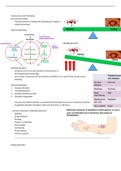
Dynamic steady states are represented by the picture below:
, Evolution
Evolution by natural selection depends on three conditions:
1. Individual organisms vary in their traits
2. Parental traits are inherited by their offspring
3. The variation in traits causes some individuals to experience higher fitness, which we
define as the survival and reproduction of an individual
When these three conditions exist, an individual with higher survival and reproductive
success will pass more copies their genes to the next generation. Over time, the genetic
composition of a population changes as the most successful phenotypes come to
predominate. As a result, the population becomes better suited to the surrounding
environmental conditions. Phenotypes that are well suited to their environment and confer
higher fitness are known as adaptations. Evolution in one species opens up new possibilities
for other species with which the evolving species interacts.
Different organisms play diverse roles in ecological systems
Early in the history of Earth, ecosystems were dominated by bacteria. Over time, bacteria
gave rise to the archaea. These evolutionary events likely happened in the ocean (maybe
near the deep-sea vents). If so, the first bacteria used chemosynthesis and gave rise to the
evolution of photosynthesis. The evolution of eukaryotic organisms (they possess distinct
cellular organelles) occurred when one bacterium engulfed another. The engulfed
bacterium became known as the mitochondria. The second key event was when a
Deep sea vents
Upon discovery of deep-sea life – depths greater than 275m where sunlight cannot
penetrate- scientists needed to understand how these species could exist. Scientists
hypothesised that tiny particles (known as marine snow) and decaying bodies of large
organisms must be the energy source, this was later rejected by the discoveries showing
great diversity near hydrothermal vents – these vents release hot water with high
concentrations of sulphur compounds and other mineral nutrients.
The bacteria in hydrothermal vents were using chemosynthesis – using the energy in
chemical bonds, combined with carbon dioxide to produce organic compounds. These
bacteria would then be a food source for other organisms or can be used in a symbiotic, for
example with the tube worm.
Ecological systems exist in a hierarchy of organization
An ecological system may be an individual, a population, a community, an ecosystem or
biosphere. An individual is a living being which has a membrane across where it exchanges
energy and materials with its environment. Populations have five distinct properties that are
not exhibited by individuals: geographic range, abundance, density, change in size and
composition. Communities are studied by looking at a subset of the species in the
community as well as the interactions among those species. When there are not distinct
boundary for communities, the scientists researching a certain community will decide the
boundary. At the ecosystem level, we typically focus on the movement of energy and matter
between physical and biological components of the ecosystem. The highest level of the
ecological hierarchy is the biosphere.
Studying ecology at different levels of organisation
The five approached to studying ecology match the different levels of hierarchy: the
individual approach, the population approach, the community approach, the ecosystem
approach and the biosphere approach. Ecologists who use the individual approach are often
interested in adaptations – the characteristics of an organism that make it well-suited to its
environment. Adaptations are the result of evolutionary change through the process of
natural selection.
Ecological systems are governed by physical and biological principles
In this section we review the three major biological principles: conservation of matter and
energy, dynamic steady states and evolution. The law of conservation of matter and the law
of conservation of energy imply that ecologists can track the movement of matter and
energy as it is converted into new forms through organisms, populations, communities,
ecosystems and the biosphere. An understanding of dynamic steady states helps provide
insights regarding the inputs and outputs of ecological systems.
Dynamic steady states are represented by the picture below:
, Evolution
Evolution by natural selection depends on three conditions:
1. Individual organisms vary in their traits
2. Parental traits are inherited by their offspring
3. The variation in traits causes some individuals to experience higher fitness, which we
define as the survival and reproduction of an individual
When these three conditions exist, an individual with higher survival and reproductive
success will pass more copies their genes to the next generation. Over time, the genetic
composition of a population changes as the most successful phenotypes come to
predominate. As a result, the population becomes better suited to the surrounding
environmental conditions. Phenotypes that are well suited to their environment and confer
higher fitness are known as adaptations. Evolution in one species opens up new possibilities
for other species with which the evolving species interacts.
Different organisms play diverse roles in ecological systems
Early in the history of Earth, ecosystems were dominated by bacteria. Over time, bacteria
gave rise to the archaea. These evolutionary events likely happened in the ocean (maybe
near the deep-sea vents). If so, the first bacteria used chemosynthesis and gave rise to the
evolution of photosynthesis. The evolution of eukaryotic organisms (they possess distinct
cellular organelles) occurred when one bacterium engulfed another. The engulfed
bacterium became known as the mitochondria. The second key event was when a