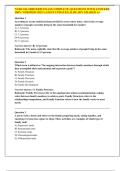
NURS 104 MIDTERM EXAM COMPLETE QUESTIONS WITH ANSWERS
100% VERIFIED 2025 LATEST UPDATED ALREADY GRADED A+
Question 1
According to recent statistical data provided in your course notes, what is the average
number of people currently living in the same household in Canada?
A) 1.5 persons
B) 2.5 persons
C) 3.2 persons
D) 4.0 persons
E) 5.1 persons
Correct Answer: B) 2.5 persons
Rationale: The notes explicitly state that the average number of people living in the same
household in Canada is 2.5 persons.
Question 2
Which term is defined as "the ongoing interaction between family members through which
they accomplish their instrumental and expressive goals"?
A) Family Structure
B) Family Function
C) Family Processes
D) Family Systems
E) Family Development
Correct Answer: C) Family Processes
Rationale: Family Processes refer to the ongoing interactions (communication, coping,
roles) between family members to achieve goals. Family Structure refers to the
relationships/composition, and Family Function refers to how the family works to meet
needs.
Question 3
A nurse visits a home and observes the family preparing meals, eating together, and
ensuring everyone has a place to sleep. These activities are examples of which type of
family task?
A) Expressive tasks
B) Instrumental tasks
C) Systemic tasks
D) Chronological tasks
E) Affirmational tasks
,[Type here]
Correct Answer: B) Instrumental tasks
Rationale: Instrumental tasks are the practical activities of daily living necessary to
maintain family life, such as eating, sleeping, and preparing meals.
Question 4
Which concept refers to the ways in which a family communicates, including emotional,
verbal, nonverbal, and circular communication patterns?
A) Instrumental tasks
B) Expressive tasks
C) Structural tasks
D) Microsystem interactions
E) Exosystem interactions
Correct Answer: B) Expressive tasks
Rationale: Expressive tasks deal with the emotional and communicative aspects of the
family, including how they share feelings and convey messages.
Question 5
A group of individuals living together, with or without legal or biological ties, is best defined
as a:
A) Psychological family
B) Bioecological family
C) Sociological family
D) Mesosystem
E) Developmental family
Correct Answer: C) Sociological family
Rationale: The sociological definition of family focuses on the grouping of people living
together (cohabitation), regardless of whether they are legally married or biologically
related.
Question 6
A patient identifies a close friend and a neighbor as their "family" because of the strong
emotional ties they share, despite having no biological relation. This fits the definition of:
A) Sociological family
B) Psychological family
C) Nuclear family
, [Type here]
D) Extended family
E) Instrumental family
Correct Answer: B) Psychological family
Rationale: A Psychological family is defined by groups with strong emotional ties, rather
than just legal, biological, or residential bonds.
Question 7
When a nurse approaches "Family as Context," where is the primary focus of care placed?
A) On the entire family unit equally.
B) On the individual patient, with the family serving as the background/context.
C) On the family's interaction with societal institutions.
D) On the community at large.
E) On the interactions between family members only.
Correct Answer: B) On the individual patient, with the family serving as the
background/context.
Rationale: In "Family as Context," the individual is the foreground (the patient), and the
family is the background resource or stressor. An example is asking the patient about their
family.
Question 8
A nurse asks a family, "How are you all coping with your father's recent diagnosis of
dementia?" This approach, which focuses on the family while viewing the individual as
context, is known as:
A) Family as Context
B) Family as System
C) Family as Client
D) Family as Component of Society
E) Family as Structure
Correct Answer: C) Family as Client
Rationale: "Family as Client" shifts the focus to the family unit as the patient, examining
how the family as a whole is reacting to an event affecting one member (who is the context).
Question 9
Which approach views the family as an interactional unit where "the whole is worth more
than the sum of its parts," focusing on internal relationships and processes?
A) Family as Context
100% VERIFIED 2025 LATEST UPDATED ALREADY GRADED A+
Question 1
According to recent statistical data provided in your course notes, what is the average
number of people currently living in the same household in Canada?
A) 1.5 persons
B) 2.5 persons
C) 3.2 persons
D) 4.0 persons
E) 5.1 persons
Correct Answer: B) 2.5 persons
Rationale: The notes explicitly state that the average number of people living in the same
household in Canada is 2.5 persons.
Question 2
Which term is defined as "the ongoing interaction between family members through which
they accomplish their instrumental and expressive goals"?
A) Family Structure
B) Family Function
C) Family Processes
D) Family Systems
E) Family Development
Correct Answer: C) Family Processes
Rationale: Family Processes refer to the ongoing interactions (communication, coping,
roles) between family members to achieve goals. Family Structure refers to the
relationships/composition, and Family Function refers to how the family works to meet
needs.
Question 3
A nurse visits a home and observes the family preparing meals, eating together, and
ensuring everyone has a place to sleep. These activities are examples of which type of
family task?
A) Expressive tasks
B) Instrumental tasks
C) Systemic tasks
D) Chronological tasks
E) Affirmational tasks
,[Type here]
Correct Answer: B) Instrumental tasks
Rationale: Instrumental tasks are the practical activities of daily living necessary to
maintain family life, such as eating, sleeping, and preparing meals.
Question 4
Which concept refers to the ways in which a family communicates, including emotional,
verbal, nonverbal, and circular communication patterns?
A) Instrumental tasks
B) Expressive tasks
C) Structural tasks
D) Microsystem interactions
E) Exosystem interactions
Correct Answer: B) Expressive tasks
Rationale: Expressive tasks deal with the emotional and communicative aspects of the
family, including how they share feelings and convey messages.
Question 5
A group of individuals living together, with or without legal or biological ties, is best defined
as a:
A) Psychological family
B) Bioecological family
C) Sociological family
D) Mesosystem
E) Developmental family
Correct Answer: C) Sociological family
Rationale: The sociological definition of family focuses on the grouping of people living
together (cohabitation), regardless of whether they are legally married or biologically
related.
Question 6
A patient identifies a close friend and a neighbor as their "family" because of the strong
emotional ties they share, despite having no biological relation. This fits the definition of:
A) Sociological family
B) Psychological family
C) Nuclear family
, [Type here]
D) Extended family
E) Instrumental family
Correct Answer: B) Psychological family
Rationale: A Psychological family is defined by groups with strong emotional ties, rather
than just legal, biological, or residential bonds.
Question 7
When a nurse approaches "Family as Context," where is the primary focus of care placed?
A) On the entire family unit equally.
B) On the individual patient, with the family serving as the background/context.
C) On the family's interaction with societal institutions.
D) On the community at large.
E) On the interactions between family members only.
Correct Answer: B) On the individual patient, with the family serving as the
background/context.
Rationale: In "Family as Context," the individual is the foreground (the patient), and the
family is the background resource or stressor. An example is asking the patient about their
family.
Question 8
A nurse asks a family, "How are you all coping with your father's recent diagnosis of
dementia?" This approach, which focuses on the family while viewing the individual as
context, is known as:
A) Family as Context
B) Family as System
C) Family as Client
D) Family as Component of Society
E) Family as Structure
Correct Answer: C) Family as Client
Rationale: "Family as Client" shifts the focus to the family unit as the patient, examining
how the family as a whole is reacting to an event affecting one member (who is the context).
Question 9
Which approach views the family as an interactional unit where "the whole is worth more
than the sum of its parts," focusing on internal relationships and processes?
A) Family as Context