

MUSCULOSKELETAL SYSTEM
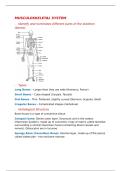
- Identify and nominates different parts of the skeleton
(bones)
- Types
Long Bones – Longer than they are wide (Humerus, Femur)
Short Bones – Cube-shaped (Carpals, Tarsals)
Flat Bones – Thin, flattened, slightly curved (Sternum, Scapula, Skull)
Irregular Bones – Complicated shapes (Vertebrae)
- Histological Structure
Bone tissue is a type of connective tissue
Compact bone: Dense outer layer. Structural unit is the osteon
(Haversian System), made up of concentric rings of matrix called lamellae
surrounding a central Haversian Canal (containing blood vessels and
nerves). Osteocytes are in lacunae.
Spongy Bone (Cancellous Bone): Internal layer, made up of flat pieces
called trabeculae – has red bone marrow.
, - Functions of bones
Support: Framework for the body
Protection: Protects vital organs (skull protects brain)
Movement: Levers for muscles to act upon
Mineral Storage: Reservoir for calcium and phosphate
Blood Cell Formation: Occurs in the red bone marrow
Fat Storage: Stored in yellow bone marrow
- Normal bone growth
Endochondral Ossification: Bone forms by replacing hyaline cartilage.
Occurs at the epiphyseal plate (growth plate) during
childhood/adolescence
Intramembranous Ossification: Bone develops from fibrous connective
tissue membranes (flat bones of the skull)
- Maintenance of bone integrity
Bone undergoes continuous remodelling involving a balance between:
Bone Deposit: by osteoblasts (responsible for the formation of bone
tissue)
Bone Resorption (Breakdown): By osteoclast (responsible for
destroying old bone tissue)
- Identify and nominates different parts of the skeleton
(bones)
- Types
Long Bones – Longer than they are wide (Humerus, Femur)
Short Bones – Cube-shaped (Carpals, Tarsals)
Flat Bones – Thin, flattened, slightly curved (Sternum, Scapula, Skull)
Irregular Bones – Complicated shapes (Vertebrae)
- Histological Structure
Bone tissue is a type of connective tissue
Compact bone: Dense outer layer. Structural unit is the osteon
(Haversian System), made up of concentric rings of matrix called lamellae
surrounding a central Haversian Canal (containing blood vessels and
nerves). Osteocytes are in lacunae.
Spongy Bone (Cancellous Bone): Internal layer, made up of flat pieces
called trabeculae – has red bone marrow.
, - Functions of bones
Support: Framework for the body
Protection: Protects vital organs (skull protects brain)
Movement: Levers for muscles to act upon
Mineral Storage: Reservoir for calcium and phosphate
Blood Cell Formation: Occurs in the red bone marrow
Fat Storage: Stored in yellow bone marrow
- Normal bone growth
Endochondral Ossification: Bone forms by replacing hyaline cartilage.
Occurs at the epiphyseal plate (growth plate) during
childhood/adolescence
Intramembranous Ossification: Bone develops from fibrous connective
tissue membranes (flat bones of the skull)
- Maintenance of bone integrity
Bone undergoes continuous remodelling involving a balance between:
Bone Deposit: by osteoblasts (responsible for the formation of bone
tissue)
Bone Resorption (Breakdown): By osteoclast (responsible for
destroying old bone tissue)


