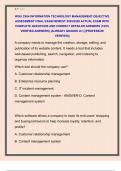
2025 NRCME Study Sheet Actual Exam Questions
and Verified Answers | Latest Version | Just
Released | Graded A+
Introduction
This 2025 NRCME (National Registry of Certified Medical Examiners) study sheet is a
high-fidelity simulation of the FMCSA certification examination.
It covers the seven core domains evaluated:
1. DOT physical-qualification standards
2. Medical-examination procedures
3. Federal regulatory requirements and 2025 updates
4. Certification, documentation, and record-keeping
5. Disqualifying (or conditionally certifying) diseases, disorders, and medications
6. Privacy, data-security, and reporting obligations
7. Ethics and professional conduct for certified medical examiners (CMEs)
All items are original, scenario-based, and aligned with the April-2025 FMCSA Medical
Examiner Handbook, 49 CFR 391, and related advisory guidance.
Use this resource for mastery-level preparation; it is neither published nor endorsed by
FMCSA.
Question 1
A 48-year-old interstate CMV driver presents with a recent (10 days) lacunar stroke,
normal imaging follow-up, and no residual deficits. His BP is 128/78 mmHg. He takes
lisinopril only. What is the MOST appropriate certification interval, if any?
A. Issue a 2-year certificate
B. Issue a 1-year certificate
C. Issue a 3-month temporary certificate pending neurologic clearance
D. Disqualify until stroke-free for ≥1 year with neurologic clearance
Answer: D. Disqualify until stroke-free for ≥1 year with neurologic clearance
Solution: FMCSA §391.45 and 2025 Stroke Advisory require a minimum 1-year seizure-
free, deficit-free period after any cerebrovascular accident, with a neurologist’s
clearance, before certification. Issuing any certificate prior to this period (A–C) violates
federal standard.
pg. 1
,Question 2
During examination, a driver’s recorded BP is 162/104 mmHg on two properly spaced
readings. He is asymptomatic and takes no antihypertensives. Which action conforms to
current FMCSA guidance?
A. Issue a 2-year certificate; hypertension is not disqualifying
B. Issue a 3-month temporary for BP control; disqualify after 3 months if still >140/90
C. Disqualify immediately; BP ≥160/100 is stage 3 and medically unqualified
D. Issue 1-year certificate and advise follow-up with PCP
Answer: B. Issue a 3-month temporary for BP control; disqualify after 3 months if
still >140/90
Solution: 2025 FMCSA BP table allows temporary certification up to 3 months for
drivers with BP 160–179/100–109 to achieve ≤140/90. Immediate disqualification (C)
applies only if ≥180/110 or ineffective treatment after temporary period.
Question 3
A for-hire driver produces a 3-year-old stress echocardiogram showing LVEF 45 % and
no inducible ischemia. He denies symptoms and takes metoprolol. Which requirement
applies before you may certify?
A. No new testing needed; issue 2-year certificate
B. Obtain a new cardiology clearance dated within the last 6 months
C. Repeat stress imaging every 5 years regardless of symptoms
D. Disqualify because LVEF <50 % is automatically prohibitive
Answer: B. Obtain a new cardiology clearance dated within the last 6 months
Solution: FMCSA recommends cardiovascular evaluation within 6 months for any
history of reduced ejection fraction or coronary disease. LVEF 45 % is acceptable if
cleared by cardiologist and driver is asymptomatic; automatic disqualification (D) is
incorrect.
Question 4
A driver uses 4 % timolol ophthalmic drops for glaucoma. He has no visual-field defects
and distant visual acuity is 20/25 OU. Certification is permissible for a maximum of:
A. 6 months
B. 1 year
C. 2 years
D. 5 years
Answer: C. 2 years
Solution: Timolol is not a disqualifying medication; with acuity ≥20/40 and normal
visual fields, routine 2-year certification applies.
pg. 2
,Question 5
While reviewing a driver’s urine dipstick, you note trace glucose and 1+ protein. He is
alert, afebrile, and BP 134/82. What must you do NEXT?
A. Disqualify for probable diabetes and renal disease
B. Ignore trace findings; proceed with exam
C. Obtain a first-morning urinalysis or basic metabolic panel to clarify before certifying
D. Issue 1-month certificate for PCP follow-up only if blood is also present
Answer: C. Obtain a first-morning urinalysis or basic metabolic panel to clarify
before certifying
Solution: FMCSA does not mandate dipstick thresholds, but unexplained
proteinuria/glycosuria requires evaluation for underlying disqualifying conditions
(diabetes, renal disease) prior to certification. Immediate disqualification (A) is
premature.
Question 6
Which of the following medications is an AUTOMATIC disqualifier for interstate CMV
operation?
A. Lisdexamfetamine for ADHD (stable dose)
B. Insulin glargine with FMCSA diabetes exemption
C. Gabapentin for neuropathy (≤1800 mg day⁻¹)
D. Marijuana metabolite ≥5 ng mL⁻¹ on DOT drug screen
Answer: D. Marijuana metabolite ≥5 ng mL⁻¹ on DOT drug screen
Solution: 49 CFR 40.21 and DOT drug-testing rules prohibit any Schedule I substance
(including marijuana) without medical exemption; thus a positive screen is
disqualifying. Other drugs (A–C) may be acceptable with monitoring/exemptions.
Question 7
A driver’s audiogram shows an average hearing loss of 48 dB at 500, 1000, and 2000 Hz
in the better ear. He passes the forced-whisper test at 5 ft with the worse ear. Which
statement is CORRECT?
A. Pass—whisper test override is allowed
B. Fail—loss ≥40 dB average is disqualifying unless hearing aid used
C. Issue 1-year certificate with ENT clearance
D. Pass if he agrees to wear hearing aids while driving
Answer: B. Fail—loss ≥40 dB average is disqualifying unless hearing aid used
Solution: FMCSA allows either whisper test (≥5 ft) OR audiometric average ≤40 dB. If
audiogram fails, driver must be fitted with hearing aid and demonstrate correction
before certification.
pg. 3
, Question 8
You receive a subpoena for a driver’s medical record. Under 49 CFR 390.23, the
EXAMINER may release records when:
A. The driver has given written consent
B. FMCSA requests them during an investigation
C. A state DOT audit requests them
D. All of the above
Answer: D. All of the above
Solution: 49 CFR 390.23 permits disclosure with driver consent, to FMCSA officials, or
to state agencies with safety authority; subpoena compliance is mandatory.
Question 9
A driver with mild intermittent asthma uses an albuterol inhaler PRN and reports
daytime symptoms ≤2× month, no nocturnal awakenings, FEV1 88 % predicted.
Certification interval should be:
A. 6 months
B. 1 year
C. 2 years
D. 5 years
Answer: C. 2 years
Solution: Well-controlled asthma (step 1) with preserved spirometry does not limit
certification; routine 2-year interval applies.
Question 10
During inspection of your completed Medical Examination Report Form (MER), which
omission will ALWAYS cause FMCSA to reject the document?
A. Failure to check “qualified” or “disqualified” box
B. Omitting driver’s phone number
C. Using non-black ink for signatures
D. Omitting examiner’s NRCME registry number
Answer: A. Failure to check “qualified” or “disqualified” box
Solution: The binary certification decision is mandatory; FMCSA returns incomplete
forms. Registry number (D) is required but its omission can sometimes be corrected
administratively.
Question 11
A driver has a current valid medical certificate but presents with a new diagnosis of
severe OSA (AHI 35) started on CPAP 1 week ago. Which statement is TRUE?
pg. 4
and Verified Answers | Latest Version | Just
Released | Graded A+
Introduction
This 2025 NRCME (National Registry of Certified Medical Examiners) study sheet is a
high-fidelity simulation of the FMCSA certification examination.
It covers the seven core domains evaluated:
1. DOT physical-qualification standards
2. Medical-examination procedures
3. Federal regulatory requirements and 2025 updates
4. Certification, documentation, and record-keeping
5. Disqualifying (or conditionally certifying) diseases, disorders, and medications
6. Privacy, data-security, and reporting obligations
7. Ethics and professional conduct for certified medical examiners (CMEs)
All items are original, scenario-based, and aligned with the April-2025 FMCSA Medical
Examiner Handbook, 49 CFR 391, and related advisory guidance.
Use this resource for mastery-level preparation; it is neither published nor endorsed by
FMCSA.
Question 1
A 48-year-old interstate CMV driver presents with a recent (10 days) lacunar stroke,
normal imaging follow-up, and no residual deficits. His BP is 128/78 mmHg. He takes
lisinopril only. What is the MOST appropriate certification interval, if any?
A. Issue a 2-year certificate
B. Issue a 1-year certificate
C. Issue a 3-month temporary certificate pending neurologic clearance
D. Disqualify until stroke-free for ≥1 year with neurologic clearance
Answer: D. Disqualify until stroke-free for ≥1 year with neurologic clearance
Solution: FMCSA §391.45 and 2025 Stroke Advisory require a minimum 1-year seizure-
free, deficit-free period after any cerebrovascular accident, with a neurologist’s
clearance, before certification. Issuing any certificate prior to this period (A–C) violates
federal standard.
pg. 1
,Question 2
During examination, a driver’s recorded BP is 162/104 mmHg on two properly spaced
readings. He is asymptomatic and takes no antihypertensives. Which action conforms to
current FMCSA guidance?
A. Issue a 2-year certificate; hypertension is not disqualifying
B. Issue a 3-month temporary for BP control; disqualify after 3 months if still >140/90
C. Disqualify immediately; BP ≥160/100 is stage 3 and medically unqualified
D. Issue 1-year certificate and advise follow-up with PCP
Answer: B. Issue a 3-month temporary for BP control; disqualify after 3 months if
still >140/90
Solution: 2025 FMCSA BP table allows temporary certification up to 3 months for
drivers with BP 160–179/100–109 to achieve ≤140/90. Immediate disqualification (C)
applies only if ≥180/110 or ineffective treatment after temporary period.
Question 3
A for-hire driver produces a 3-year-old stress echocardiogram showing LVEF 45 % and
no inducible ischemia. He denies symptoms and takes metoprolol. Which requirement
applies before you may certify?
A. No new testing needed; issue 2-year certificate
B. Obtain a new cardiology clearance dated within the last 6 months
C. Repeat stress imaging every 5 years regardless of symptoms
D. Disqualify because LVEF <50 % is automatically prohibitive
Answer: B. Obtain a new cardiology clearance dated within the last 6 months
Solution: FMCSA recommends cardiovascular evaluation within 6 months for any
history of reduced ejection fraction or coronary disease. LVEF 45 % is acceptable if
cleared by cardiologist and driver is asymptomatic; automatic disqualification (D) is
incorrect.
Question 4
A driver uses 4 % timolol ophthalmic drops for glaucoma. He has no visual-field defects
and distant visual acuity is 20/25 OU. Certification is permissible for a maximum of:
A. 6 months
B. 1 year
C. 2 years
D. 5 years
Answer: C. 2 years
Solution: Timolol is not a disqualifying medication; with acuity ≥20/40 and normal
visual fields, routine 2-year certification applies.
pg. 2
,Question 5
While reviewing a driver’s urine dipstick, you note trace glucose and 1+ protein. He is
alert, afebrile, and BP 134/82. What must you do NEXT?
A. Disqualify for probable diabetes and renal disease
B. Ignore trace findings; proceed with exam
C. Obtain a first-morning urinalysis or basic metabolic panel to clarify before certifying
D. Issue 1-month certificate for PCP follow-up only if blood is also present
Answer: C. Obtain a first-morning urinalysis or basic metabolic panel to clarify
before certifying
Solution: FMCSA does not mandate dipstick thresholds, but unexplained
proteinuria/glycosuria requires evaluation for underlying disqualifying conditions
(diabetes, renal disease) prior to certification. Immediate disqualification (A) is
premature.
Question 6
Which of the following medications is an AUTOMATIC disqualifier for interstate CMV
operation?
A. Lisdexamfetamine for ADHD (stable dose)
B. Insulin glargine with FMCSA diabetes exemption
C. Gabapentin for neuropathy (≤1800 mg day⁻¹)
D. Marijuana metabolite ≥5 ng mL⁻¹ on DOT drug screen
Answer: D. Marijuana metabolite ≥5 ng mL⁻¹ on DOT drug screen
Solution: 49 CFR 40.21 and DOT drug-testing rules prohibit any Schedule I substance
(including marijuana) without medical exemption; thus a positive screen is
disqualifying. Other drugs (A–C) may be acceptable with monitoring/exemptions.
Question 7
A driver’s audiogram shows an average hearing loss of 48 dB at 500, 1000, and 2000 Hz
in the better ear. He passes the forced-whisper test at 5 ft with the worse ear. Which
statement is CORRECT?
A. Pass—whisper test override is allowed
B. Fail—loss ≥40 dB average is disqualifying unless hearing aid used
C. Issue 1-year certificate with ENT clearance
D. Pass if he agrees to wear hearing aids while driving
Answer: B. Fail—loss ≥40 dB average is disqualifying unless hearing aid used
Solution: FMCSA allows either whisper test (≥5 ft) OR audiometric average ≤40 dB. If
audiogram fails, driver must be fitted with hearing aid and demonstrate correction
before certification.
pg. 3
, Question 8
You receive a subpoena for a driver’s medical record. Under 49 CFR 390.23, the
EXAMINER may release records when:
A. The driver has given written consent
B. FMCSA requests them during an investigation
C. A state DOT audit requests them
D. All of the above
Answer: D. All of the above
Solution: 49 CFR 390.23 permits disclosure with driver consent, to FMCSA officials, or
to state agencies with safety authority; subpoena compliance is mandatory.
Question 9
A driver with mild intermittent asthma uses an albuterol inhaler PRN and reports
daytime symptoms ≤2× month, no nocturnal awakenings, FEV1 88 % predicted.
Certification interval should be:
A. 6 months
B. 1 year
C. 2 years
D. 5 years
Answer: C. 2 years
Solution: Well-controlled asthma (step 1) with preserved spirometry does not limit
certification; routine 2-year interval applies.
Question 10
During inspection of your completed Medical Examination Report Form (MER), which
omission will ALWAYS cause FMCSA to reject the document?
A. Failure to check “qualified” or “disqualified” box
B. Omitting driver’s phone number
C. Using non-black ink for signatures
D. Omitting examiner’s NRCME registry number
Answer: A. Failure to check “qualified” or “disqualified” box
Solution: The binary certification decision is mandatory; FMCSA returns incomplete
forms. Registry number (D) is required but its omission can sometimes be corrected
administratively.
Question 11
A driver has a current valid medical certificate but presents with a new diagnosis of
severe OSA (AHI 35) started on CPAP 1 week ago. Which statement is TRUE?
pg. 4