
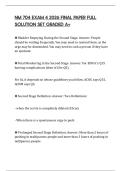
NM 704 EXAM 4 2026 FINAL PAPER FULL
SOLUTION SET GRADED A+
◉ Bladder Emptying During the Second Stage. Answer: People
should be voiding frequently. You may need to remind them, as the
urge may be diminished. You may need to cath a person if they have
an epidural.
◉ Fetal Monitoring in the Second Stage. Answer: For EFM it's Q15
barring complications (then it'd be Q5).
For IA, it depends on whose guidelines you follow. ACOG says Q15,
ACNM says Q5.
◉ Second Stage Definition. Answer: Two Definitions:
- when the cervix is completely dilated (10cm)
- When there is a spontaneous urge to push
◉ Prolonged Second Stage Definition. Answer: More than 2 hours of
pushing in multiparous people and more than 3 hours of pushing in
nulliparous people
, ◉ Spontaneous Pushing. Answer: Usually results in 5 to 6 bearing-
down efforts per contraction for 3 - 10 seconds each. Pushing will
often occur during an exhalation, with an open mouth and glottis.
This will usually be accompanied by grunting or low groaning. The
birthing person controls when and for how long to push
◉ Coached Pushing. Answer: Bearing-down efforts begin when the
clinician assesses full dilation and pushing is directed with
instructions from a nurse or clinician for when to push and for how
long. This usually results in 3 pushes per contraction with a duration
of 8 to 10 seconds each. Pushing occurs while the person is holding
their breath; silence is encouraged and often results in a valsalva
maneuver
◉ Closed-Glottis Pushing Associations. Answer: - Decreased fetal
oxygenation
- Increased perineal trauma
- Impaired PP pelvic function
◉ Supine and Lithotomy Pushing Position. Answer: Associated with
uterine pressure on the vena cava, parental hypotension, decreased
uterine perfusion, and variant fetal heart rate patterns
SOLUTION SET GRADED A+
◉ Bladder Emptying During the Second Stage. Answer: People
should be voiding frequently. You may need to remind them, as the
urge may be diminished. You may need to cath a person if they have
an epidural.
◉ Fetal Monitoring in the Second Stage. Answer: For EFM it's Q15
barring complications (then it'd be Q5).
For IA, it depends on whose guidelines you follow. ACOG says Q15,
ACNM says Q5.
◉ Second Stage Definition. Answer: Two Definitions:
- when the cervix is completely dilated (10cm)
- When there is a spontaneous urge to push
◉ Prolonged Second Stage Definition. Answer: More than 2 hours of
pushing in multiparous people and more than 3 hours of pushing in
nulliparous people
, ◉ Spontaneous Pushing. Answer: Usually results in 5 to 6 bearing-
down efforts per contraction for 3 - 10 seconds each. Pushing will
often occur during an exhalation, with an open mouth and glottis.
This will usually be accompanied by grunting or low groaning. The
birthing person controls when and for how long to push
◉ Coached Pushing. Answer: Bearing-down efforts begin when the
clinician assesses full dilation and pushing is directed with
instructions from a nurse or clinician for when to push and for how
long. This usually results in 3 pushes per contraction with a duration
of 8 to 10 seconds each. Pushing occurs while the person is holding
their breath; silence is encouraged and often results in a valsalva
maneuver
◉ Closed-Glottis Pushing Associations. Answer: - Decreased fetal
oxygenation
- Increased perineal trauma
- Impaired PP pelvic function
◉ Supine and Lithotomy Pushing Position. Answer: Associated with
uterine pressure on the vena cava, parental hypotension, decreased
uterine perfusion, and variant fetal heart rate patterns


