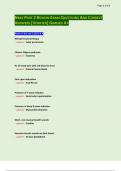
CHT BonenT exam newesT 2025/2026 wiTH CompleTe
QuesTions and CorreCT answers |already Graded
a+||Brand new Version!
How to prevent air embolism - ANSWER-arm the air detector; tighten all connections in the
extracorporeal circuit; check the normal saline level in the IV bag; return the patient's blood
with saline with the air detector on
Anaphylaxis - ANSWER-Severe allergic reaction
Sign/symptoms of anaphylaxis - ANSWER-Happens within the first 5-10 minutes, trouble
breathing, hypotension, hives and itching, anxious or restlessness, swelling around eyes,
numbness or tingling around mouth, low back pain, tachycardia, cardiac arrest, and burning
pain at venous needle site ) could be from disinfectant infusion)
What to do when pt is experiencing anaphylaxis - ANSWER-Call for help, stop tx, clamp all lines, do
not return blood, monitor vitals
Causes of anaphylaxis - ANSWER-- Ethylene oxide (a new dialyzer germicide) allergy
- Reaction to germicide left in the bloodlines
- Drug allergy (e.g., to iron dextran, heparin)
How to prevent anaphylaxis - ANSWER-rinse dialyzers and bloodlines well during equipment
preparation; avoid drugs the patients has a known allergy to
Angina - ANSWER-Chest pain
,Signs/symptoms of angina - ANSWER-Pain or tightness in chest/ arm/jaw, pt may be cold/
sweating/ trouble breathing, hypotension
What to do if pt is experiencing angina - ANSWER-Lower BFR to 150 to decrease stress on heart,
lower UFR to prevent further fluid loss and stress in heart, monitor vitals, give saline if
hypotensive, call for help.
Causes of angina - ANSWER-- Coronary artery disease (blocked heart arteries)
- Anemia (shortage of red blood cells)
- Hypotension
- Anxiety
How to prevent Angina - ANSWER-- Monitor blood pressure closely to avoid hypotension.
- Calculate the fluid goal correctly.
Arrhythmias - ANSWER-irregular heartbeats
Sign/symptoms of arrhythmia s - ANSWER-Skipped or extra heartbeats, slow or fast pulse,
palpitations, anxiety
What to do if pt is experiencing arrhythmia - ANSWER-Check vitals, manually check pulse, lower
UFR is pt is hypotensive, call for help.
What causes arrhythmias? - ANSWER-Changes is ph or electrolyte levels especially potassium,
hypotension, heart disease
How to prevent Arrhythmias - ANSWER-- Use the right dialysate concentrate.
- Manually check the pt's pulse during tx.
,- Monitor blood pressure. And UFR to prevent hypotension
cardiac arrest - ANSWER-complete stopping of heart activity
Sign/symptoms of cardiac arrest - ANSWER-No pulse, no breathing, loss of consciousness
In center hemo must be done - ANSWER-3x a week for about 4 hours
Cons of in center HD - ANSWER-Most limitation on Diet, fluid than other modalities
Requires the most medication
Most symptoms
Patients who run 4 hour tx - ANSWER-Are 30% less likely to die than pts who run shorter times
Each 30 mins extra of tx increase life by 7%
Patients are 50% more likely to die after - ANSWER-2 day no treatment weekend, the last 12 hours
of the 2 days the risk of death triples
diastolic blood pressure - ANSWER-When the heart is at rest.
Benefits of nocturnal in center - ANSWER-You get 2x as many txs as standard because it is longer
and more gentle with fluid removal
Rarely cramp
Easy on heart
Fewer limitations on food and drink
Free days
72% better survival rate than standard in center
, You check blood pressure with - ANSWER-Stethoscope and sphygmomanometer
Nocturnal in center hemo must be done - ANSWER-3x a weeks about 8 hours per tx
If BP site is below the heart.... - ANSWER-The reading will be to high
Benefits of nocturnal home hemo - ANSWER-Better protein level
Don't need binders
No fluid limits
Fewer symptoms
Less heart damage
Live as long as people who get a deceased kidney transplant
If BP site is above the heart.... - ANSWER-The reading will be to low
Home hemo must be done - ANSWER-3x a week 4-6 hours per tx
Benefits of PD - ANSWER-Can do alone at home or work
Only need 1-2weeks of training
Allows for a more normal diet
Allows pt to feel more normal
peritonitis - ANSWER-inflammation of the peritoneum, this can scar the peritoneum and make PD
no longer possible, can be avoided by doing a sterile exchange
2 types of PD - ANSWER-Continuous ambulatory peritoneal dialysis (CAPD)
QuesTions and CorreCT answers |already Graded
a+||Brand new Version!
How to prevent air embolism - ANSWER-arm the air detector; tighten all connections in the
extracorporeal circuit; check the normal saline level in the IV bag; return the patient's blood
with saline with the air detector on
Anaphylaxis - ANSWER-Severe allergic reaction
Sign/symptoms of anaphylaxis - ANSWER-Happens within the first 5-10 minutes, trouble
breathing, hypotension, hives and itching, anxious or restlessness, swelling around eyes,
numbness or tingling around mouth, low back pain, tachycardia, cardiac arrest, and burning
pain at venous needle site ) could be from disinfectant infusion)
What to do when pt is experiencing anaphylaxis - ANSWER-Call for help, stop tx, clamp all lines, do
not return blood, monitor vitals
Causes of anaphylaxis - ANSWER-- Ethylene oxide (a new dialyzer germicide) allergy
- Reaction to germicide left in the bloodlines
- Drug allergy (e.g., to iron dextran, heparin)
How to prevent anaphylaxis - ANSWER-rinse dialyzers and bloodlines well during equipment
preparation; avoid drugs the patients has a known allergy to
Angina - ANSWER-Chest pain
,Signs/symptoms of angina - ANSWER-Pain or tightness in chest/ arm/jaw, pt may be cold/
sweating/ trouble breathing, hypotension
What to do if pt is experiencing angina - ANSWER-Lower BFR to 150 to decrease stress on heart,
lower UFR to prevent further fluid loss and stress in heart, monitor vitals, give saline if
hypotensive, call for help.
Causes of angina - ANSWER-- Coronary artery disease (blocked heart arteries)
- Anemia (shortage of red blood cells)
- Hypotension
- Anxiety
How to prevent Angina - ANSWER-- Monitor blood pressure closely to avoid hypotension.
- Calculate the fluid goal correctly.
Arrhythmias - ANSWER-irregular heartbeats
Sign/symptoms of arrhythmia s - ANSWER-Skipped or extra heartbeats, slow or fast pulse,
palpitations, anxiety
What to do if pt is experiencing arrhythmia - ANSWER-Check vitals, manually check pulse, lower
UFR is pt is hypotensive, call for help.
What causes arrhythmias? - ANSWER-Changes is ph or electrolyte levels especially potassium,
hypotension, heart disease
How to prevent Arrhythmias - ANSWER-- Use the right dialysate concentrate.
- Manually check the pt's pulse during tx.
,- Monitor blood pressure. And UFR to prevent hypotension
cardiac arrest - ANSWER-complete stopping of heart activity
Sign/symptoms of cardiac arrest - ANSWER-No pulse, no breathing, loss of consciousness
In center hemo must be done - ANSWER-3x a week for about 4 hours
Cons of in center HD - ANSWER-Most limitation on Diet, fluid than other modalities
Requires the most medication
Most symptoms
Patients who run 4 hour tx - ANSWER-Are 30% less likely to die than pts who run shorter times
Each 30 mins extra of tx increase life by 7%
Patients are 50% more likely to die after - ANSWER-2 day no treatment weekend, the last 12 hours
of the 2 days the risk of death triples
diastolic blood pressure - ANSWER-When the heart is at rest.
Benefits of nocturnal in center - ANSWER-You get 2x as many txs as standard because it is longer
and more gentle with fluid removal
Rarely cramp
Easy on heart
Fewer limitations on food and drink
Free days
72% better survival rate than standard in center
, You check blood pressure with - ANSWER-Stethoscope and sphygmomanometer
Nocturnal in center hemo must be done - ANSWER-3x a weeks about 8 hours per tx
If BP site is below the heart.... - ANSWER-The reading will be to high
Benefits of nocturnal home hemo - ANSWER-Better protein level
Don't need binders
No fluid limits
Fewer symptoms
Less heart damage
Live as long as people who get a deceased kidney transplant
If BP site is above the heart.... - ANSWER-The reading will be to low
Home hemo must be done - ANSWER-3x a week 4-6 hours per tx
Benefits of PD - ANSWER-Can do alone at home or work
Only need 1-2weeks of training
Allows for a more normal diet
Allows pt to feel more normal
peritonitis - ANSWER-inflammation of the peritoneum, this can scar the peritoneum and make PD
no longer possible, can be avoided by doing a sterile exchange
2 types of PD - ANSWER-Continuous ambulatory peritoneal dialysis (CAPD)