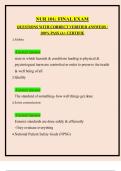
NUR101 FINAL EXAM REVIEW QUESTIONS WITH CORRECT VERIFIED ANSWERS | 100% PASS (A+ CERTIFIE
NUR101 FINAL EXAM REVIEW QUESTIONS WITH CORRECT VERIFIED ANSWERS | 100% PASS (A+ CERTIFIE 1. Acute pain? Correct Answer type of pain; short duration, sometimes requires medication 2. Chronic pain Correct Answer type of pain; longer-lasting, always requires medication 3. - using passive mobility and active mobility (ROM of joints) Correct Answer What is one of the ways to assess muscle strength of the extremities? 4. Neuropathic pain 2 / 17 Correct Answer Classification of Pain: nerves are affected or nervous system becomes damaged 5. Somatic pain: Classification of Pain: originates from the body's musculoskeletal system, including the skin, muscles, bones, joints, ligaments, and tendons 6. Referred pain Correct Answer Classification of Pain: sensation of pain in an area different from where the actual injury or damage is occurring 7. Nociceptive pain Correct Answer Classification of Pain: the pain that happens after an injury or tissue damage; may feel aching, burning or throbbing 8. assess around wound for warm temperature Correct Answer How do you assess a wound for a dark skin pt? 3 / 17 9. Discoloration w/ no blanching (can be redness or darker color) Correct Answer First sign of a pressure wound? (Stage 1) 10. Pinching the skin; should recoil under 2 seconds (Chest and upper arms preferred location) Correct Answer How do you assess for skin turgor? 11. Sign of dehydration Correct Answer What does it signify when a pt has tenting (skin fold presence)? 12. erythema Correct Answer Abnormal skin color assessment: inflammation and redness 4 / 17 13. Cyanosis Correct Answer Abnormal skin color assessment: hypoxemia and blue color; blue-to-gray on darker pts 14. Pallor Correct Answer Abnormal skin color assessment: pale and low perfusion 15. Jaundice Correct Answer Abnormal skin color assessment: liver damage or hemolysis, yellow yellow-to-green on darker pts 16. Bruising (Hemorrhage) Correct Answer Abnormal skin color assessment: examples are petechiae, ecchymosis, hematoma 5 / 17 17. Using diaphragm, auscultate all (4) quadrants, 1 min each *Absent sounds = 3-5 minutes Correct Answer How to assess for bowel sounds? 18. S1; S2 Correct Answer Normal heart sounds are ___ and ___ 19. S3 Correct Answer type of heart sound: "kentucky"; ventricular gallop Normal in children, athletes, and adolescents 20. S4 Correct Answer type of heat sound: "tennessee"; atrial gallop Always abnormal (heart failure) 21. 5th ICS, MCL 6 / 17 (also the PMI; where apical pulse is found): Mitral valve is located: 22. Using diaphragm, allow pts to take deep breaths in/out through mouth (at least 1 entire respiratory cycle) Correct Answer How to perform lung auscultation: 23. trachea (neck) central upper area of chest/back (1-2 ICS) Correct Answer Auscultation of Bronchial sounds (Tracheal) 24. front/back central area of chest around sternal border (3-4 ICS) Correct Answer Auscultation of Bronchovesicular sounds 25. Everywhere else Correct Answer 7 / 17 Auscultation of Vesicular sounds
Written for
- Institution
- NUR 101
- Course
- NUR 101
Document information
- Uploaded on
- December 2, 2025
- Number of pages
- 17
- Written in
- 2025/2026
- Type
- Exam (elaborations)
- Contains
- Questions & answers
Subjects
- nur101 final exam review
- final exam questions
-
nur101 final exam review questions with correct
-
exam questions with correct verified answers
-
answers 100 pass a certified