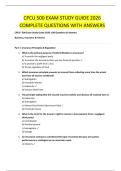
SERIES 7 TOP-OF-THE-WEEK (TOW)
EXAM 2026: COMPLETE PRACTICE
QUESTIONS & ANSWERS
EQUITY SECURITIES (Questions 1-20)
1. A company's Board of Directors has just declared a quarterly cash dividend. What is the
first day an investor can purchase the stock and NOT be entitled to receive the declared
dividend?
A) Record Date
B) Declaration Date
C) Payment Date
D) Ex-Dividend Date ✓
2. Which of the following securities represents ownership in a corporation?
A) Convertible Debenture
B) Callable Preferred Stock
C) American Depositary Receipt (ADR)
D) Both B and C ✓
3. An investor who purchases a growth stock is most likely expecting returns primarily from:
A) High dividend yields.
B) Capital appreciation. ✓
C) Fixed interest payments.
D) Priority in liquidation.
4. A customer buys 100 shares of XYZ at $60 and sells 1 XYZ Jan 60 Call at $3. This strategy is
known as a:
A) Naked Call
B) Covered Call ✓
C) Protective Put
D) Long Straddle
5. The document provided to shareholders describing matters to be voted on at the annual
meeting is the:
A) 10-K Report
B) Red Herring
,C) Proxy Statement ✓
D) Prospectus
6. What is the primary risk associated with investing in American Depositary Receipts (ADRs)?
A) Interest Rate Risk
B) Call Risk
C) Currency (Exchange) Risk ✓
D) Reinvestment Risk
7. A customer wants an equity investment that provides regular income. A registered
representative would most likely recommend:
A) Common stock of a biotechnology startup.
B) Preferred stock of a utility company. ✓
C) Growth-oriented mutual funds.
D) Call options on blue-chip stocks.
8. Which order guarantees execution but does not guarantee price?
A) Market Order ✓
B) Limit Order
C) Stop Order
D) Stop Limit Order
9. A "stop order" to sell becomes a ________ order when the stop price is reached.
A) Limit
B) Market ✓
C) Good 'Til Cancelled
D) Fill-or-Kill
10. The "bid" price in a stock quote is:
A) The price at which a dealer is willing to sell.
B) The price at which a dealer is willing to buy. ✓
C) The difference between the dealer's buy and sell price.
D) The previous day's closing price.
11. Which of the following is a feature of common stock but NOT of preferred stock?
A) Fixed Dividend Rate
B) Voting Rights ✓
C) Priority over common stock in bankruptcy
D) Par Value
,12. A company conducting a 1-for-5 reverse stock split will reduce the number of shares
outstanding and:
A) Decrease the total market capitalization.
B) Increase the total shareholder equity.
C) Increase the market price per share. ✓
D) Decrease the par value per share.
13. The order book display (Level 2) on NASDAQ shows:
A) Only the inside bid and ask.
B) Market maker bids and asks at various prices. ✓
C) All pending customer limit orders.
D) The tape of executed transactions.
14. The maximum loss for the buyer of a call option is:
A) Unlimited
B) The strike price minus the premium
C) The premium paid ✓
D) The strike price plus the premium
15. Which index is a price-weighted average of 30 large industrial stocks?
A) S&P 500 Index
B) Dow Jones Industrial Average ✓
C) NASDAQ Composite Index
D) Russell 2000 Index
16. An investor who sells stock short is anticipating:
A) A rise in the stock's price.
B) A decline in the stock's price. ✓
C) Stable prices to collect dividends.
D) A corporate merger.
17. The process of moving a company's stock listing from the NYSE to NASDAQ is called:
A) An IPO
B) A Transfer of Listing ✓
C) A Private Placement
D) A Tender Offer
18. For margin purposes, the Federal Reserve Board's Regulation T initial requirement for long
stock positions is:
A) 25%
, B) 50% ✓
C) 75%
D) 100%
19. A customer in the 35% tax bracket is concerned about dividend income. Which security's
dividends may qualify for a lower tax rate?
A) Common Stock of a U.S. Corporation ✓
B) Preferred Stock of a U.S. Corporation
C) Corporate Bonds
D) Money Market Funds
20. A "restricted stock" grant to a corporate executive typically has a selling restriction
governed by:
A) FINRA Rule 2210
B) SEC Rule 144 ✓
C) MSRB Rule G-37
D) SEC Regulation FD
DEBT SECURITIES (Questions 21-35)
21. A bond with a 5% coupon is purchased at a discount. The current yield will be:
A) Equal to the nominal yield.
B) Less than the nominal yield.
C) Greater than the nominal yield. ✓
D) Unrelated to the nominal yield.
22. Which type of bond is backed by the full faith and credit of the U.S. government?
A) Federal National Mortgage Association (Fannie Mae)
B) Federal Home Loan Mortgage Corporation (Freddie Mac)
C) Treasury Bond ✓
D) Government National Mortgage Association (Ginnie Mae)
23. The risk that an issuer will be unable to make interest and principal payments is called:
A) Interest Rate Risk
B) Credit Risk ✓
C) Purchasing Power Risk
D) Liquidity Risk
EXAM 2026: COMPLETE PRACTICE
QUESTIONS & ANSWERS
EQUITY SECURITIES (Questions 1-20)
1. A company's Board of Directors has just declared a quarterly cash dividend. What is the
first day an investor can purchase the stock and NOT be entitled to receive the declared
dividend?
A) Record Date
B) Declaration Date
C) Payment Date
D) Ex-Dividend Date ✓
2. Which of the following securities represents ownership in a corporation?
A) Convertible Debenture
B) Callable Preferred Stock
C) American Depositary Receipt (ADR)
D) Both B and C ✓
3. An investor who purchases a growth stock is most likely expecting returns primarily from:
A) High dividend yields.
B) Capital appreciation. ✓
C) Fixed interest payments.
D) Priority in liquidation.
4. A customer buys 100 shares of XYZ at $60 and sells 1 XYZ Jan 60 Call at $3. This strategy is
known as a:
A) Naked Call
B) Covered Call ✓
C) Protective Put
D) Long Straddle
5. The document provided to shareholders describing matters to be voted on at the annual
meeting is the:
A) 10-K Report
B) Red Herring
,C) Proxy Statement ✓
D) Prospectus
6. What is the primary risk associated with investing in American Depositary Receipts (ADRs)?
A) Interest Rate Risk
B) Call Risk
C) Currency (Exchange) Risk ✓
D) Reinvestment Risk
7. A customer wants an equity investment that provides regular income. A registered
representative would most likely recommend:
A) Common stock of a biotechnology startup.
B) Preferred stock of a utility company. ✓
C) Growth-oriented mutual funds.
D) Call options on blue-chip stocks.
8. Which order guarantees execution but does not guarantee price?
A) Market Order ✓
B) Limit Order
C) Stop Order
D) Stop Limit Order
9. A "stop order" to sell becomes a ________ order when the stop price is reached.
A) Limit
B) Market ✓
C) Good 'Til Cancelled
D) Fill-or-Kill
10. The "bid" price in a stock quote is:
A) The price at which a dealer is willing to sell.
B) The price at which a dealer is willing to buy. ✓
C) The difference between the dealer's buy and sell price.
D) The previous day's closing price.
11. Which of the following is a feature of common stock but NOT of preferred stock?
A) Fixed Dividend Rate
B) Voting Rights ✓
C) Priority over common stock in bankruptcy
D) Par Value
,12. A company conducting a 1-for-5 reverse stock split will reduce the number of shares
outstanding and:
A) Decrease the total market capitalization.
B) Increase the total shareholder equity.
C) Increase the market price per share. ✓
D) Decrease the par value per share.
13. The order book display (Level 2) on NASDAQ shows:
A) Only the inside bid and ask.
B) Market maker bids and asks at various prices. ✓
C) All pending customer limit orders.
D) The tape of executed transactions.
14. The maximum loss for the buyer of a call option is:
A) Unlimited
B) The strike price minus the premium
C) The premium paid ✓
D) The strike price plus the premium
15. Which index is a price-weighted average of 30 large industrial stocks?
A) S&P 500 Index
B) Dow Jones Industrial Average ✓
C) NASDAQ Composite Index
D) Russell 2000 Index
16. An investor who sells stock short is anticipating:
A) A rise in the stock's price.
B) A decline in the stock's price. ✓
C) Stable prices to collect dividends.
D) A corporate merger.
17. The process of moving a company's stock listing from the NYSE to NASDAQ is called:
A) An IPO
B) A Transfer of Listing ✓
C) A Private Placement
D) A Tender Offer
18. For margin purposes, the Federal Reserve Board's Regulation T initial requirement for long
stock positions is:
A) 25%
, B) 50% ✓
C) 75%
D) 100%
19. A customer in the 35% tax bracket is concerned about dividend income. Which security's
dividends may qualify for a lower tax rate?
A) Common Stock of a U.S. Corporation ✓
B) Preferred Stock of a U.S. Corporation
C) Corporate Bonds
D) Money Market Funds
20. A "restricted stock" grant to a corporate executive typically has a selling restriction
governed by:
A) FINRA Rule 2210
B) SEC Rule 144 ✓
C) MSRB Rule G-37
D) SEC Regulation FD
DEBT SECURITIES (Questions 21-35)
21. A bond with a 5% coupon is purchased at a discount. The current yield will be:
A) Equal to the nominal yield.
B) Less than the nominal yield.
C) Greater than the nominal yield. ✓
D) Unrelated to the nominal yield.
22. Which type of bond is backed by the full faith and credit of the U.S. government?
A) Federal National Mortgage Association (Fannie Mae)
B) Federal Home Loan Mortgage Corporation (Freddie Mac)
C) Treasury Bond ✓
D) Government National Mortgage Association (Ginnie Mae)
23. The risk that an issuer will be unable to make interest and principal payments is called:
A) Interest Rate Risk
B) Credit Risk ✓
C) Purchasing Power Risk
D) Liquidity Risk