
SUPPORTING SYSTEMS
THE SKELETON:
- Animals and plants are held in shape or supported in some way
- In animals, support systems usually take the form of a skeleton
- Skeleton Functions: Supports, protects and enables movement
TYPES OF SKELETONS:
- Hydrostatic Skeletons:
Consist of fluid-filled, closed chambers within an organism
- Exoskeletons:
Surround the body of an organism
- Endoskeletons:
Occur within the body of an organism
HYDROSTATIC SKELETON
Description Consist of fluid-filled, closed chamber/s inside the body.
Functions Provide support against which muscles can contract to
bring about movement.
Help to cushion internal parts from shock.
Types of Occur in soft-bodied invertebrates:
animals coelenterates(jellyfish, anemones),
annelids(earthworms), nematodes(roundworms)
How do these animals move:
- Contracting muscles surrounding the fluid-filled cavity creates
pressure that causes a change in shape of the animal.
- This causes movement such as burrowing, crawling or swimming.
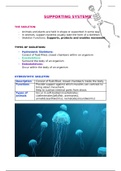
Jellyfish:
- Move by contracting their bell-shaped form, forcing water out which
propels the jellyfish forward.
- This type of skeleton is well suited for aquatic animals.
Earthworms:
- Change their body shape as they move forward by peristalsis.
- Circular and longitudinal muscles produce movement through waves of
contraction and relaxation.
- When lengthwise muscles contract, segments of the body shorten.
- When circular muscles contract, segments of the body elongate.
- Chaetae(bristles) press into the ground to ensure movement forward.
Disadvantages of the Hydrostatic skeleton:
, - Lack well developed skeletal defence mechanisms
- Have a restricted range of movement
- Confined to areas near or in water as they lose water so readily
- Cannot reach any great size, whether they live on land or in
water
EXOSKELETON
Description Surround the body of an organism.
Functions Support and protect internal organs.
Types of Tortoises, corals, star fish, molluscs with shells and
animals diatoms, arthropods: Made from polysaccharide, chitin:
substance similar to cellulose found in the cell walls of
plants. Light and strong compound.
Advantages of the Arthropod Exoskeleton:
- An external structure that supports the animal and protects its
internal organs from injury.
- Has muscles attached to knobs and plates so it allows for
movement.
- Has joints where the exoskeleton is thin and flexible, enabling the
animals to move more easily.
- Often covered with a layer of wax called a cuticle that reduces
loss of water from the body, preventing the animal from drying
out.
Disadvantages of the Exoskeleton:
- Because of their rigidity, mobility is limited
- Limited growth. Therefore a large animal would need a large
exoskeleton that would be very heavy and restrict movement.
How can disadvantages be overcome:
Growth Limitations Arthropods shed their
exoskeletons to enable them to
grow – moulting or ecdysis.
A new exoskeleton is
regenerated by the underlying
epidermis.
After the exoskeleton is shed, the
arthropod pumps up its body by
the intake of air or water to
expand the new exoskeleton to a
larger size.
Dehydration of the cuticle then
, takes place which causes it to
harden.
Animals become easy prey to
predators when they are moulting.
Many molluscs have calcareous
shells and as they grow, the
diameter of the shell is added
to and enlarged without altering
its shape.
Movement Limitations can be Arthropod exoskeleton is divided
overcome by allowing into different functional units:
flexibility head, thorax and abdomen of
insects
Arthropods have jointed limbs
where the exoskeleton is thin at
joints, enabling leg movement.
ENDOSKELETON
Description Found within the body of an animal. Made up of either
bone and/or cartilage: softer and lighter than bone.
Functions Support and protect internal organs. Enable movement.
Types of All vertebrates possess an endoskeleton. Some also
animals have an exoskeleton: turtles, terrapins and tortoises.
Advantages of the Endoskeleton:
- Supports the body, giving its shape.
- Made up of living tissue that can grow as the animal increases
in size.
- Protects the internal organs such as the brain, lungs and heart.
- Provides anchors for muscles which work with bones to allow
movement.
ENDOSKELETON TISSUES:
1. Cartilage
2. Bone
Cartilage:
- Occurs in isolated areas in the body such as in part of the ribs, the
nose, pinna of the ear, between vertebrae and in the lining of joints.
- Cartilage is much softer than bone because it contains less
minerals.
- It has few blood vessels and no nerves.
THE SKELETON:
- Animals and plants are held in shape or supported in some way
- In animals, support systems usually take the form of a skeleton
- Skeleton Functions: Supports, protects and enables movement
TYPES OF SKELETONS:
- Hydrostatic Skeletons:
Consist of fluid-filled, closed chambers within an organism
- Exoskeletons:
Surround the body of an organism
- Endoskeletons:
Occur within the body of an organism
HYDROSTATIC SKELETON
Description Consist of fluid-filled, closed chamber/s inside the body.
Functions Provide support against which muscles can contract to
bring about movement.
Help to cushion internal parts from shock.
Types of Occur in soft-bodied invertebrates:
animals coelenterates(jellyfish, anemones),
annelids(earthworms), nematodes(roundworms)
How do these animals move:
- Contracting muscles surrounding the fluid-filled cavity creates
pressure that causes a change in shape of the animal.
- This causes movement such as burrowing, crawling or swimming.
Jellyfish:
- Move by contracting their bell-shaped form, forcing water out which
propels the jellyfish forward.
- This type of skeleton is well suited for aquatic animals.
Earthworms:
- Change their body shape as they move forward by peristalsis.
- Circular and longitudinal muscles produce movement through waves of
contraction and relaxation.
- When lengthwise muscles contract, segments of the body shorten.
- When circular muscles contract, segments of the body elongate.
- Chaetae(bristles) press into the ground to ensure movement forward.
Disadvantages of the Hydrostatic skeleton:
, - Lack well developed skeletal defence mechanisms
- Have a restricted range of movement
- Confined to areas near or in water as they lose water so readily
- Cannot reach any great size, whether they live on land or in
water
EXOSKELETON
Description Surround the body of an organism.
Functions Support and protect internal organs.
Types of Tortoises, corals, star fish, molluscs with shells and
animals diatoms, arthropods: Made from polysaccharide, chitin:
substance similar to cellulose found in the cell walls of
plants. Light and strong compound.
Advantages of the Arthropod Exoskeleton:
- An external structure that supports the animal and protects its
internal organs from injury.
- Has muscles attached to knobs and plates so it allows for
movement.
- Has joints where the exoskeleton is thin and flexible, enabling the
animals to move more easily.
- Often covered with a layer of wax called a cuticle that reduces
loss of water from the body, preventing the animal from drying
out.
Disadvantages of the Exoskeleton:
- Because of their rigidity, mobility is limited
- Limited growth. Therefore a large animal would need a large
exoskeleton that would be very heavy and restrict movement.
How can disadvantages be overcome:
Growth Limitations Arthropods shed their
exoskeletons to enable them to
grow – moulting or ecdysis.
A new exoskeleton is
regenerated by the underlying
epidermis.
After the exoskeleton is shed, the
arthropod pumps up its body by
the intake of air or water to
expand the new exoskeleton to a
larger size.
Dehydration of the cuticle then
, takes place which causes it to
harden.
Animals become easy prey to
predators when they are moulting.
Many molluscs have calcareous
shells and as they grow, the
diameter of the shell is added
to and enlarged without altering
its shape.
Movement Limitations can be Arthropod exoskeleton is divided
overcome by allowing into different functional units:
flexibility head, thorax and abdomen of
insects
Arthropods have jointed limbs
where the exoskeleton is thin at
joints, enabling leg movement.
ENDOSKELETON
Description Found within the body of an animal. Made up of either
bone and/or cartilage: softer and lighter than bone.
Functions Support and protect internal organs. Enable movement.
Types of All vertebrates possess an endoskeleton. Some also
animals have an exoskeleton: turtles, terrapins and tortoises.
Advantages of the Endoskeleton:
- Supports the body, giving its shape.
- Made up of living tissue that can grow as the animal increases
in size.
- Protects the internal organs such as the brain, lungs and heart.
- Provides anchors for muscles which work with bones to allow
movement.
ENDOSKELETON TISSUES:
1. Cartilage
2. Bone
Cartilage:
- Occurs in isolated areas in the body such as in part of the ribs, the
nose, pinna of the ear, between vertebrae and in the lining of joints.
- Cartilage is much softer than bone because it contains less
minerals.
- It has few blood vessels and no nerves.



