
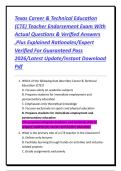
Texas Career & Technical Education
(CTE) Teacher Endorsement Exam With
Actual Questions & Verified Answers
,Plus Explained Rationales/Expert
Verified For Guaranteed Pass
2026/Latest Update/Instant Download
Pdf
1. Which of the following best describes Career & Technical
Education (CTE)?
A. Focuses solely on academic subjects
B. Prepares students for immediate employment and
postsecondary education
C. Emphasizes only theoretical knowledge
D. Focuses exclusively on sports and physical education
B. Prepares students for immediate employment and
postsecondary education
CTE programs integrate academic and technical skills to
prepare students for careers and further education.
2. What is the primary role of a CTE teacher in the classroom?
A. Deliver only lectures
B. Facilitate learning through hands-on activities and industry-
related projects
C. Grade assignments exclusively
, D. Avoid interaction with industry partners
B. Facilitate learning through hands-on activities and industry-
related projects
CTE teachers combine academic instruction with practical,
career-focused experiences.
3. Which federal act provides funding for CTE programs in Texas?
A. No Child Left Behind Act
B. Perkins V
C. Every Student Succeeds Act
D. IDEA
B. Perkins V
The Perkins V Act provides federal funding for career and
technical education programs.
4. What is the purpose of work-based learning in CTE?
A. To replace classroom instruction
B. To provide students with real-world experience in their
career field
C. To focus only on standardized testing
D. To reduce teaching workload
B. To provide students with real-world experience in their
career field
Work-based learning connects classroom learning to real
workplace skills and experiences.
5. Which of the following is an example of an industry-recognized
credential?
A. High school diploma
B. OSHA certification
C. School attendance certificate
D. Class participation award
, B. OSHA certification
Industry-recognized credentials validate students’ skills for
employers.
6. When designing a CTE lesson plan, which factor is most
important?
A. Aligning activities with state standards and industry
requirements
B. Using only textbooks
C. Ignoring student interests
D. Avoiding technology integration
A. Aligning activities with state standards and industry
requirements
Effective CTE instruction aligns with TEKS and industry
expectations.
7. Which of the following is an essential component of a CTE
program?
A. Athletic competition
B. Academic integration with technical skills
C. Purely theoretical coursework
D. Student discipline only
B. Academic integration with technical skills
CTE programs blend academics and technical skills to prepare
students for careers.
8. Which Texas Education Agency (TEA) document outlines CTE
program standards?
A. Texas Essential Knowledge and Skills (TEKS)
B. Texas Teacher Evaluation and Support System
C. Texas Graduation Plan
D. STAAR Test Blueprint
, A. Texas Essential Knowledge and Skills (TEKS)
TEKS provide specific learning outcomes and objectives for CTE
courses.
9. How can CTE teachers incorporate technology effectively?
A. Only using it for attendance
B. Integrating industry-standard software and tools for skill
development
C. Avoiding any computer-based tools
D. Using outdated equipment only
B. Integrating industry-standard software and tools for skill
development
Technology use in CTE supports hands-on learning and
industry relevance.
10. What is a key benefit of dual credit programs in CTE?
A. Students can skip high school
B. Students earn both high school and college credit
simultaneously
C. Students are exempt from state testing
D. Students focus solely on theory
B. Students earn both high school and college credit
simultaneously
Dual credit programs give students a head start on
postsecondary education while completing high school
requirements.
11. Which of the following best describes experiential
learning?
A. Learning through passive listening
B. Learning through direct experience and reflection
C. Memorizing facts for exams
(CTE) Teacher Endorsement Exam With
Actual Questions & Verified Answers
,Plus Explained Rationales/Expert
Verified For Guaranteed Pass
2026/Latest Update/Instant Download
1. Which of the following best describes Career & Technical
Education (CTE)?
A. Focuses solely on academic subjects
B. Prepares students for immediate employment and
postsecondary education
C. Emphasizes only theoretical knowledge
D. Focuses exclusively on sports and physical education
B. Prepares students for immediate employment and
postsecondary education
CTE programs integrate academic and technical skills to
prepare students for careers and further education.
2. What is the primary role of a CTE teacher in the classroom?
A. Deliver only lectures
B. Facilitate learning through hands-on activities and industry-
related projects
C. Grade assignments exclusively
, D. Avoid interaction with industry partners
B. Facilitate learning through hands-on activities and industry-
related projects
CTE teachers combine academic instruction with practical,
career-focused experiences.
3. Which federal act provides funding for CTE programs in Texas?
A. No Child Left Behind Act
B. Perkins V
C. Every Student Succeeds Act
D. IDEA
B. Perkins V
The Perkins V Act provides federal funding for career and
technical education programs.
4. What is the purpose of work-based learning in CTE?
A. To replace classroom instruction
B. To provide students with real-world experience in their
career field
C. To focus only on standardized testing
D. To reduce teaching workload
B. To provide students with real-world experience in their
career field
Work-based learning connects classroom learning to real
workplace skills and experiences.
5. Which of the following is an example of an industry-recognized
credential?
A. High school diploma
B. OSHA certification
C. School attendance certificate
D. Class participation award
, B. OSHA certification
Industry-recognized credentials validate students’ skills for
employers.
6. When designing a CTE lesson plan, which factor is most
important?
A. Aligning activities with state standards and industry
requirements
B. Using only textbooks
C. Ignoring student interests
D. Avoiding technology integration
A. Aligning activities with state standards and industry
requirements
Effective CTE instruction aligns with TEKS and industry
expectations.
7. Which of the following is an essential component of a CTE
program?
A. Athletic competition
B. Academic integration with technical skills
C. Purely theoretical coursework
D. Student discipline only
B. Academic integration with technical skills
CTE programs blend academics and technical skills to prepare
students for careers.
8. Which Texas Education Agency (TEA) document outlines CTE
program standards?
A. Texas Essential Knowledge and Skills (TEKS)
B. Texas Teacher Evaluation and Support System
C. Texas Graduation Plan
D. STAAR Test Blueprint
, A. Texas Essential Knowledge and Skills (TEKS)
TEKS provide specific learning outcomes and objectives for CTE
courses.
9. How can CTE teachers incorporate technology effectively?
A. Only using it for attendance
B. Integrating industry-standard software and tools for skill
development
C. Avoiding any computer-based tools
D. Using outdated equipment only
B. Integrating industry-standard software and tools for skill
development
Technology use in CTE supports hands-on learning and
industry relevance.
10. What is a key benefit of dual credit programs in CTE?
A. Students can skip high school
B. Students earn both high school and college credit
simultaneously
C. Students are exempt from state testing
D. Students focus solely on theory
B. Students earn both high school and college credit
simultaneously
Dual credit programs give students a head start on
postsecondary education while completing high school
requirements.
11. Which of the following best describes experiential
learning?
A. Learning through passive listening
B. Learning through direct experience and reflection
C. Memorizing facts for exams


