ATP-510 Midterm
Study
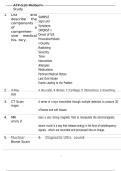
1. List and
SAMPLE
describe the
Signs and
components
Symptoms
of a
comprehen- OPQRST-I
sive medical Onset of S/S
his- tory. Provocation/Palliatio
n Quality
Radiating
Severity
Time
Interventions
Allergies
Medications
Pertinent Medical History
Last Oral Intake
Events Leading to the Problem
2. X-Ray A (Accurate), B (Bones), C (Cartilage), D (Dislocations), E (Everything
else)
3. CT Scan A series of x-rays transmitted through multiple detectors to produce 3D
images
of bones and soft tissues
4. MRI Uses a very strong magnetic field to manipulate the electromagnetic
activity of
atomic nuclei in a way that releases energy in the form of radiofrequency
signals, which are recorded and processed into an image.
5. Nuclear 6. Diagnostic Ultra- sound
Bone Scan
1/
35
, ATP-510 Midterm
Study
Bone scintigraphy uses a assess the severity of a variety of bone diseases and conditions
small amount of radioactive
tracers to diagnose and Used to identify soft tissue defects
7. Blood Pressure <120/<80
2/
35
, ATP-510 Midterm
Study
8. Pulse 60-72 bpm (athletes), 60-100 bpm
9. Respiratory Rate 12-20 RR
10. Temperature 96.4-99.1 (98.6)
11. Explain the Cultural competence refers to behaviors, language, customs, arts, morals,
im- portance knowl- edge, and beliefs of a particular group of people, and
of cul- tural
respecting their cultures.
compe- tence
in health-
care.
12. Stadiometer A stadiometer is used to measure a patient's height
13. Sphygmo- This is used to measure blood pressure
manomet
er
14. Stethoscope This is used to listen to internal body sounds
15. Otoscope This is used to examine the ear canal and eardrum
16. Opthalmoscope This is used to inspect the interior structures of the eye
17. Pulse Oximeter Measures the oxygen saturation and pulse rate
18. Snellen chart This measures visual acuity
19. Reflex hammer Used to test deep tendon reflexes
20. Kussma 21. Cheyne Stokes breathing
ul
breathing
3/
35
, ATP-510 Midterm
Study
Deep, labored, and rapid
breathing, mostly
associated with metabolic
acidosis
This is a gradual increase
and decrease in
respirations followed by
periods of apnea, mostly
seen in heart failure,
stroke, brain injury, and
end-of-life stages
4/
35
Study
1. List and
SAMPLE
describe the
Signs and
components
Symptoms
of a
comprehen- OPQRST-I
sive medical Onset of S/S
his- tory. Provocation/Palliatio
n Quality
Radiating
Severity
Time
Interventions
Allergies
Medications
Pertinent Medical History
Last Oral Intake
Events Leading to the Problem
2. X-Ray A (Accurate), B (Bones), C (Cartilage), D (Dislocations), E (Everything
else)
3. CT Scan A series of x-rays transmitted through multiple detectors to produce 3D
images
of bones and soft tissues
4. MRI Uses a very strong magnetic field to manipulate the electromagnetic
activity of
atomic nuclei in a way that releases energy in the form of radiofrequency
signals, which are recorded and processed into an image.
5. Nuclear 6. Diagnostic Ultra- sound
Bone Scan
1/
35
, ATP-510 Midterm
Study
Bone scintigraphy uses a assess the severity of a variety of bone diseases and conditions
small amount of radioactive
tracers to diagnose and Used to identify soft tissue defects
7. Blood Pressure <120/<80
2/
35
, ATP-510 Midterm
Study
8. Pulse 60-72 bpm (athletes), 60-100 bpm
9. Respiratory Rate 12-20 RR
10. Temperature 96.4-99.1 (98.6)
11. Explain the Cultural competence refers to behaviors, language, customs, arts, morals,
im- portance knowl- edge, and beliefs of a particular group of people, and
of cul- tural
respecting their cultures.
compe- tence
in health-
care.
12. Stadiometer A stadiometer is used to measure a patient's height
13. Sphygmo- This is used to measure blood pressure
manomet
er
14. Stethoscope This is used to listen to internal body sounds
15. Otoscope This is used to examine the ear canal and eardrum
16. Opthalmoscope This is used to inspect the interior structures of the eye
17. Pulse Oximeter Measures the oxygen saturation and pulse rate
18. Snellen chart This measures visual acuity
19. Reflex hammer Used to test deep tendon reflexes
20. Kussma 21. Cheyne Stokes breathing
ul
breathing
3/
35
, ATP-510 Midterm
Study
Deep, labored, and rapid
breathing, mostly
associated with metabolic
acidosis
This is a gradual increase
and decrease in
respirations followed by
periods of apnea, mostly
seen in heart failure,
stroke, brain injury, and
end-of-life stages
4/
35