
Drawing on the Resource Based View literature, evaluate whether and how
Ningbo Bird Co. Ltd. generates sustainable competitive advantage.
The primary function of this document is to accept or reject the notion that resource-based view
(Barney, 1991) has a correlation with firm’s (Ningbo Bird Ltd) performance in achieving a sustainable
competitive advantage. Concluded by assessing the theoretical competence of RBV theory whilst
presenting complimentary approaches to sustain competitive advantage.
The Resource-Based View (later referred to as RBV theory) takes an ‘inside-out’ view and draws
upon the resources and capabilities within the firm to develop sustainable competitive advantage
(Madhani, 2010). To fathom the RBV theory; resources must be distinguished from capabilities
amongst the pool of riddling and tautologous terminology. RBV theory accepts that resources and
capabilities act as the primary elements for achieving superior competitive advantage.
A capability is the aptitude to complete an activity that involves intricate patterns of organisation and
cooperation between people and other resources (McGee, Thomas and Wilson, 2005). Yet, resources
consist of all assets, capabilities, organisational processes, firm attributes, information and
knowledge. These are utilised by a firm to enable implementation of strategies that improve its
efficiency and effectiveness (Daft, 1983). Barney’s (1991) theory offers that competitive advantage is
a biproduct of the assembly of heterogeneous and immobile resources. Madhani (2010) later
reinforces this conjecturing ‘competitive advantage occurs only when there is a situation of resource
heterogeneity and resource immobility.’ The assembly of said heterogenic and immobile resources
have been propagated as the core competencies of a firm.
Barney (1991) proposed that SCA cannot be created simply by evaluating environmental
opportunities and threats, and then conducting business only in high-opportunity, low-threat
environments. RBV in fact perceives the value derived from management skills, information
capabilities, and administrative processes as scarce factors that are able to generate economic rents
(Sheehan and Foss, 2007).
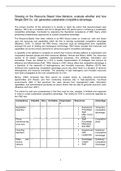
The criteria for said core competencies is that they must be rare, valuable, in-imitable and organised
in order to create sustainable competitive advantage. This criteria for SCA is commonly regarded as
the VRIO test.
Competency Valuable Rare Inimitable Organisatio Resources Advantage
n
Negotiation ✔ ✖ ✔ ✔ Experience Temporary
Expertise Knowledge competitive
Staff advantage
M&A Know-
how
Phone ✔ ✖ ✖ ✔ Staff Competitive
manufacturing Knowledge parity
know-how Machinery
Bird M&A
Founding ✔ ✔ ✔ ✔ Experienced Sustained
Members staff Competitive
Leadership Advantage
Sales and ✔ ✔ ✔ ✔ Knowledge Sustained
service Capital Competitive
network Staff Advantage
1
Ningbo Bird Co. Ltd. generates sustainable competitive advantage.
The primary function of this document is to accept or reject the notion that resource-based view
(Barney, 1991) has a correlation with firm’s (Ningbo Bird Ltd) performance in achieving a sustainable
competitive advantage. Concluded by assessing the theoretical competence of RBV theory whilst
presenting complimentary approaches to sustain competitive advantage.
The Resource-Based View (later referred to as RBV theory) takes an ‘inside-out’ view and draws
upon the resources and capabilities within the firm to develop sustainable competitive advantage
(Madhani, 2010). To fathom the RBV theory; resources must be distinguished from capabilities
amongst the pool of riddling and tautologous terminology. RBV theory accepts that resources and
capabilities act as the primary elements for achieving superior competitive advantage.
A capability is the aptitude to complete an activity that involves intricate patterns of organisation and
cooperation between people and other resources (McGee, Thomas and Wilson, 2005). Yet, resources
consist of all assets, capabilities, organisational processes, firm attributes, information and
knowledge. These are utilised by a firm to enable implementation of strategies that improve its
efficiency and effectiveness (Daft, 1983). Barney’s (1991) theory offers that competitive advantage is
a biproduct of the assembly of heterogeneous and immobile resources. Madhani (2010) later
reinforces this conjecturing ‘competitive advantage occurs only when there is a situation of resource
heterogeneity and resource immobility.’ The assembly of said heterogenic and immobile resources
have been propagated as the core competencies of a firm.
Barney (1991) proposed that SCA cannot be created simply by evaluating environmental
opportunities and threats, and then conducting business only in high-opportunity, low-threat
environments. RBV in fact perceives the value derived from management skills, information
capabilities, and administrative processes as scarce factors that are able to generate economic rents
(Sheehan and Foss, 2007).
The criteria for said core competencies is that they must be rare, valuable, in-imitable and organised
in order to create sustainable competitive advantage. This criteria for SCA is commonly regarded as
the VRIO test.
Competency Valuable Rare Inimitable Organisatio Resources Advantage
n
Negotiation ✔ ✖ ✔ ✔ Experience Temporary
Expertise Knowledge competitive
Staff advantage
M&A Know-
how
Phone ✔ ✖ ✖ ✔ Staff Competitive
manufacturing Knowledge parity
know-how Machinery
Bird M&A
Founding ✔ ✔ ✔ ✔ Experienced Sustained
Members staff Competitive
Leadership Advantage
Sales and ✔ ✔ ✔ ✔ Knowledge Sustained
service Capital Competitive
network Staff Advantage
1


