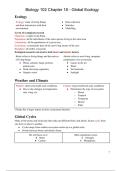
Biology 102 Chapter 18 - Global Ecology
Ecology
Ecology: study of living things ● Data collection
and their interactions with their ● Statistics
environment. ● Modelling
Levels of ecological research
Organism: a single living thing.
Population: all the individuals of the same species living in the same area
Community: all the populations of a given area
Ecosystem: a community plus all the non living factors of the area
Biosphere: all earth's ecosystem
Ecological research can involve both biotic and abiotic factors
Biotic refers to living things and derivatives Abiotic refers to non-living, inorganic
of living things: components of an ecosystem:
● Plants, animals, fungi, protists, ● Gasses in the air
prokaryotes ● Water
● Dead, decaying organisms ● Soil minerals
● Organic waste ● Sunlight
Weather and Climate
Weather: short term/small scale conditions Climate: long term/broad scale conditions
● Day to day changes in temperature, ● Determines the type of ecosystem
rain, wing, etc. ○ Desert
○ Tropical
○ Temperate
○ Boreal
○ Polar
Climate has a larger impact on how ecosystems function.
Global Cycles
Many of the atoms and molecules that make up different biotic and abiotic factors cycle from
one form or place to another.
● Cycles range from smaller ecosystem scales up to a global scale.
● Switch between biotic and abiotic forms.
We will focus on 2: Other significant cycles:
● Water ● Nitrogen
● Carbon ● Phosphorus
1
, Biology 102 Chapter 18 - Global Ecology
Hydrologic (water) cycle
Transpiration: water absorbed by plant roots is transported up the plant via the xylem and
evaporates into the air through pores in the leaves.
Also, glaciers and icecaps.
Climate change
What is changing? The main culprit is fossil fuels
● Mainly temperature
That leads to other changes Fossil fuels
● Changes in rainfall patterns
Literal fossils
○ Flood
The remains of living organisms (mostly
○ Drought
plants) from millions of years of earth's
● Melting ice
history
○ Increased sea level
What are living things safe from?
● Changes in plant/animal behavior
Carbon
● Increases wildfire frequency
When burned, carbon reacts with oxygen in
Why is the temperature increasing?
the air to produce CO2.
Many things can contribute to this
● Many are natural
Carbon Cycle
Photosynthesis is the process by which plants and "Greenhouse gas"
algae use energy from sunlight to convert water and ● Carbon dioxide
CO₂ into sugars and O2. ● Water vapor
Respiration is the process by which organisms take ● Methane
up O₂ and release CO₂ during energy metabolism. ● Nitrous oxide
Carbon Sinks and Sources
Sinks Sources
Oceans Volcanoes
Forests Forest fires
Grasslands Tilling for crops
Soil Deforestation
Energy use
Transport
All natural Natural and human-created
2
Ecology
Ecology: study of living things ● Data collection
and their interactions with their ● Statistics
environment. ● Modelling
Levels of ecological research
Organism: a single living thing.
Population: all the individuals of the same species living in the same area
Community: all the populations of a given area
Ecosystem: a community plus all the non living factors of the area
Biosphere: all earth's ecosystem
Ecological research can involve both biotic and abiotic factors
Biotic refers to living things and derivatives Abiotic refers to non-living, inorganic
of living things: components of an ecosystem:
● Plants, animals, fungi, protists, ● Gasses in the air
prokaryotes ● Water
● Dead, decaying organisms ● Soil minerals
● Organic waste ● Sunlight
Weather and Climate
Weather: short term/small scale conditions Climate: long term/broad scale conditions
● Day to day changes in temperature, ● Determines the type of ecosystem
rain, wing, etc. ○ Desert
○ Tropical
○ Temperate
○ Boreal
○ Polar
Climate has a larger impact on how ecosystems function.
Global Cycles
Many of the atoms and molecules that make up different biotic and abiotic factors cycle from
one form or place to another.
● Cycles range from smaller ecosystem scales up to a global scale.
● Switch between biotic and abiotic forms.
We will focus on 2: Other significant cycles:
● Water ● Nitrogen
● Carbon ● Phosphorus
1
, Biology 102 Chapter 18 - Global Ecology
Hydrologic (water) cycle
Transpiration: water absorbed by plant roots is transported up the plant via the xylem and
evaporates into the air through pores in the leaves.
Also, glaciers and icecaps.
Climate change
What is changing? The main culprit is fossil fuels
● Mainly temperature
That leads to other changes Fossil fuels
● Changes in rainfall patterns
Literal fossils
○ Flood
The remains of living organisms (mostly
○ Drought
plants) from millions of years of earth's
● Melting ice
history
○ Increased sea level
What are living things safe from?
● Changes in plant/animal behavior
Carbon
● Increases wildfire frequency
When burned, carbon reacts with oxygen in
Why is the temperature increasing?
the air to produce CO2.
Many things can contribute to this
● Many are natural
Carbon Cycle
Photosynthesis is the process by which plants and "Greenhouse gas"
algae use energy from sunlight to convert water and ● Carbon dioxide
CO₂ into sugars and O2. ● Water vapor
Respiration is the process by which organisms take ● Methane
up O₂ and release CO₂ during energy metabolism. ● Nitrous oxide
Carbon Sinks and Sources
Sinks Sources
Oceans Volcanoes
Forests Forest fires
Grasslands Tilling for crops
Soil Deforestation
Energy use
Transport
All natural Natural and human-created
2