
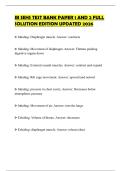
IB SEHS TEST BANK PAPER 1 AND 2 FULL
SOLUTION EDITION UPDATED 2026
⩥ Inhaling: Diaphragm muscle. Answer: contracts
⩥ Inhaling: Movement of diaphragm. Answer: Flattens pushing
digestive organs down
⩥ Inhaling: External coastal muscles. Answer: contract and expand
⩥ Inhaling: Rib cage movement. Answer: upward and outwrd
⩥ Inhaling: pressure in chest cavity. Answer: Decreases below
atmospheric pressure
⩥ Inhaling: Movement of air. Answer: into the lungs
⩥ Exhaling: Volume of thorax. Answer: decreases
⩥ Exhaling: diaphragm muscle. Answer: relaxes (dm)
,⩥ Exhaling: movement of diaphragm. Answer: relaxes and resumes to
dome shape
⩥ Exhaling: external intercostal muscles. Answer: relaxes (eim)
⩥ Exhaling: rib cage movement. Answer: inward and downward
⩥ Exhaling: Pressure in chest cavity. Answer: increases above
atmospheric pressure
⩥ Exhaling: movement of air. Answer: Air is forced out of the lungs
⩥ Pulmonary ventilation. Answer: Inflow and outflow of air between the
atmosphere and the lungs (also called breathing)
⩥ Pulmonary ventilation equation. Answer: Tidal volume x breathing
rate
⩥ Total Lung capacity (TLC). Answer: Total amount of air that the lungs
can hold, the volume of air in the lungs after inspiration
⩥ TLC Equation. Answer: TV + ERV + IRV + RV
, ⩥ Vital capacity (VC). Answer: Maximum volume of air that can be
exhaled after a maximum inhalation
⩥ VC equation. Answer: ERV + TV + IRV
⩥ Tidal volume (TV). Answer: volume breathed in and out in any one
breath
⩥ Expiratory Reserve Volume (ERV). Answer: volume of air in access
of tidal volume that can be exhaled forcibly
⩥ Inspiratory reserve volume (IRV). Answer: Additional inspired air
over and above tidal volume
⩥ Residual volume (RV). Answer: Volume of air still contained in the
lungs after an maximal exhalation
⩥ Minute ventilation. Answer: amount of air moved in or out of the
lungs per minute
⩥ Minute ventilation equation. Answer: TV x Breathing rate
SOLUTION EDITION UPDATED 2026
⩥ Inhaling: Diaphragm muscle. Answer: contracts
⩥ Inhaling: Movement of diaphragm. Answer: Flattens pushing
digestive organs down
⩥ Inhaling: External coastal muscles. Answer: contract and expand
⩥ Inhaling: Rib cage movement. Answer: upward and outwrd
⩥ Inhaling: pressure in chest cavity. Answer: Decreases below
atmospheric pressure
⩥ Inhaling: Movement of air. Answer: into the lungs
⩥ Exhaling: Volume of thorax. Answer: decreases
⩥ Exhaling: diaphragm muscle. Answer: relaxes (dm)
,⩥ Exhaling: movement of diaphragm. Answer: relaxes and resumes to
dome shape
⩥ Exhaling: external intercostal muscles. Answer: relaxes (eim)
⩥ Exhaling: rib cage movement. Answer: inward and downward
⩥ Exhaling: Pressure in chest cavity. Answer: increases above
atmospheric pressure
⩥ Exhaling: movement of air. Answer: Air is forced out of the lungs
⩥ Pulmonary ventilation. Answer: Inflow and outflow of air between the
atmosphere and the lungs (also called breathing)
⩥ Pulmonary ventilation equation. Answer: Tidal volume x breathing
rate
⩥ Total Lung capacity (TLC). Answer: Total amount of air that the lungs
can hold, the volume of air in the lungs after inspiration
⩥ TLC Equation. Answer: TV + ERV + IRV + RV
, ⩥ Vital capacity (VC). Answer: Maximum volume of air that can be
exhaled after a maximum inhalation
⩥ VC equation. Answer: ERV + TV + IRV
⩥ Tidal volume (TV). Answer: volume breathed in and out in any one
breath
⩥ Expiratory Reserve Volume (ERV). Answer: volume of air in access
of tidal volume that can be exhaled forcibly
⩥ Inspiratory reserve volume (IRV). Answer: Additional inspired air
over and above tidal volume
⩥ Residual volume (RV). Answer: Volume of air still contained in the
lungs after an maximal exhalation
⩥ Minute ventilation. Answer: amount of air moved in or out of the
lungs per minute
⩥ Minute ventilation equation. Answer: TV x Breathing rate


