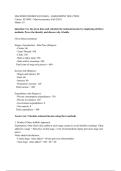
MACROECONOMICS (ECO403) - ASSIGNMENT SOLUTION
Course: ECO403 - Macroeconomics (Fall 2025)
Marks: 10
Question: Use the given data and calculate the national income by employing all three
methods. Prove the identity and discuss why it holds.
Given Data (summary)
Stages of production - Sale Price (Rupees):
- Cotton: 60
- Yarn (Thread): 100
- Cloth: 150
- Shirt at tailor shop: 250
- Shirt sold to consumer: 300
Total (sum of stage sale prices) = 860
Income side (Rupees):
- Wages and salaries: 80
- Rent: 60
- Interest: 40
- Proprietor's income: 120
Total income = 300
Expenditure side (Rupees):
- Private consumption expenditures: 150
- Private investment: 150
- Government expenditures: 0
- Net exports: 0
Total expenditure = 300
Answer (a): Calculate national income using three methods
1. Product (Value-Added) Approach
Explanation: Only final value added at each stage counts (to avoid double-counting). Value
added at a stage = Sale price at that stage - Cost of intermediate inputs (previous stage sale
price).
Value added calculations:
- Cotton stage: value added = 60 (no previous intermediate)
- Yarn stage: value added = 100 - 60 = 40
Course: ECO403 - Macroeconomics (Fall 2025)
Marks: 10
Question: Use the given data and calculate the national income by employing all three
methods. Prove the identity and discuss why it holds.
Given Data (summary)
Stages of production - Sale Price (Rupees):
- Cotton: 60
- Yarn (Thread): 100
- Cloth: 150
- Shirt at tailor shop: 250
- Shirt sold to consumer: 300
Total (sum of stage sale prices) = 860
Income side (Rupees):
- Wages and salaries: 80
- Rent: 60
- Interest: 40
- Proprietor's income: 120
Total income = 300
Expenditure side (Rupees):
- Private consumption expenditures: 150
- Private investment: 150
- Government expenditures: 0
- Net exports: 0
Total expenditure = 300
Answer (a): Calculate national income using three methods
1. Product (Value-Added) Approach
Explanation: Only final value added at each stage counts (to avoid double-counting). Value
added at a stage = Sale price at that stage - Cost of intermediate inputs (previous stage sale
price).
Value added calculations:
- Cotton stage: value added = 60 (no previous intermediate)
- Yarn stage: value added = 100 - 60 = 40