
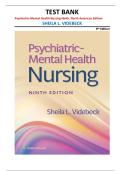
TEST BANK
Psychiatric-Mental Health Nursing Ninth, North American Edition
SHEILA L. VIDEBECK
9th Edition
, TEST BANK
Psychiatric Mental Health Nursing 9th Edition
Chapter 1
1. The nurse is assessing the factors contributing to the
well- being of a newly admitted client. Which of the
following would the nurse identify as having a positive
impact onthe individual's mental health?
A) Not needing others for companionship
B) The ability to effectively manage stress
C) A family history of mental illness
D) Striving for total self-reliance
Ans: B
Feedback:
Individual factors influencing mental health include
biologic makeup, autonomy, independence, self-esteem,
capacity for growth, vitality, ability to find meaning in life,
emotional resilience or hardiness, sense of belonging,
reality orientation, and coping or stress management
abilities. Interpersonal factors such as intimacy and a
balance of separateness and connectedness are both
needed
for good mental health, and therefore ahealthy person would need others for
companionship. A family history of mental illnesscould relate to the biologic makeup
of an individual, which may have a negative impacton an individual's mental health, as
well as a negative impact on an individual's interpersonal and socialñcultural factors of
health. Total self-reliance is not possible, and a positive social/cultural factor is
access to adequate resources.
2. Which of the following statements about mental illness are true? Select all that apply.
A) Mental illness can cause significant distress, impaired functioning, or both.
B) Mental illness is only due to social/cultural factors.
C) Social/cultural factors that relate to mental illness include excessive
dependency on or withdrawal from relationships.
D) Individuals suffering from mental illness are usually able to cope effectively with
daily life.
E) Individuals suffering from mental illness may experience dissatisfaction with
relationships and self.
Ans: A, D, E
Feedback:
Mental illness can cause significant distress, impaired functioning, or both. Mental
illness may be related to individual, interpersonal, or social/cultural factors. Excessive
dependency on or withdrawal from relationships are interpersonal factors that relate
to mental illness. Individuals suffering from mental illness can feel overwhelmed with
daily life. Individuals suffering from mental illness may experience dissatisfaction with
relationships and self.
3. Which of the following are true regarding mental health and mental illness?
, A) Behavior that may be viewed as acceptable in one culture is always unacceptable
in other cultures.
B) It is easy to determine if a person is mentally healthy or mentally ill.
C) In most cases, mental health is a state of emotional, psychological, and social
wellness evidenced by satisfying interpersonal relationships, effective
behavior and coping, positive self-concept, and emotional stability.
D) Persons who engage in fantasies are mentally
ill. Ans: C
Feedback:
What one society may view as acceptable and appropriate behavior, another society may
see that as maladaptive, and inappropriate. Mental health and mental illness are
difficult to define precisely. In most cases, mental health is a state of emotional,
psychological, and social wellness evidenced by satisfying interpersonal relationships,
effective behavior and coping, positive self-concept, and emotional stability. Persons
who engage in fantasies may be mentally healthy, but the inability to distinguish reality
from fantasy is an individual factor that may contribute to mental illness.
4. A client grieving the recent loss of her husband asks if she is becoming mentally
ill because she is so sad. The nurse's best response would be,
A) ìYou may have a temporary mental illness because you are experiencing so
much pain.î
B) ìYou are not mentally ill. This is an expected reaction to the loss you
have experienced.î
C) ìWere you generally dissatisfied with your relationship before your husband's
death?î
D) ìTry not to worry about that right now. You never know what the future brings.î
Ans: B
Feedback:
Mental illness includes general dissatisfaction with self, ineffective relationships,
ineffective coping, and lack of personal growth. Additionally the behavior must not be
culturally expected. Acute grief reactions are expected and therefore not considered
mental illness. False reassurance or overanalysis does not accurately address the
client's concerns.
2|Page
, 5. The nurse consults the DSM for which of the following purposes?
A) To devise a plan of care for a newly admitted client
B) To predict the client's prognosis of treatment outcomes
C) To document the appropriate diagnostic code in the client's medical record
D) To serve as a guide for client assessment
Ans: D
Feedback:
The DSM provides standard nomenclature, presents defining characteristics, and
identifies underlying causes of mental disorders. It does not provide care plans or
prognostic outcomes of treatment. Diagnosis of mental illness is not within the
generalist RN's scope of practice, so documenting the code in the medical record
would be inappropriate.
6. Which would be a reason for a student nurse to use the DSM?
A) Identifying the medical diagnosis
B) Treat clients
C) Evaluate treatments
D) Understand the reason for the admission and the nature of psychiatric illnesses.
Ans: D
Feedback:
Although student nurses do not use the DSM to diagnose clients, they will find it a
helpful resource to understand the reason for the admission and to begin building
knowledge about the nature of psychiatric illnesses. Identifying the medical diagnosis,
treating, and evaluating treatments are not a part of the nursing process.
7. The legislation enacted in 1963 was largely responsible for which of the following
shifts in care for the mentally ill?
A) The widespread use of community-based services
B) The advancement in pharmacotherapies
C) Increased access to hospitalization
D) Improved rights for clients in long-term institutional
care Ans: A
Feedback:
The Community Mental Health Centers Construction Act of 1963 accomplished the
release of individuals from long-term stays in state institutions, the decrease in
admissions to hospitals, and the development of community-based services as an
alternative to hospital care.
3|Page
Psychiatric-Mental Health Nursing Ninth, North American Edition
SHEILA L. VIDEBECK
9th Edition
, TEST BANK
Psychiatric Mental Health Nursing 9th Edition
Chapter 1
1. The nurse is assessing the factors contributing to the
well- being of a newly admitted client. Which of the
following would the nurse identify as having a positive
impact onthe individual's mental health?
A) Not needing others for companionship
B) The ability to effectively manage stress
C) A family history of mental illness
D) Striving for total self-reliance
Ans: B
Feedback:
Individual factors influencing mental health include
biologic makeup, autonomy, independence, self-esteem,
capacity for growth, vitality, ability to find meaning in life,
emotional resilience or hardiness, sense of belonging,
reality orientation, and coping or stress management
abilities. Interpersonal factors such as intimacy and a
balance of separateness and connectedness are both
needed
for good mental health, and therefore ahealthy person would need others for
companionship. A family history of mental illnesscould relate to the biologic makeup
of an individual, which may have a negative impacton an individual's mental health, as
well as a negative impact on an individual's interpersonal and socialñcultural factors of
health. Total self-reliance is not possible, and a positive social/cultural factor is
access to adequate resources.
2. Which of the following statements about mental illness are true? Select all that apply.
A) Mental illness can cause significant distress, impaired functioning, or both.
B) Mental illness is only due to social/cultural factors.
C) Social/cultural factors that relate to mental illness include excessive
dependency on or withdrawal from relationships.
D) Individuals suffering from mental illness are usually able to cope effectively with
daily life.
E) Individuals suffering from mental illness may experience dissatisfaction with
relationships and self.
Ans: A, D, E
Feedback:
Mental illness can cause significant distress, impaired functioning, or both. Mental
illness may be related to individual, interpersonal, or social/cultural factors. Excessive
dependency on or withdrawal from relationships are interpersonal factors that relate
to mental illness. Individuals suffering from mental illness can feel overwhelmed with
daily life. Individuals suffering from mental illness may experience dissatisfaction with
relationships and self.
3. Which of the following are true regarding mental health and mental illness?
, A) Behavior that may be viewed as acceptable in one culture is always unacceptable
in other cultures.
B) It is easy to determine if a person is mentally healthy or mentally ill.
C) In most cases, mental health is a state of emotional, psychological, and social
wellness evidenced by satisfying interpersonal relationships, effective
behavior and coping, positive self-concept, and emotional stability.
D) Persons who engage in fantasies are mentally
ill. Ans: C
Feedback:
What one society may view as acceptable and appropriate behavior, another society may
see that as maladaptive, and inappropriate. Mental health and mental illness are
difficult to define precisely. In most cases, mental health is a state of emotional,
psychological, and social wellness evidenced by satisfying interpersonal relationships,
effective behavior and coping, positive self-concept, and emotional stability. Persons
who engage in fantasies may be mentally healthy, but the inability to distinguish reality
from fantasy is an individual factor that may contribute to mental illness.
4. A client grieving the recent loss of her husband asks if she is becoming mentally
ill because she is so sad. The nurse's best response would be,
A) ìYou may have a temporary mental illness because you are experiencing so
much pain.î
B) ìYou are not mentally ill. This is an expected reaction to the loss you
have experienced.î
C) ìWere you generally dissatisfied with your relationship before your husband's
death?î
D) ìTry not to worry about that right now. You never know what the future brings.î
Ans: B
Feedback:
Mental illness includes general dissatisfaction with self, ineffective relationships,
ineffective coping, and lack of personal growth. Additionally the behavior must not be
culturally expected. Acute grief reactions are expected and therefore not considered
mental illness. False reassurance or overanalysis does not accurately address the
client's concerns.
2|Page
, 5. The nurse consults the DSM for which of the following purposes?
A) To devise a plan of care for a newly admitted client
B) To predict the client's prognosis of treatment outcomes
C) To document the appropriate diagnostic code in the client's medical record
D) To serve as a guide for client assessment
Ans: D
Feedback:
The DSM provides standard nomenclature, presents defining characteristics, and
identifies underlying causes of mental disorders. It does not provide care plans or
prognostic outcomes of treatment. Diagnosis of mental illness is not within the
generalist RN's scope of practice, so documenting the code in the medical record
would be inappropriate.
6. Which would be a reason for a student nurse to use the DSM?
A) Identifying the medical diagnosis
B) Treat clients
C) Evaluate treatments
D) Understand the reason for the admission and the nature of psychiatric illnesses.
Ans: D
Feedback:
Although student nurses do not use the DSM to diagnose clients, they will find it a
helpful resource to understand the reason for the admission and to begin building
knowledge about the nature of psychiatric illnesses. Identifying the medical diagnosis,
treating, and evaluating treatments are not a part of the nursing process.
7. The legislation enacted in 1963 was largely responsible for which of the following
shifts in care for the mentally ill?
A) The widespread use of community-based services
B) The advancement in pharmacotherapies
C) Increased access to hospitalization
D) Improved rights for clients in long-term institutional
care Ans: A
Feedback:
The Community Mental Health Centers Construction Act of 1963 accomplished the
release of individuals from long-term stays in state institutions, the decrease in
admissions to hospitals, and the development of community-based services as an
alternative to hospital care.
3|Page


