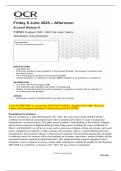
A LEVEL HISTORY A: Actual June 2025 PAST PAPER 1: England 1547–1603: The Later
Tudors. All Assessment Questions & Mark Scheme [OCR Y107/01]
Exam Resource Summary
The A Level History A June 2025 England 1547–1603: The Later Tudors Paper (OCR Y107/01)
combines the full official examination paper with its detailed mark scheme to create a focused and
comprehensive revision resource. This paper assesses students’ understanding of the political, religious,
and social developments in England during the later Tudor period, including the reigns of Edward VI,
Mary I, and Elizabeth I, as well as key issues such as succession, religious reform, governance, and social
unrest. Candidates are required to analyse primary and secondary sources, evaluate differing historical
interpretations, and construct coherent, evidence-based arguments. By presenting each question alongside
its marking criteria, the resource offers clear guidance on examiner expectations, analytical depth, and the
structured responses required for high-band marks. This integrated format supports targeted revision,
strengthens source evaluation and essay-writing skills, and prepares students thoroughly for the May/June
2026 OCR A Level History A England 1547–1603: The Later Tudors examination.
OCR is an exempt Charity
Turn over
, 2
Section A
Mid Tudor Crises 1547–1558
Study the four sources and answer Question 1.
1 ‘There was widespread opposition to the religious changes under Edward VI.’
Use the four sources in their historical context to assess how far they support this view. [30]
Source A: A contemporary Catholic chronicle describes reactions to the religious changes in
the first year of Edward VI’s reign.
The 5th of September 1547 began the king’s visitation at St Paul’s, and all the images were pulled
down; and the 9th day of the same month the said visitation was at St Bride’s, and after that in
various other parish churches; and so all images pulled down through all England at that time, and all
churches new white-limed, with the commandments on the walls.
Adapted from the Chronicle of Grey Friars of London.
Source B: The religious demands of the Western rebels, in response to the introduction of the
1549 Prayer Book.
Item, we will have the Laws of our Sovereign Lord King Henry VIII concerning the Six Articles, to be in
use again, as they were during his reign.
Item, we will have the mass in Latin, as it was before, and celebrated by the priest without any man or
woman communicating with him.
Item, we will have holy bread and holy water every Sunday, palms and ashes at the accustomed time,
Images set up again in every church.
Item, we will not receive the new service because it is like a Christmas game, but will have our old
service of Matins, mass, Evensong and procession in Latin.
The demands of the Western rebels, 1549 (selected).
Source C: Parliament issues an Act condemning Catholic service books and images.
The king has issued through Parliament a uniform, quiet and godly order of service called the Book
of Common Prayer, which contains nothing but the pure word of God. However, alongside it are still
practised corrupt, untrue and superstitious ceremonies, which allow some to attack the order and
meaning of the Prayer Book and encourage great diversity of opinion. Therefore, it is ordered that all
books used for the old mass be abolished, and any images of stone, timber or marble be defaced and
destroyed.
An Act for the abolition and putting away of images and various books, 1549.
© OCR 2025 Y107/01 Jun25
, 3
Source D: A Protestant reformer comments on the achievements of Edward VI before the
king’s death.
The king has accomplished more in his youth than many have done in their adult life. He has repealed
the Act of Six Articles. He has removed images from churches. He has overthrown image worship. He
has abolished the mass and destroyed almost every kind of superstition. He has published good and
pious homilies to lessen the ignorance of uneducated ministers. Each of these achievements would
be considered a great action in other men, but as nothing to him, given the very great amount he has
accomplished.
Sir John Cheke, a former tutor to Edward, writes to a Protestant reformer in Switzerland, 1553.
© OCR 2025 Y107/01 Jun25 Turn over
Tudors. All Assessment Questions & Mark Scheme [OCR Y107/01]
Exam Resource Summary
The A Level History A June 2025 England 1547–1603: The Later Tudors Paper (OCR Y107/01)
combines the full official examination paper with its detailed mark scheme to create a focused and
comprehensive revision resource. This paper assesses students’ understanding of the political, religious,
and social developments in England during the later Tudor period, including the reigns of Edward VI,
Mary I, and Elizabeth I, as well as key issues such as succession, religious reform, governance, and social
unrest. Candidates are required to analyse primary and secondary sources, evaluate differing historical
interpretations, and construct coherent, evidence-based arguments. By presenting each question alongside
its marking criteria, the resource offers clear guidance on examiner expectations, analytical depth, and the
structured responses required for high-band marks. This integrated format supports targeted revision,
strengthens source evaluation and essay-writing skills, and prepares students thoroughly for the May/June
2026 OCR A Level History A England 1547–1603: The Later Tudors examination.
OCR is an exempt Charity
Turn over
, 2
Section A
Mid Tudor Crises 1547–1558
Study the four sources and answer Question 1.
1 ‘There was widespread opposition to the religious changes under Edward VI.’
Use the four sources in their historical context to assess how far they support this view. [30]
Source A: A contemporary Catholic chronicle describes reactions to the religious changes in
the first year of Edward VI’s reign.
The 5th of September 1547 began the king’s visitation at St Paul’s, and all the images were pulled
down; and the 9th day of the same month the said visitation was at St Bride’s, and after that in
various other parish churches; and so all images pulled down through all England at that time, and all
churches new white-limed, with the commandments on the walls.
Adapted from the Chronicle of Grey Friars of London.
Source B: The religious demands of the Western rebels, in response to the introduction of the
1549 Prayer Book.
Item, we will have the Laws of our Sovereign Lord King Henry VIII concerning the Six Articles, to be in
use again, as they were during his reign.
Item, we will have the mass in Latin, as it was before, and celebrated by the priest without any man or
woman communicating with him.
Item, we will have holy bread and holy water every Sunday, palms and ashes at the accustomed time,
Images set up again in every church.
Item, we will not receive the new service because it is like a Christmas game, but will have our old
service of Matins, mass, Evensong and procession in Latin.
The demands of the Western rebels, 1549 (selected).
Source C: Parliament issues an Act condemning Catholic service books and images.
The king has issued through Parliament a uniform, quiet and godly order of service called the Book
of Common Prayer, which contains nothing but the pure word of God. However, alongside it are still
practised corrupt, untrue and superstitious ceremonies, which allow some to attack the order and
meaning of the Prayer Book and encourage great diversity of opinion. Therefore, it is ordered that all
books used for the old mass be abolished, and any images of stone, timber or marble be defaced and
destroyed.
An Act for the abolition and putting away of images and various books, 1549.
© OCR 2025 Y107/01 Jun25
, 3
Source D: A Protestant reformer comments on the achievements of Edward VI before the
king’s death.
The king has accomplished more in his youth than many have done in their adult life. He has repealed
the Act of Six Articles. He has removed images from churches. He has overthrown image worship. He
has abolished the mass and destroyed almost every kind of superstition. He has published good and
pious homilies to lessen the ignorance of uneducated ministers. Each of these achievements would
be considered a great action in other men, but as nothing to him, given the very great amount he has
accomplished.
Sir John Cheke, a former tutor to Edward, writes to a Protestant reformer in Switzerland, 1553.
© OCR 2025 Y107/01 Jun25 Turn over