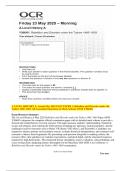
A LEVEL HISTORY A: Actual May 2025 PAST PAPER 1: Rebellion and Disorder under the
Tudors 1485–1603. All Assessment Questions & Mark Scheme [OCR Y306/01]
Exam Resource Summary
The A Level History A May 2025 Rebellion and Disorder under the Tudors 1485–1603 Paper (OCR
Y306/01) integrates the complete official examination paper with its detailed mark scheme to provide a
focused and comprehensive revision resource. This paper assesses students’ understanding of political,
social, and religious unrest during the Tudor period, including key uprisings, factional disputes, and the
challenges faced by monarchs such as Henry VII, Henry VIII, Mary I, and Elizabeth I. Candidates are
required to analyse primary and secondary sources, evaluate historical interpretations, and construct well-
reasoned, evidence-based arguments. By presenting each question alongside its marking criteria, the
resource offers clear guidance on examiner expectations, analytical depth, and the structured responses
required for high-band marks. This integrated format strengthens source evaluation, critical thinking, and
essay-writing skills, preparing learners thoroughly for the May/June 2026 OCR A Level History A
Rebellion and Disorder under the Tudors 1485–1603 examination.
OCR is an exempt Charity
Turn over
, 2
Section A
Read the two passages and answer Question 1.
1 Evaluate the interpretations in both of the two passages.
Explain which you think is more convincing as an explanation of the threat posed by the Western
Rebellion to the government. [30]
Passage A
Adapted from Mark Stoyle, Tudor rebellion, p22-5, BBC History Magazine 2022. From first line "The name the Prayer Book Rebellion (Western Rebellion) suggests a somewhat soft event." to last line "Even so, the protestors’ aims came close to being achieved during the factional struggle that then raged in
Passage B
Adapted from D MacCulloch and A Fletcher, Tudor Rebellions, p64, Routledge, 2020. From first line "The rebellion never had a real chance of forcing the government to make concessions in its religious policy," to last line " or perhaps the leaders’ nerve failed at the prospect of leaving their own terri
© OCR 2025 Y306/01 Jun25
, 3
Section B
Answer any two questions.
2* ‘Tudor rebellions were the responses of local communities to local grievances.’
How far do you agree with this view of the period from 1485 to 1603? [25]
3* ‘Rebellions with foreign support were the most serious threat to Tudor governments.’
How far do you agree with this view of the period from 1485 to 1603?
[25]
4* ‘All Tudor monarchs maintained political stability in the same way.’
How far do you agree with this view of the period from 1485 to 1603? [25]
END OF QUESTION PAPER
© OCR 2025 Y306/01 Jun25
Tudors 1485–1603. All Assessment Questions & Mark Scheme [OCR Y306/01]
Exam Resource Summary
The A Level History A May 2025 Rebellion and Disorder under the Tudors 1485–1603 Paper (OCR
Y306/01) integrates the complete official examination paper with its detailed mark scheme to provide a
focused and comprehensive revision resource. This paper assesses students’ understanding of political,
social, and religious unrest during the Tudor period, including key uprisings, factional disputes, and the
challenges faced by monarchs such as Henry VII, Henry VIII, Mary I, and Elizabeth I. Candidates are
required to analyse primary and secondary sources, evaluate historical interpretations, and construct well-
reasoned, evidence-based arguments. By presenting each question alongside its marking criteria, the
resource offers clear guidance on examiner expectations, analytical depth, and the structured responses
required for high-band marks. This integrated format strengthens source evaluation, critical thinking, and
essay-writing skills, preparing learners thoroughly for the May/June 2026 OCR A Level History A
Rebellion and Disorder under the Tudors 1485–1603 examination.
OCR is an exempt Charity
Turn over
, 2
Section A
Read the two passages and answer Question 1.
1 Evaluate the interpretations in both of the two passages.
Explain which you think is more convincing as an explanation of the threat posed by the Western
Rebellion to the government. [30]
Passage A
Adapted from Mark Stoyle, Tudor rebellion, p22-5, BBC History Magazine 2022. From first line "The name the Prayer Book Rebellion (Western Rebellion) suggests a somewhat soft event." to last line "Even so, the protestors’ aims came close to being achieved during the factional struggle that then raged in
Passage B
Adapted from D MacCulloch and A Fletcher, Tudor Rebellions, p64, Routledge, 2020. From first line "The rebellion never had a real chance of forcing the government to make concessions in its religious policy," to last line " or perhaps the leaders’ nerve failed at the prospect of leaving their own terri
© OCR 2025 Y306/01 Jun25
, 3
Section B
Answer any two questions.
2* ‘Tudor rebellions were the responses of local communities to local grievances.’
How far do you agree with this view of the period from 1485 to 1603? [25]
3* ‘Rebellions with foreign support were the most serious threat to Tudor governments.’
How far do you agree with this view of the period from 1485 to 1603?
[25]
4* ‘All Tudor monarchs maintained political stability in the same way.’
How far do you agree with this view of the period from 1485 to 1603? [25]
END OF QUESTION PAPER
© OCR 2025 Y306/01 Jun25