

POST-NORMAL SCIENCE (PNS)
Science for the post-normal age - Funtowicz & Ravetz (1993)
Post-normal science = facts are uncertain, values in dispute, stakes
high and decisions urgent → new, enriched awareness of functions
and methods of science.
→ focuses on problems with quality assurance of scientific info →
solution requires new ideas about scientific methodology →
evaluation of scientific inputs to decision making requires an
extended peer community = set of legitimate participants in the
process of quality assurance of scientific inputs → involves broader
societal and cultural institutions.
→ key elements PNS: (a) appropriate management of uncertainty, quality and value-ladenness. (b)
multiple commitments and perspectives. (c) internal and external extension of peer community.
→ 2 aspects of PNS: (1) quality of scientific info (analysed by different types of uncertainty in
knowledge and intended functions of the info). (2) problem-solving strategies (analysed by
uncertainties in knowledge and complexities in ethics).
We would be misled if we retained image of a process where true scientific facts determine
correct policy conclusions → BUT new challenges do not make traditional science irrelevant →
we have to choose the appropriate kinds of problem-solving strategies for each case.
Applied science is mission-oriented → professional consultancy is client-serving and post-normal
science i s issue-driven → traditional basic research is curiosity-motivated.
Different levels of uncertainty:
- Technical (inexactness): uncertainty is managed when standard routines are adequate →
derived from statistics, techniques, conventions (are themselves symbolic
manipulations).
- Methodological (unreliability): when more complex aspects of info,
as values or reliability, are relevant → personal judgments
depending on higher-level skills are required → practice is
professional consultancy (medicine/engineering).
- Epistemological (border with ignorance): when irremediable
uncertainty is at core of the problem → completeness uncertainty.
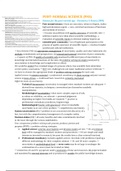
System uncertainties (SU) = problem is not concerned with discovery of a
fact, but with the comprehension/management of a complex reality.
Decision stakes (DS) = all costs, benefits and value commitments involved
in the issue through the various stakeholders.
Four components problem-solving task: process, product, person and
purpose (PPPP) → problem-solving strategies:
1. Applied science: systems uncertainties and decision stakes are low → SU at technical
level will be managed by standard routines and procedures → DS are simple and small
(resources invested in research, because the results have a clear external function).
2. Professional consultancy: includes applied science, but deals with problems requiring a
different methodology for their complete solution → SU and DS more complex →
uncertainty at methodological level → error-costs may be so large to endanger the
continuation of a career (must be treated as risks).
→ similarities AS and PC: (a) operate under constraints of time and resources, (b) projects funded
and mandated by external interests and (c) products lie outside the public knowledge domain.
, → differences: different quality assurance; outcomes of AS have reproducibility and prediction →
PC deals with unique situations and the personal element is important.
3. Post-normal science: extended peer-community → uncertainties are of e
pistemological
/ethical kind → DS reflect conflicting purposes among stakeholders → there are
problems like major technological hazards/large-scale pollution → all causal elements
are uncertain in the extreme → public agreement and participation are decisive for risk
assessment in the setting of policy.
→ PNS is complementary to AS and PC → not a replacement → it doesn’t contest claims to
reliable knowledge or certified expertise.
The Kuhnian Revolution - Sismondo (2010)
Thomas Kuhn: periods of normal science get interrupted by revolutions → ignoring history gives
a naïve picture of the scientific enterprise.
Whig history = temptation to see the past through the lens of the present → see moves in the
direction of what we now believe to be true.
Normal science = science whereby members of a field share recognition of key past (a)
achievements in their field, (b) beliefs about which theories are right, (c) an understanding of the
important problems and (d) methods for solving those problems.
→ they share a paradigm = shared assumptions, beliefs and values that unite the community and
allow normal science to take place → within paradigms research continues with creativity →
always embedded in firm conceptual and social backgrounds → peer-review.
→ theoretical side of a paradigm: serves as a worldview; providing categories and frameworks
into which to fit phenomena → practical side of a paradigm: serves as a form of life; providing
patterns of behavior/frameworks for action.
→ normal science as puzzle-solving: p
roblems are solved within the terms of the paradigm →
failure to solve a problem reflects more badly on researcher than on theories/methods.
Revolutionary science = accumulation of anomalies that forms real problems → causes
discomfort with paradigm, which creates a period of crisis = when alternative can be adopted →
alternative may become a paradigm itself, structuring a new period of normal science.
→ during normal science we can talk about progress, because scientists have little difficulty
recognizing achievements → revolutions are not progressive, because they build and destroy.
Theories of different paradigms are incommensurable = lacking a common measure → people
working in different paradigms see the world differently → incomplete/difficult communication.
→ roots incommensurability: (a) positivistic (meanings of theoretical terms are related to the
implied observations), (b) indoctrination (paradigms shape observations = t heory-dependence of
observation), (c) past research can be opaque (easy to understand old research in present
terms).
Foundationalism = knowledge can be traced back to firm foundations → combination of sensory
impressions and rational principles, which support a building of higher-order beliefs.
→ like bricks, each belief is supported by more beneath it. Criticism Kuhn’s paradigms:
- Fuzzy definition of paradigm.
- Between Kuhn’s normal science and revolutionary science there are many gradations.
- Confirming research of paradigm is not in line with research purpose to find new things.
- If experiment doesn’t allow revision of views, it is hard to see why it should be done at all.
- Continuity from one paradigm to the next is incorrect → when theories change, there is
no immediate change in experiments or instruments.
Science for the post-normal age - Funtowicz & Ravetz (1993)
Post-normal science = facts are uncertain, values in dispute, stakes
high and decisions urgent → new, enriched awareness of functions
and methods of science.
→ focuses on problems with quality assurance of scientific info →
solution requires new ideas about scientific methodology →
evaluation of scientific inputs to decision making requires an
extended peer community = set of legitimate participants in the
process of quality assurance of scientific inputs → involves broader
societal and cultural institutions.
→ key elements PNS: (a) appropriate management of uncertainty, quality and value-ladenness. (b)
multiple commitments and perspectives. (c) internal and external extension of peer community.
→ 2 aspects of PNS: (1) quality of scientific info (analysed by different types of uncertainty in
knowledge and intended functions of the info). (2) problem-solving strategies (analysed by
uncertainties in knowledge and complexities in ethics).
We would be misled if we retained image of a process where true scientific facts determine
correct policy conclusions → BUT new challenges do not make traditional science irrelevant →
we have to choose the appropriate kinds of problem-solving strategies for each case.
Applied science is mission-oriented → professional consultancy is client-serving and post-normal
science i s issue-driven → traditional basic research is curiosity-motivated.
Different levels of uncertainty:
- Technical (inexactness): uncertainty is managed when standard routines are adequate →
derived from statistics, techniques, conventions (are themselves symbolic
manipulations).
- Methodological (unreliability): when more complex aspects of info,
as values or reliability, are relevant → personal judgments
depending on higher-level skills are required → practice is
professional consultancy (medicine/engineering).
- Epistemological (border with ignorance): when irremediable
uncertainty is at core of the problem → completeness uncertainty.
System uncertainties (SU) = problem is not concerned with discovery of a
fact, but with the comprehension/management of a complex reality.
Decision stakes (DS) = all costs, benefits and value commitments involved
in the issue through the various stakeholders.
Four components problem-solving task: process, product, person and
purpose (PPPP) → problem-solving strategies:
1. Applied science: systems uncertainties and decision stakes are low → SU at technical
level will be managed by standard routines and procedures → DS are simple and small
(resources invested in research, because the results have a clear external function).
2. Professional consultancy: includes applied science, but deals with problems requiring a
different methodology for their complete solution → SU and DS more complex →
uncertainty at methodological level → error-costs may be so large to endanger the
continuation of a career (must be treated as risks).
→ similarities AS and PC: (a) operate under constraints of time and resources, (b) projects funded
and mandated by external interests and (c) products lie outside the public knowledge domain.
, → differences: different quality assurance; outcomes of AS have reproducibility and prediction →
PC deals with unique situations and the personal element is important.
3. Post-normal science: extended peer-community → uncertainties are of e
pistemological
/ethical kind → DS reflect conflicting purposes among stakeholders → there are
problems like major technological hazards/large-scale pollution → all causal elements
are uncertain in the extreme → public agreement and participation are decisive for risk
assessment in the setting of policy.
→ PNS is complementary to AS and PC → not a replacement → it doesn’t contest claims to
reliable knowledge or certified expertise.
The Kuhnian Revolution - Sismondo (2010)
Thomas Kuhn: periods of normal science get interrupted by revolutions → ignoring history gives
a naïve picture of the scientific enterprise.
Whig history = temptation to see the past through the lens of the present → see moves in the
direction of what we now believe to be true.
Normal science = science whereby members of a field share recognition of key past (a)
achievements in their field, (b) beliefs about which theories are right, (c) an understanding of the
important problems and (d) methods for solving those problems.
→ they share a paradigm = shared assumptions, beliefs and values that unite the community and
allow normal science to take place → within paradigms research continues with creativity →
always embedded in firm conceptual and social backgrounds → peer-review.
→ theoretical side of a paradigm: serves as a worldview; providing categories and frameworks
into which to fit phenomena → practical side of a paradigm: serves as a form of life; providing
patterns of behavior/frameworks for action.
→ normal science as puzzle-solving: p
roblems are solved within the terms of the paradigm →
failure to solve a problem reflects more badly on researcher than on theories/methods.
Revolutionary science = accumulation of anomalies that forms real problems → causes
discomfort with paradigm, which creates a period of crisis = when alternative can be adopted →
alternative may become a paradigm itself, structuring a new period of normal science.
→ during normal science we can talk about progress, because scientists have little difficulty
recognizing achievements → revolutions are not progressive, because they build and destroy.
Theories of different paradigms are incommensurable = lacking a common measure → people
working in different paradigms see the world differently → incomplete/difficult communication.
→ roots incommensurability: (a) positivistic (meanings of theoretical terms are related to the
implied observations), (b) indoctrination (paradigms shape observations = t heory-dependence of
observation), (c) past research can be opaque (easy to understand old research in present
terms).
Foundationalism = knowledge can be traced back to firm foundations → combination of sensory
impressions and rational principles, which support a building of higher-order beliefs.
→ like bricks, each belief is supported by more beneath it. Criticism Kuhn’s paradigms:
- Fuzzy definition of paradigm.
- Between Kuhn’s normal science and revolutionary science there are many gradations.
- Confirming research of paradigm is not in line with research purpose to find new things.
- If experiment doesn’t allow revision of views, it is hard to see why it should be done at all.
- Continuity from one paradigm to the next is incorrect → when theories change, there is
no immediate change in experiments or instruments.


