Academic Skills summary – Economics and Business Economics (VU)
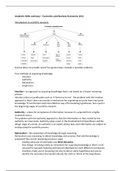
Introduction to scientific research:
Science does not provide ‘proof’ for general laws; instead, it provides evidence.
Four methods of acquiring knowledge:
- Intuition
- Authority
- Rationalism
- Empiricism
Intuition = an approach to acquiring knowledge that is not based on a known reasoning
process.
Intuition relies on justification such as ‘it feels true to me’. The problem with the intuitive
approach is that it does not provide a mechanism for separating accurate from inaccurate
knowledge à not the best and most effective way of formulating hypotheses, but a part in
the beginning stages of scientific research.
Authority = a basis for acceptance of information, because it is acquired from a highly
respected source.
The problem with the authority approach is that the information or facts stated by the
authority are inaccurate. Authority plays a part in the development of hypotheses and the
design stage of a study. An authority is an expert whose facts and information are subject to
testing using the scientific process.
Rationalism = the acquisition of knowledge through reasoning.
Rationalism uses reasoning to obtain knowledge and assumes that valid knowledge is
acquired if the correct reasoning process is used.
- Leading advocate of rationality was René Descartes
- One danger of relying solely on rationalism for acquiring knowledge is that it is not
unusual for two well-meaning and honest individuals to reach different conclusions.
- Scientists make use of reasoning not only to derive some hypotheses but also to
identify the outcomes that would indicate the truth or falsity of the hypotheses.
,Empiricism = the acquisition of knowledge through experience.
Philosophers argued that virtually all knowledge is based on experience. John Locke put it
well when he claimed that each person is born a tabula rasa (= individuals’ minds are blank
slates or tablets upon which the environment or nature writes). The origin of all knowledge
is from our senses à our senses imprint ideas in our brains that then are further worked
upon through cognitive processes. Several dangers exist if it is used alone:
Our perceptions are affected by a number of variables:
- Research has demonstrated that such variables as past experiences and our
motivations at the time of perceiving can drastically alter what we see.
- Research has also revealed that our memory for events does not remain constant.
Not only do we tend to forget things, but at times an actual distortion of memory
might take place.
Empiricism is a vital element in science, but in science, empirical observations must be
conducted under controlled conditions and systematic strategies must be used to minimize
researcher bias and to maximize objectivity.
Empiricism is traced back to John Locke and David Hume.
Science is a very special mixture of the approaches just mentioned, and it is the most
trustworthy way to acquire reliable and valid knowledge about the natural world.
Induction = a reasoning process that involves going from the specific to the general.
Deduction = a reasoning process that involves going from the general to the specific.
Hypothesis testing is the process of testing a predicted relationship or hypothesis by making
observations and then comparing the observed facts with the hypothesis or predicted
relationship.
Logical positivism = a philosophical approach that focused on verifying hypotheses as the
key criterion of science
- Logical positivism became known as the Vienna Circle
- One of the central views of the Vienna Circle was: a statement is meaningful only
when it is verifiable by observation or experience = verificationism
- Logical positivism believed that the most important aspect of science was the
verification of hypotheses by objective observation or experience
- For the logical positivists, hypothesis testing was an inductive approach that moved
from experiential ‘facts’ to general propositions.
Falsificationism = a deductive approach to science that focuses on falsifying hypotheses as
the key criterion of science
Duhem-Quine principle states that a hypothesis cannot be tested in isolation from other
assumptions
Naturalism = position popular in behavioural science stating that science should justify its
practices according to how well they work rather than according to philosophical arguments
, Empirical adequacy: present when theories and hypotheses closely fir empirical evidence
Normal science = the period in which scientific activity is governed and directed by a single
paradigm
Paradigm = a framework of thought or beliefs by which reality is interpreted
Thomas Kuhn conducted a historical analysis of science and in 1962 he published his famous
book The Structure of Scientific Revolutions. His research suggested that science reflects two
types of activities: normal science and revolutionary science. A paradigm is a framework of
thought or beliefs by which you interpret reality. Over time, anomalies and criticisms
develop and revolutionary science occurs. During this briefer period, the old paradigm is
replaced by a new paradigm. Replacement of one paradigm with another is a significant
event because the belief system that governs the current view of reality is replaced with a
new set of beliefs.
Revolutionary science = a period in which scientific activity is characterized by the
replacement of one paradigm with another
Another philosopher of science named Lakatos took an approach similar to Kuhn’s by
attempting to portray scientific activity as taking place within a framework. Kuhn labelled
this framework a paradigm, but Lakatos coined the phrase research program to represent
this framework.
Research program = Lakatos’ term for a paradigm. It includes a set of “hard-core” beliefs
and an outer “protective belt” of additional beliefs.
- Hard-core beliefs or principles: the defining characteristics of a research program
- Protective belt: additional beliefs, principles, assumptions, and so on
Lakatos argued that when a hard-core hypothesis is not supported, the researcher would
simply modify something in the protective belt. à Makes it very difficult for a theory to be
falsified or rejected.
A competing paradigm at this time was an ‘organismic’ paradigm or research program. The
basic set of concepts and beliefs or the fundamental principles of the organismic view were
that learning is achieved through the testing of rules or hypotheses and organisms are
active rather than reactive. Change or learning occurs by some internal transformations
such as would be advocated by Gestalt theory, information processing or cognitive
psychology.
Feyerabend was a philosopher of science who looked at the various methodological
approaches to science that had been advocated and was not surprised to see that each had
been criticised and was lacking. Proponent of the anarchistic method.
Feyerabend argued that there is no such thing as the method of science. According to him,
science has many methods.
Feyerabend also argued that science included many irrational practices and was partially the
result of the operation of power. He concluded that scientific knowledge was not nearly as
secure as scientists would have the public believe.
Introduction to scientific research:
Science does not provide ‘proof’ for general laws; instead, it provides evidence.
Four methods of acquiring knowledge:
- Intuition
- Authority
- Rationalism
- Empiricism
Intuition = an approach to acquiring knowledge that is not based on a known reasoning
process.
Intuition relies on justification such as ‘it feels true to me’. The problem with the intuitive
approach is that it does not provide a mechanism for separating accurate from inaccurate
knowledge à not the best and most effective way of formulating hypotheses, but a part in
the beginning stages of scientific research.
Authority = a basis for acceptance of information, because it is acquired from a highly
respected source.
The problem with the authority approach is that the information or facts stated by the
authority are inaccurate. Authority plays a part in the development of hypotheses and the
design stage of a study. An authority is an expert whose facts and information are subject to
testing using the scientific process.
Rationalism = the acquisition of knowledge through reasoning.
Rationalism uses reasoning to obtain knowledge and assumes that valid knowledge is
acquired if the correct reasoning process is used.
- Leading advocate of rationality was René Descartes
- One danger of relying solely on rationalism for acquiring knowledge is that it is not
unusual for two well-meaning and honest individuals to reach different conclusions.
- Scientists make use of reasoning not only to derive some hypotheses but also to
identify the outcomes that would indicate the truth or falsity of the hypotheses.
,Empiricism = the acquisition of knowledge through experience.
Philosophers argued that virtually all knowledge is based on experience. John Locke put it
well when he claimed that each person is born a tabula rasa (= individuals’ minds are blank
slates or tablets upon which the environment or nature writes). The origin of all knowledge
is from our senses à our senses imprint ideas in our brains that then are further worked
upon through cognitive processes. Several dangers exist if it is used alone:
Our perceptions are affected by a number of variables:
- Research has demonstrated that such variables as past experiences and our
motivations at the time of perceiving can drastically alter what we see.
- Research has also revealed that our memory for events does not remain constant.
Not only do we tend to forget things, but at times an actual distortion of memory
might take place.
Empiricism is a vital element in science, but in science, empirical observations must be
conducted under controlled conditions and systematic strategies must be used to minimize
researcher bias and to maximize objectivity.
Empiricism is traced back to John Locke and David Hume.
Science is a very special mixture of the approaches just mentioned, and it is the most
trustworthy way to acquire reliable and valid knowledge about the natural world.
Induction = a reasoning process that involves going from the specific to the general.
Deduction = a reasoning process that involves going from the general to the specific.
Hypothesis testing is the process of testing a predicted relationship or hypothesis by making
observations and then comparing the observed facts with the hypothesis or predicted
relationship.
Logical positivism = a philosophical approach that focused on verifying hypotheses as the
key criterion of science
- Logical positivism became known as the Vienna Circle
- One of the central views of the Vienna Circle was: a statement is meaningful only
when it is verifiable by observation or experience = verificationism
- Logical positivism believed that the most important aspect of science was the
verification of hypotheses by objective observation or experience
- For the logical positivists, hypothesis testing was an inductive approach that moved
from experiential ‘facts’ to general propositions.
Falsificationism = a deductive approach to science that focuses on falsifying hypotheses as
the key criterion of science
Duhem-Quine principle states that a hypothesis cannot be tested in isolation from other
assumptions
Naturalism = position popular in behavioural science stating that science should justify its
practices according to how well they work rather than according to philosophical arguments
, Empirical adequacy: present when theories and hypotheses closely fir empirical evidence
Normal science = the period in which scientific activity is governed and directed by a single
paradigm
Paradigm = a framework of thought or beliefs by which reality is interpreted
Thomas Kuhn conducted a historical analysis of science and in 1962 he published his famous
book The Structure of Scientific Revolutions. His research suggested that science reflects two
types of activities: normal science and revolutionary science. A paradigm is a framework of
thought or beliefs by which you interpret reality. Over time, anomalies and criticisms
develop and revolutionary science occurs. During this briefer period, the old paradigm is
replaced by a new paradigm. Replacement of one paradigm with another is a significant
event because the belief system that governs the current view of reality is replaced with a
new set of beliefs.
Revolutionary science = a period in which scientific activity is characterized by the
replacement of one paradigm with another
Another philosopher of science named Lakatos took an approach similar to Kuhn’s by
attempting to portray scientific activity as taking place within a framework. Kuhn labelled
this framework a paradigm, but Lakatos coined the phrase research program to represent
this framework.
Research program = Lakatos’ term for a paradigm. It includes a set of “hard-core” beliefs
and an outer “protective belt” of additional beliefs.
- Hard-core beliefs or principles: the defining characteristics of a research program
- Protective belt: additional beliefs, principles, assumptions, and so on
Lakatos argued that when a hard-core hypothesis is not supported, the researcher would
simply modify something in the protective belt. à Makes it very difficult for a theory to be
falsified or rejected.
A competing paradigm at this time was an ‘organismic’ paradigm or research program. The
basic set of concepts and beliefs or the fundamental principles of the organismic view were
that learning is achieved through the testing of rules or hypotheses and organisms are
active rather than reactive. Change or learning occurs by some internal transformations
such as would be advocated by Gestalt theory, information processing or cognitive
psychology.
Feyerabend was a philosopher of science who looked at the various methodological
approaches to science that had been advocated and was not surprised to see that each had
been criticised and was lacking. Proponent of the anarchistic method.
Feyerabend argued that there is no such thing as the method of science. According to him,
science has many methods.
Feyerabend also argued that science included many irrational practices and was partially the
result of the operation of power. He concluded that scientific knowledge was not nearly as
secure as scientists would have the public believe.