
LEGAL 2700 Exam 1 Review – Questions With Right
Solutions
Save
Practice questions for this set
Learn 1/6 Study with Learn
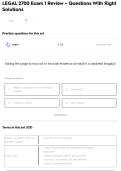
Asking the judge to toss out or exclude evidence at trial(if it is obtained illegally)
Choose an answer
What is needed to have an efficient
1 2 Defendant
market?
3 Motion in Limine: 4 stare decisis
Don't know?
Terms in this set (129)
What is needed to have an Law, Rule of Law, Property
efficient market?
-Laws that are made are generally and equally
applicable
Rule of Law -Clear, publicized, stable, and just laws.
-process is accessible, fair, and efficient
-justice is delivered timely
, The exclusionary right of property provides a basis for
Property
the private market and modern business
Emphasizes the role of judges in determining the
Common Law meaning of laws and how they apply. Used by all states
except Louisiana.
Let the decision stand, judges follow precedents
stare decisis
whenever possible.
judge's comments, observations, and opinions on the
dicta
case
Relies more on legislation than judicial decisions to
Civil Law determine what the law is. In Civil Law Courts judges
don't feel obligated to follow prior judicial decisions
-Regulation of society
-Government represents society
*Public Law
-Includes Constitutional law, Administrative law, and
Criminal law
-regulation of private resources
*Private Law
-includes property law, contract law, and tort law
-defines the legal relationship of people with other
people or between them and the state
*Substantive Law
-*defines rights and duties
-deals with the method and means by which substantive
law is made and administered
Procedural Law:
-*provides the machinery for enforcing those rights and
duties
Plaintiff party that files a lawsuit
Defendant party who is sued
Counterclaim When the defendant makes claims against the plaintiff
The name for a defendant who was not named in the
complaint but is later joined. EX: John is suing BMW for
Third party defendant car crash caused by a brake malfunction. If BMW
chooses to bring in their brake manufacturing company
this would be a third party defendant.
, Being entitled to have the court hear your case (having
a valid reason) Requirements: There must be a legal
Standing to sue wrong and you yourself must have a personal stake in
the resolution(you have to be the person that was
harmed)
The Plaintiff must allege:
How does a plaintiff
established standing to
1. A case or controversy (legal wrong)
sue?
2. A personal stake in the resolution
Authority over the parties to the case on the part of the
court
Personal jurisdiction
-personal jurisdiction over a plaintiff is obtained when
the plaintiff files the suit
-Summons
How is personal jurisdiction
-Service of process-delivery of the summons to appear
over the defendant
in court(can leave summons with someone of age and
obtained?
mail it to the last known address if they aren't there
during service of process)
-provide for the service of process beyond the
boundaries of the state
Long-arm statutes:
-this is how a state obtains personal jurisdiction over a
defendant who is out of state (must satisfy the minimum
contacts test to obtain a long-arm statute)
The defendant must have minimum contacts with the
state.(only 1 of the 3 has to be true)
Minimum Contacts Test:
1. Has the _defendant___ committed a __tort_______ within
Requirements for the long- the _state_______?
arm statutes:
2. Does the defendant __own property___________ within the
state that is the _subject matter_____ of the lawsuit?
3.Has the defendant entered into a _contract_____ within
the state or _transacted the business___ that is the subject
matter of the lawsuit within that state?
Solutions
Save
Practice questions for this set
Learn 1/6 Study with Learn
Asking the judge to toss out or exclude evidence at trial(if it is obtained illegally)
Choose an answer
What is needed to have an efficient
1 2 Defendant
market?
3 Motion in Limine: 4 stare decisis
Don't know?
Terms in this set (129)
What is needed to have an Law, Rule of Law, Property
efficient market?
-Laws that are made are generally and equally
applicable
Rule of Law -Clear, publicized, stable, and just laws.
-process is accessible, fair, and efficient
-justice is delivered timely
, The exclusionary right of property provides a basis for
Property
the private market and modern business
Emphasizes the role of judges in determining the
Common Law meaning of laws and how they apply. Used by all states
except Louisiana.
Let the decision stand, judges follow precedents
stare decisis
whenever possible.
judge's comments, observations, and opinions on the
dicta
case
Relies more on legislation than judicial decisions to
Civil Law determine what the law is. In Civil Law Courts judges
don't feel obligated to follow prior judicial decisions
-Regulation of society
-Government represents society
*Public Law
-Includes Constitutional law, Administrative law, and
Criminal law
-regulation of private resources
*Private Law
-includes property law, contract law, and tort law
-defines the legal relationship of people with other
people or between them and the state
*Substantive Law
-*defines rights and duties
-deals with the method and means by which substantive
law is made and administered
Procedural Law:
-*provides the machinery for enforcing those rights and
duties
Plaintiff party that files a lawsuit
Defendant party who is sued
Counterclaim When the defendant makes claims against the plaintiff
The name for a defendant who was not named in the
complaint but is later joined. EX: John is suing BMW for
Third party defendant car crash caused by a brake malfunction. If BMW
chooses to bring in their brake manufacturing company
this would be a third party defendant.
, Being entitled to have the court hear your case (having
a valid reason) Requirements: There must be a legal
Standing to sue wrong and you yourself must have a personal stake in
the resolution(you have to be the person that was
harmed)
The Plaintiff must allege:
How does a plaintiff
established standing to
1. A case or controversy (legal wrong)
sue?
2. A personal stake in the resolution
Authority over the parties to the case on the part of the
court
Personal jurisdiction
-personal jurisdiction over a plaintiff is obtained when
the plaintiff files the suit
-Summons
How is personal jurisdiction
-Service of process-delivery of the summons to appear
over the defendant
in court(can leave summons with someone of age and
obtained?
mail it to the last known address if they aren't there
during service of process)
-provide for the service of process beyond the
boundaries of the state
Long-arm statutes:
-this is how a state obtains personal jurisdiction over a
defendant who is out of state (must satisfy the minimum
contacts test to obtain a long-arm statute)
The defendant must have minimum contacts with the
state.(only 1 of the 3 has to be true)
Minimum Contacts Test:
1. Has the _defendant___ committed a __tort_______ within
Requirements for the long- the _state_______?
arm statutes:
2. Does the defendant __own property___________ within the
state that is the _subject matter_____ of the lawsuit?
3.Has the defendant entered into a _contract_____ within
the state or _transacted the business___ that is the subject
matter of the lawsuit within that state?


