Macbeth: Act 1 Scene 2
Deep-diving into the details
Summary
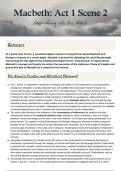
At a camp near Forres, a wounded captain reports to King Duncan about Macbeth and
Banquo’s bravery in a recent battle. Macbeth is praised for defeating the rebel Macdonwald
and turning the tide against the invading Norwegian forces. King Duncan is impressed by
Macbeth’s courage and loyalty. He orders the execution of the traitorous Thane of Cawdor and
grants this title to Macbeth as a reward for his bravery.
The Scene’s Function and Structural Placement
Act 1, Scene 2 of Macbeth is significant in shaping the audience’s first impression of our eponymous
protagonist, Macbeth. Crucially, Macbeth does not establish this impression himself; instead, it is
constructed through second-hand accounts of his off-stage bravery. This narrative distance immediately
introduces the theme of duplicity (the tension between appearance and reality), which later becomes
central to the play. The audience’s initial perception of Macbeth as courageous, valiant and loyal is
mediated through others’ subjective praise. This sets up the dramatic irony that runs through the play:
Macbeth is being celebrated as a noble military hero at precisely the same moment he is about to embark
on a treacherous path of corruption. Shakespeare thus encourages the audience to question the reliability
of outward appearances and to consider how easily perceptions can be manipulated.
The scene also introduces the audience to the conventions of militarism that underpin the play,
reflecting the ideals of the medieval chivalric code. Macbeth’s valour is defined in terms of martial
prowess, honour and loyalty to the crown, and even violence - all of which are values emblematic of a
brave warrior. The captain’s visceral descriptions of Macbeth slaying his enemies in battle convey the
brutality of war, conveying violence as both admirable and necessary. Such vivid images of Macbeth’s
prowess align his identity in this code, and in doing so, Shakespeare forms the foundations of Macbeth’s
moral disintegration. Ironically, the same qualities of courage and aggression that earn him praise and
promotion in battle at the start of the play become the reason for his downfall when he uses them against
Duncan.
Alongside establishing the chivalric code, the scene is also instrumental in introducing the theme of
masculinity, symbolised through the imagery of swords and blood (see the language section). Masculinity
is equated with strength, violent heroism and dominance, qualities in Macbeth later questioned by Lady
Macbeth and thrown out of balance by his own insecurities. In the backdrop of 11th-century Scotland, a
time where masculine identity was inextricably bound up with militaristic success, Shakespeare sets up
the conflict between societal pressures, moral restraint and psychological ambition.
Structurally, the scene is sandwiched between two supernatural episodes involving the witches (Act 1,
Scene 1 and Act 1, Scene 3). This tactful placement by Shakespeare suggests that even in a scene
, centred around dominance, militaristic order and human heroism, forces of the supernatural are already
exerting their influence. This, therefore, consolidates the precariousness of stability in the play, particularly
Duncan’s influence and rule. As a result, the scene becomes a pivot point between the natural and
supernatural realms, and between the man Macbeth is perceived to be and the one he will become.
Key Language and Imagery
Violent imagery
‘Till he unseam’d him from the nave to the chaps’
The violent verb ‘unseam’d’ here gruesomely conveys Macbeth’s violence and (very literally) his cut-throat,
ruthless fighting. He seems quick to respond and react, impulsive and brave, which later contrasts with his
hesitancy as he faces the moral dilemma of killing Duncan.
The captain’s report of Macbeth’s off-stage violence is not only literal but also serves a metaphorical
purpose: it signals his capacity for extreme actions, which will later manifest in the form of the murders he
commits.
Before we see Macbeth on stage, his militaristic bravery and martial loyalty are established, which
becomes ironic when he uses this directly against the crown.
‘Brandish’d steel, which smoked with bloody execution
This means that his sword was hot with the desire to kill.
The use of ‘smoked’ is an example of both personification and metaphor, which imbues the weapon
with not only agency, but appetite: the blade itself thirsts for blood. This may also be seen to be
foreshadowing Macbeth’s use of a dagger to kill Duncan in Act 2. What’s salient to note, however, is that
here (and in Act 2 when the hallucination of the dagger leads Macbeth to Duncan), the dagger can be
seen to have more agency and control than Macbeth.
The use of the word ‘execution’ carries a dual meaning: it means to kill, and it means to carry out a duty or
action. This ambiguity resembles the moral complexity of Macbeth’s actions - on one hand, he is
celebrated for killing rebels, but this same skill will later lead to his own execution.
‘Bellona’s bridegroom’
Classical Allusion - Bellona is the Roman Goddess of war. By calling Macbeth her ‘bridegroom’, the
wounded captain elevates him to a mythic, almost divine status, associating him with unsurpassed martial
prowess.
This also suggests how Macbeth is married to the idea of war and conflict, but while he is devoted to it, it
may also be something that entraps him. It could even be a subtle reference to his marriage to Lady
Macbeth, who, like Bellona, craves conflict and power.
Duality / Contrast
MACDONWALD - ‘Merciless Macdonwald’; ‘rebel’; ‘multiplying villainies of nature’
MACBETH - ‘valour’s minion’; ‘valiant cousin’; ‘worthy gentleman’; ‘noble’
Deep-diving into the details
Summary
At a camp near Forres, a wounded captain reports to King Duncan about Macbeth and
Banquo’s bravery in a recent battle. Macbeth is praised for defeating the rebel Macdonwald
and turning the tide against the invading Norwegian forces. King Duncan is impressed by
Macbeth’s courage and loyalty. He orders the execution of the traitorous Thane of Cawdor and
grants this title to Macbeth as a reward for his bravery.
The Scene’s Function and Structural Placement
Act 1, Scene 2 of Macbeth is significant in shaping the audience’s first impression of our eponymous
protagonist, Macbeth. Crucially, Macbeth does not establish this impression himself; instead, it is
constructed through second-hand accounts of his off-stage bravery. This narrative distance immediately
introduces the theme of duplicity (the tension between appearance and reality), which later becomes
central to the play. The audience’s initial perception of Macbeth as courageous, valiant and loyal is
mediated through others’ subjective praise. This sets up the dramatic irony that runs through the play:
Macbeth is being celebrated as a noble military hero at precisely the same moment he is about to embark
on a treacherous path of corruption. Shakespeare thus encourages the audience to question the reliability
of outward appearances and to consider how easily perceptions can be manipulated.
The scene also introduces the audience to the conventions of militarism that underpin the play,
reflecting the ideals of the medieval chivalric code. Macbeth’s valour is defined in terms of martial
prowess, honour and loyalty to the crown, and even violence - all of which are values emblematic of a
brave warrior. The captain’s visceral descriptions of Macbeth slaying his enemies in battle convey the
brutality of war, conveying violence as both admirable and necessary. Such vivid images of Macbeth’s
prowess align his identity in this code, and in doing so, Shakespeare forms the foundations of Macbeth’s
moral disintegration. Ironically, the same qualities of courage and aggression that earn him praise and
promotion in battle at the start of the play become the reason for his downfall when he uses them against
Duncan.
Alongside establishing the chivalric code, the scene is also instrumental in introducing the theme of
masculinity, symbolised through the imagery of swords and blood (see the language section). Masculinity
is equated with strength, violent heroism and dominance, qualities in Macbeth later questioned by Lady
Macbeth and thrown out of balance by his own insecurities. In the backdrop of 11th-century Scotland, a
time where masculine identity was inextricably bound up with militaristic success, Shakespeare sets up
the conflict between societal pressures, moral restraint and psychological ambition.
Structurally, the scene is sandwiched between two supernatural episodes involving the witches (Act 1,
Scene 1 and Act 1, Scene 3). This tactful placement by Shakespeare suggests that even in a scene
, centred around dominance, militaristic order and human heroism, forces of the supernatural are already
exerting their influence. This, therefore, consolidates the precariousness of stability in the play, particularly
Duncan’s influence and rule. As a result, the scene becomes a pivot point between the natural and
supernatural realms, and between the man Macbeth is perceived to be and the one he will become.
Key Language and Imagery
Violent imagery
‘Till he unseam’d him from the nave to the chaps’
The violent verb ‘unseam’d’ here gruesomely conveys Macbeth’s violence and (very literally) his cut-throat,
ruthless fighting. He seems quick to respond and react, impulsive and brave, which later contrasts with his
hesitancy as he faces the moral dilemma of killing Duncan.
The captain’s report of Macbeth’s off-stage violence is not only literal but also serves a metaphorical
purpose: it signals his capacity for extreme actions, which will later manifest in the form of the murders he
commits.
Before we see Macbeth on stage, his militaristic bravery and martial loyalty are established, which
becomes ironic when he uses this directly against the crown.
‘Brandish’d steel, which smoked with bloody execution
This means that his sword was hot with the desire to kill.
The use of ‘smoked’ is an example of both personification and metaphor, which imbues the weapon
with not only agency, but appetite: the blade itself thirsts for blood. This may also be seen to be
foreshadowing Macbeth’s use of a dagger to kill Duncan in Act 2. What’s salient to note, however, is that
here (and in Act 2 when the hallucination of the dagger leads Macbeth to Duncan), the dagger can be
seen to have more agency and control than Macbeth.
The use of the word ‘execution’ carries a dual meaning: it means to kill, and it means to carry out a duty or
action. This ambiguity resembles the moral complexity of Macbeth’s actions - on one hand, he is
celebrated for killing rebels, but this same skill will later lead to his own execution.
‘Bellona’s bridegroom’
Classical Allusion - Bellona is the Roman Goddess of war. By calling Macbeth her ‘bridegroom’, the
wounded captain elevates him to a mythic, almost divine status, associating him with unsurpassed martial
prowess.
This also suggests how Macbeth is married to the idea of war and conflict, but while he is devoted to it, it
may also be something that entraps him. It could even be a subtle reference to his marriage to Lady
Macbeth, who, like Bellona, craves conflict and power.
Duality / Contrast
MACDONWALD - ‘Merciless Macdonwald’; ‘rebel’; ‘multiplying villainies of nature’
MACBETH - ‘valour’s minion’; ‘valiant cousin’; ‘worthy gentleman’; ‘noble’