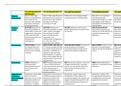
The learning approach: The learning approach: SLT The cognitive approach The biological approach The psych
behaviourism
Views on Doesn’t offer stage Doesn’t offer stage theories of Children form increasingly complex Maturation is an important Psychosexu
development theories of development development but instead see concepts/schemas as they get older. principle; genetically by age and
but instead see the the processes that underpin determined changes in a child’s developme
processes that underpin learning as continuous, physiological status influence the genital
learning as continuous, occurring at any age. psychological and behavioural
occurring at any age. characteristics.
Nature vs NURTURE Behaviourists NURTURE Behaviourists NATURE Behaviour is the rest of a NATURE AND NURTURE NATURE AN
nurture characterised babies as characterised babies as ‘blank genetic blueprint that we inherit from Information processing and that much
‘blank slates’ at birth and slates’ at birth and suggest our parents. schemas are innate but they are driven by b
suggest that all behaviour that all behaviour comes constantly refined through instincts, h
comes about through about through learned experience. with paren
learned associations and associations and future deve
reinforcement reinforcement contingencies
contingencies. or, in the case of SLT,
observation and imitation.
Reductionism REDUCTIONIST It breaks REDUCTIONIST AND HOLISTIC MACHINE REDUCTINISM The approach REDUCTIONIST Explains human REDUCTION
up complex behaviour SLT reduces complex learning presents people as information behaviour and psychological drives and
into stimulus-response to a handful of key processes processing systems and ignores the states at the level of the gene or influence o
units for ease of testing (imitation, modelling, etc.) influence of emotion on behaviour. neuron. argument t
in the lab. though the approach does dynamic in
place emphasis on cognitive three parts
factors that mediate learning, viewed as a
and how these interact with
external forces.
Determinism HARD All behaviour is SOFT Reciprocal determinism SOFT We are the ‘choosers’ of our own HARD Genetic determinism – HARD Psyc
environmentally – we are influenced by the thoughts and behaviours, yet these behaviour is directed by innate unconsciou
determined by external environment but we also exert choices can only operate within the influences. behaviour
forces that we can’t some influence upon it limits of what we know and have conscious m
control. through the behaviours we experienced.
choose to perform.
Explanation and Explanation: abnormality Explanation: the principles of Explanation: explains depression Explanation: explains OCD Explanation
treatment of arises from faulty modelling and observational through Beck’s theory (faulty info through genetic explanations to unconsc
abnormal/atypical learning in the sense that learning can explain how processing, negative self-schemas, the (candidate genes) and neural trauma and
behaviour destructive patterns of negative behaviours (e.g. negative triad) and through Ellis’s ABC explanations (serotonin). mechanism
behaviour have been aggression) may be learned model (activating event, beliefs and
reinforced. It explains through the existence of consequences). Treatment: drug therapies Treatment:
behaviourism
Views on Doesn’t offer stage Doesn’t offer stage theories of Children form increasingly complex Maturation is an important Psychosexu
development theories of development development but instead see concepts/schemas as they get older. principle; genetically by age and
but instead see the the processes that underpin determined changes in a child’s developme
processes that underpin learning as continuous, physiological status influence the genital
learning as continuous, occurring at any age. psychological and behavioural
occurring at any age. characteristics.
Nature vs NURTURE Behaviourists NURTURE Behaviourists NATURE Behaviour is the rest of a NATURE AND NURTURE NATURE AN
nurture characterised babies as characterised babies as ‘blank genetic blueprint that we inherit from Information processing and that much
‘blank slates’ at birth and slates’ at birth and suggest our parents. schemas are innate but they are driven by b
suggest that all behaviour that all behaviour comes constantly refined through instincts, h
comes about through about through learned experience. with paren
learned associations and associations and future deve
reinforcement reinforcement contingencies
contingencies. or, in the case of SLT,
observation and imitation.
Reductionism REDUCTIONIST It breaks REDUCTIONIST AND HOLISTIC MACHINE REDUCTINISM The approach REDUCTIONIST Explains human REDUCTION
up complex behaviour SLT reduces complex learning presents people as information behaviour and psychological drives and
into stimulus-response to a handful of key processes processing systems and ignores the states at the level of the gene or influence o
units for ease of testing (imitation, modelling, etc.) influence of emotion on behaviour. neuron. argument t
in the lab. though the approach does dynamic in
place emphasis on cognitive three parts
factors that mediate learning, viewed as a
and how these interact with
external forces.
Determinism HARD All behaviour is SOFT Reciprocal determinism SOFT We are the ‘choosers’ of our own HARD Genetic determinism – HARD Psyc
environmentally – we are influenced by the thoughts and behaviours, yet these behaviour is directed by innate unconsciou
determined by external environment but we also exert choices can only operate within the influences. behaviour
forces that we can’t some influence upon it limits of what we know and have conscious m
control. through the behaviours we experienced.
choose to perform.
Explanation and Explanation: abnormality Explanation: the principles of Explanation: explains depression Explanation: explains OCD Explanation
treatment of arises from faulty modelling and observational through Beck’s theory (faulty info through genetic explanations to unconsc
abnormal/atypical learning in the sense that learning can explain how processing, negative self-schemas, the (candidate genes) and neural trauma and
behaviour destructive patterns of negative behaviours (e.g. negative triad) and through Ellis’s ABC explanations (serotonin). mechanism
behaviour have been aggression) may be learned model (activating event, beliefs and
reinforced. It explains through the existence of consequences). Treatment: drug therapies Treatment: