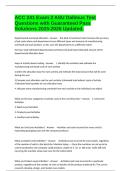
ACC 241 Exam 2 ASU Dallmus Test
Questions with Guaranteed Pass
Solutions 2025-2026 Updated.
departmental overhead allocation - Answer this kind of overheard rate increases the accuracy
of job costs when each department incurs different types and amounts of manufacturing
overhead and each product, or job, uses the departments to a different extent
formula: total estimated departmental overhead cost pool/total estimated amount of the
departmental allocation base
steps of activity-based costing - Answer 1. Identify the activities and estimate the
manufacturing overhead costs of each activity
2.Select the allocation base for each activity and estimate the total amount that will be used
during the year
3.Compute cost allocation rate for each activity: Estimated total indirect costs of activity
/Estimated total quantity of cost allocation base
4. Allocate some manufacturing overhead from each activity to the individual cost object
What are the four categories of activity costs in the cost hierarchy? - Answer 1: Unit-Level
Activities
2: Batch-Level Activities
3: Product-Level Activities
4: Facility-Level Activities
What are Unit-Level Activities? - Answer -Activities and costs incurred for every unit-Ex:
Inspecting/packaging each unit the company produces
What are Batch-Level Activities? - Answer -Activities/costs incurred for every batch, regardless
of the number of units in the batch-Ex: Machine Setup --> Once the machines are set up to be
used in production, the company could produce a batch of 1, 10, or 100 units, while still only
incurring the machine setup cost once for the entire batch
What are Product-Level Activities? - Answer -Activities and costs incurred for a particular
product, regardless of the number of units or batches of the product produced-Ex: The cost to
research, develop, design, and market new models
, activity based management - Answer a management approach that focuses on managing
activities as a way of eliminating waste and reducing delays and defects
-refers to the use of activity-based cost information to make decisions that increase profits while
satisfying customer needs
What are value-added activities? - Answer Activities for which the customer is willing to pay
because these activities add value to the final product
What are non-value-added activities? - Answer Activities that neither enhance the customer's
image of the product nor provide a competitive advantage
Benefits of adopting activity-based costing - Answer - significant amounts of indirect costs are
allocated using only one or two cost pools.
- all or most indirect costs are identified as output unit-level costs.
- products make diverse demands on resources because of differences in volume, process steps,
batch size, or complexity
- products that a company is well suited to make and sell show small profits - operations staff
has substantial disagreement with the reported costs of manufacturing and marketing products
and services.
Lean Production System - Answer production system designed for smooth production flows
that avoid inefficiencies, eliminate unnecessary inventories, and continuously improve
production processes
traditional production system - Answer -keep large inventories on hand
-problems:
--storage cost
-hide quality
-bottlenecks and obsolete products
-solution:
Lean productions system
Questions with Guaranteed Pass
Solutions 2025-2026 Updated.
departmental overhead allocation - Answer this kind of overheard rate increases the accuracy
of job costs when each department incurs different types and amounts of manufacturing
overhead and each product, or job, uses the departments to a different extent
formula: total estimated departmental overhead cost pool/total estimated amount of the
departmental allocation base
steps of activity-based costing - Answer 1. Identify the activities and estimate the
manufacturing overhead costs of each activity
2.Select the allocation base for each activity and estimate the total amount that will be used
during the year
3.Compute cost allocation rate for each activity: Estimated total indirect costs of activity
/Estimated total quantity of cost allocation base
4. Allocate some manufacturing overhead from each activity to the individual cost object
What are the four categories of activity costs in the cost hierarchy? - Answer 1: Unit-Level
Activities
2: Batch-Level Activities
3: Product-Level Activities
4: Facility-Level Activities
What are Unit-Level Activities? - Answer -Activities and costs incurred for every unit-Ex:
Inspecting/packaging each unit the company produces
What are Batch-Level Activities? - Answer -Activities/costs incurred for every batch, regardless
of the number of units in the batch-Ex: Machine Setup --> Once the machines are set up to be
used in production, the company could produce a batch of 1, 10, or 100 units, while still only
incurring the machine setup cost once for the entire batch
What are Product-Level Activities? - Answer -Activities and costs incurred for a particular
product, regardless of the number of units or batches of the product produced-Ex: The cost to
research, develop, design, and market new models
, activity based management - Answer a management approach that focuses on managing
activities as a way of eliminating waste and reducing delays and defects
-refers to the use of activity-based cost information to make decisions that increase profits while
satisfying customer needs
What are value-added activities? - Answer Activities for which the customer is willing to pay
because these activities add value to the final product
What are non-value-added activities? - Answer Activities that neither enhance the customer's
image of the product nor provide a competitive advantage
Benefits of adopting activity-based costing - Answer - significant amounts of indirect costs are
allocated using only one or two cost pools.
- all or most indirect costs are identified as output unit-level costs.
- products make diverse demands on resources because of differences in volume, process steps,
batch size, or complexity
- products that a company is well suited to make and sell show small profits - operations staff
has substantial disagreement with the reported costs of manufacturing and marketing products
and services.
Lean Production System - Answer production system designed for smooth production flows
that avoid inefficiencies, eliminate unnecessary inventories, and continuously improve
production processes
traditional production system - Answer -keep large inventories on hand
-problems:
--storage cost
-hide quality
-bottlenecks and obsolete products
-solution:
Lean productions system