

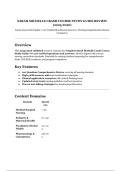
SARAH MICHELLE CRASH COURSE STUDY GUIDE REVIEW
(2025/2026)
Latest 2025/2026 Update | 210 Verified Questions & Answers | Nursing Comprehensive Review
| Graded A+
Overview
This 2025/2026 validated resource contains the complete Sarah Michelle Crash Course
Study Guide with 210 verified questions and answers, directly aligned with current
nursing curriculum standards. Essential for nursing students preparing for comprehensive
finals, NCLEX® readiness, and program completion.
Key Features
● 210 Question Comprehensive Review covering all nursing domains
● High-yield memory aids and visualization techniques
● Clinical application scenarios with critical thinking focus
● Updated 2025/2026 nursing guidelines and best practices
● Proven test-taking strategies for maximum performance
Content Domains
Domain Questi
ons
Medical-Surgical 1–60
Nursing
Pediatric & 61–100
Maternal-Health
Psychiatric-Mental 101–13
Health 5
Pharmacology & 136–16
Calculations 5
, Fundamental 166–19
Nursing Skills 0
Leadership & 191–21
Management 0
Answer Format
Correct answers in bold green with:
● Sarah Michelle's signature memory techniques
● Clinical judgment development pathways
● Priority-setting frameworks
● Error prevention strategies
Critical Updates 2025/2026
● NEW – Updated medication classifications (biologics, SGLT2i, GLP-1)
● REVISED – NCLEX®-RN® test plan alignment (NCSBN 2026)
● ENHANCED – Clinical decision-making models (Tanner’s Model)
● EXPANDED – Prioritization and delegation content (ABC, Maslow, 5 Rights)
Medical-Surgical Nursing (Q1–Q60)
1. A client with chest pain has ST elevation in leads II, III, aVF. Priority action?
a) Administer aspirin
b) Activate cath lab; MONA protocol
c) Give beta blocker
d) Order troponin
Memory Aid: “Right ventricle looks at II, III, aVF — Right-sided MI!”
Priority: ABC — restore perfusion.
2. Post-op cholecystectomy client has bile-colored drainage from JP drain.
Expected?
a) Yes — normal first 24–48 hr
b) No — infection
c) Bleeding
d) Pancreatic leak
Memory Aid: “Bile = Bright yellow/green = Good to go!”
,3. Client with DKA has Kussmaul respirations, fruity breath. First
intervention?
a) Give bicarbonate
b) IV NS bolus + regular insulin drip
c) Potassium
d) Intubate
Memory Aid: “Kussmaul = Kills sugar with deep breaths”
Rule: Fluids before insulin.
4. Client with COPD exacerbation. Best position?
a) Supine
b) Tripod (lean forward)
c) Prone
d) Side-lying
Memory Aid: “Tripod = Three points of contact for better diaphragm”
5. Client with HF has 3+ pitting edema, crackles. Medication to hold?
a) Lisinopril
b) Metoprolol (if HR <60)
c) Furosemide
d) Digoxin
Priority: Safety — Avoid bradycardia.
6. Client post-cath has hematoma at femoral site. First action?
a) Apply heat
b) Apply direct pressure 15 min
c) Elevate leg
d) Notify MD after
Memory Aid: “Pressure = P for Prevent bleeding”
7. Client with pancreatitis has Cullen’s sign. Indicates:
a) Hemorrhagic pancreatitis
b) Cholecystitis
c) Appendicitis
d) PUD
Memory Aid: “Cullen = Color around umbilicus = Bleeding”
8. Client with cirrhosis has asterixis. Cause?
a) Hypoglycemia
b) Hepatic encephalopathy (ammonia)
c) Hypokalemia
d) Dehydration
Memory Aid: “Flapping = Ammonia clap”
Give: Lactulose.
, 9. Client with PE has sudden dyspnea, pleuritic pain. Oxygen via:
a) Nasal cannula 2 L
b) Non-rebreather mask
c) Venturi
d) CPAP
Memory Aid: “PE = Plug in lungs → High-flow O₂”
10.Client with myxedema coma. Priority lab?
a) CBC
b) TSH, free T4
c) Cortisol
d) Glucose
Memory Aid: “Myxedema = My thyroid is dead”
11.Client with Guillain-Barré. Expected finding?
a) Hyperreflexia
b) Ascending paralysis, areflexia
c) Spasticity
d) Tremors
Memory Aid: “Guillain = Going up the body”
12.Client with C. diff. Isolation type?
a) Droplet
b) Contact (handwashing with soap)
c) Airborne
d) Standard
Memory Aid: “C. diff = Can’t kill with alcohol”
13.Client with Addison’s crisis. First fluid?
a) D5W
b) NS bolus + hydrocortisone
c) LR
d) Albumin
Memory Aid: “Addison = Add cortisol + salt”
14.Client with ARDS. Best ventilator mode?
a) CPAP
b) Low tidal volume (6 mL/kg), PEEP
c) High FiO₂
d) SIMV
Memory Aid: “ARDS = Avoid stretch, use PEEP”
15.Client post-thyroidectomy has stridor. Cause?
a) Hypocalcemia
b) Laryngeal edema or hematoma
(2025/2026)
Latest 2025/2026 Update | 210 Verified Questions & Answers | Nursing Comprehensive Review
| Graded A+
Overview
This 2025/2026 validated resource contains the complete Sarah Michelle Crash Course
Study Guide with 210 verified questions and answers, directly aligned with current
nursing curriculum standards. Essential for nursing students preparing for comprehensive
finals, NCLEX® readiness, and program completion.
Key Features
● 210 Question Comprehensive Review covering all nursing domains
● High-yield memory aids and visualization techniques
● Clinical application scenarios with critical thinking focus
● Updated 2025/2026 nursing guidelines and best practices
● Proven test-taking strategies for maximum performance
Content Domains
Domain Questi
ons
Medical-Surgical 1–60
Nursing
Pediatric & 61–100
Maternal-Health
Psychiatric-Mental 101–13
Health 5
Pharmacology & 136–16
Calculations 5
, Fundamental 166–19
Nursing Skills 0
Leadership & 191–21
Management 0
Answer Format
Correct answers in bold green with:
● Sarah Michelle's signature memory techniques
● Clinical judgment development pathways
● Priority-setting frameworks
● Error prevention strategies
Critical Updates 2025/2026
● NEW – Updated medication classifications (biologics, SGLT2i, GLP-1)
● REVISED – NCLEX®-RN® test plan alignment (NCSBN 2026)
● ENHANCED – Clinical decision-making models (Tanner’s Model)
● EXPANDED – Prioritization and delegation content (ABC, Maslow, 5 Rights)
Medical-Surgical Nursing (Q1–Q60)
1. A client with chest pain has ST elevation in leads II, III, aVF. Priority action?
a) Administer aspirin
b) Activate cath lab; MONA protocol
c) Give beta blocker
d) Order troponin
Memory Aid: “Right ventricle looks at II, III, aVF — Right-sided MI!”
Priority: ABC — restore perfusion.
2. Post-op cholecystectomy client has bile-colored drainage from JP drain.
Expected?
a) Yes — normal first 24–48 hr
b) No — infection
c) Bleeding
d) Pancreatic leak
Memory Aid: “Bile = Bright yellow/green = Good to go!”
,3. Client with DKA has Kussmaul respirations, fruity breath. First
intervention?
a) Give bicarbonate
b) IV NS bolus + regular insulin drip
c) Potassium
d) Intubate
Memory Aid: “Kussmaul = Kills sugar with deep breaths”
Rule: Fluids before insulin.
4. Client with COPD exacerbation. Best position?
a) Supine
b) Tripod (lean forward)
c) Prone
d) Side-lying
Memory Aid: “Tripod = Three points of contact for better diaphragm”
5. Client with HF has 3+ pitting edema, crackles. Medication to hold?
a) Lisinopril
b) Metoprolol (if HR <60)
c) Furosemide
d) Digoxin
Priority: Safety — Avoid bradycardia.
6. Client post-cath has hematoma at femoral site. First action?
a) Apply heat
b) Apply direct pressure 15 min
c) Elevate leg
d) Notify MD after
Memory Aid: “Pressure = P for Prevent bleeding”
7. Client with pancreatitis has Cullen’s sign. Indicates:
a) Hemorrhagic pancreatitis
b) Cholecystitis
c) Appendicitis
d) PUD
Memory Aid: “Cullen = Color around umbilicus = Bleeding”
8. Client with cirrhosis has asterixis. Cause?
a) Hypoglycemia
b) Hepatic encephalopathy (ammonia)
c) Hypokalemia
d) Dehydration
Memory Aid: “Flapping = Ammonia clap”
Give: Lactulose.
, 9. Client with PE has sudden dyspnea, pleuritic pain. Oxygen via:
a) Nasal cannula 2 L
b) Non-rebreather mask
c) Venturi
d) CPAP
Memory Aid: “PE = Plug in lungs → High-flow O₂”
10.Client with myxedema coma. Priority lab?
a) CBC
b) TSH, free T4
c) Cortisol
d) Glucose
Memory Aid: “Myxedema = My thyroid is dead”
11.Client with Guillain-Barré. Expected finding?
a) Hyperreflexia
b) Ascending paralysis, areflexia
c) Spasticity
d) Tremors
Memory Aid: “Guillain = Going up the body”
12.Client with C. diff. Isolation type?
a) Droplet
b) Contact (handwashing with soap)
c) Airborne
d) Standard
Memory Aid: “C. diff = Can’t kill with alcohol”
13.Client with Addison’s crisis. First fluid?
a) D5W
b) NS bolus + hydrocortisone
c) LR
d) Albumin
Memory Aid: “Addison = Add cortisol + salt”
14.Client with ARDS. Best ventilator mode?
a) CPAP
b) Low tidal volume (6 mL/kg), PEEP
c) High FiO₂
d) SIMV
Memory Aid: “ARDS = Avoid stretch, use PEEP”
15.Client post-thyroidectomy has stridor. Cause?
a) Hypocalcemia
b) Laryngeal edema or hematoma


