
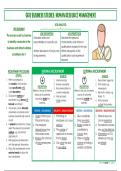
GR12 BUSINESS STUDIES: HUMAN RESOURCE MANAGEMENT
JOB ANALYSIS
RECRUITMENT
The process used by business JOB DESCRIPTION JOB SPESIFICTION
Describes duties and Describes the personal
to identify vacancies in the responsibilities of a specific job. characteristics and minimum
business and attract suitable qualifications required for the job.
Written description of the job and Written description of the
candidates for it. its requirements. qualifications and experience
required.
RECRUITMENT PROCEDURE INTERNAL RECRUITMENT EXTERNAL RECRUITMENT
(STEPS) SOURCES: SOURCES:
1. HRM must prepare a 1. Internal e-mails. 1. Recruitment agencies
job analysis, that includes 2. Business newsletter. 2. Print media, e.g.
a job specification AND DESCRIPTION: DESCRIPTION:
3. Recommendation of newspapers
a job description; Refers to the use of internal Refers to the use of external
current employees. 3. Electronic media, e.g.
2. Choose the method of resources to advertise sources to advertise
4. Notice boards Radio, TV
recruitment, e.g. Internal OR vacancies inside the vacancies outside the
inside business. 4. Notice boards
External recruitment business. business.
outside the business.
3. Vacancies can be internally
advertised via internal email / POSITIVE / ADVANTAGE NEGATIVE / DISADVANTAGE POSITIVE / ADVANTAGE NEGATIVE / DISADVANTAGE
business newsletter /By word of 1. Faster to fill the post - 1. Promoting an 1. New candidates 1. External resources
mouth Placement is easy employee can cause bring new ideas. can be expensive.
4. If external recruitment is chosen, 2. The employee jealousy. 2. Bigger number of 2. The selection process
select the relevant recruitment already knows how 2. The number of candidates to may not be effective.
method, e.g. recruitment
the business works. applicants to choose choose from. 3. Information on CVs
agencies etc
3. Reduce the chances from is limited 3. There is a better references may not
5. HRM prepare advertisement
of losing employees. 3. Can close the door chance of finding a be reliable.
with the relevant information
6. Place the advertisement in the to new ideas. suitable candidate.
selected media to draw the
best candidates.
Develop by CSNOW PLC (2023)
, PURPOSE OF INTERVIEW = Obtain information on the strengths and weaknesses of each candidate.
BEFORE THE INTERVIEW DURING THE INTERVIEW
Role of Role of Role of
SELECTION INTERVIEWER INTERVIEWER CANDIDATE / APPLICANT
Determine which applications 1. Die interviewer must set a core set of questions 1. Give each candidate 1. Greet the interviewer
meet the minimum work so that the same questions are aked for each the same amount of by name with a firm
requirements and separate them candidate. time. handshake and a
from the rest. 2. Introduce the friendly smile.
2. Check the CVs for anything that may need to be
interview panel to 2. Listen carefully to the
SELECTION PROCEDURE explained. each candidate questions before you
(STEPS) 3. Book and prepare the venue for the interview. 3. Make interviewee respond.
1. Receive application forms 4. Inform all shortlisted candidates of the date and feel at ease. 3. Make eye contact
and sort them according to place of the interview. and keep good body
the criteria. language.
2. Check information and EMPLOYMENT LEGAL REQUIREMENTS ASPECTS REASONS:
contact references in the CONTRACT of Employment Contract of Employment Contract TERMINATION
CVs. Employment contract is • Employer and • Details of the of Employment Contract
3. Compile shortlist of suitable an agreement between employee must employee.
1. Misconduct
candidates. the employer and the agree to changes • Details of the business
• Employer and • Job description 2. Retrenchment
4. Interview shortlisted employee and is legally
employee must both • Job specification
candidates. binding. 3. Resignation
sign the contract. • Salary
5. Test candidates to ensure the • Employment contract • Fringe benefits 4. Retirement
best candidate is selected. must include a code • Working hours
5. Incapacity
6. Offer work to the candidate of conduct and a • Leave
in writing. code of ethics. (Pg7 = Full sentences/Explain)
FRINGE BENEFITS IMPACT OF FRINGE BENEFITS:
1. Pension POSITIVE / ADANTAGES NEGATIVE / DISADVANTAGES
2. Medical assistance 1. Attractive fringe benefits lead to less worker 1. Businesses that cannot offer fringe benefits do not
3. Provident Fund turnover. succeed in getting skilled workers.
2. Attracting Qualified Employees 2. It can lead to corruption if it is unfairly awarded.
4. Funeral benefits
3. Improves productivity, leading to higher 3. Benefits are extra costs that can lead to cash
5. Car allowances profitability. flow problems.
Develop by CSNOW PLC (2023)
, INDUCTION PURPOSE OF INDUCTION
PLACEMENT New employees need to 1. Introduce new employees to management
Selected candidates are placed be familiar with their new and colleagues
where they will function optimally work environment, 2. Introduce new employees to their workspace
and add value to the business. products and services. 3. Give new employees a tour through the
building.
BENEFITS OF INDUCTION PROGRAM
ASPECTS OF INDUCTION PROGRAM
PLACEMENT PROCEDURE 1. New employees can establish relationships
(STEPS) 1. Introduction to colleagues.
with co-employees.
1. EMPLOYER sets responsibilities for 2. Safety regulations and rules.
2. Allow new employees to settle quickly
3. Oversight of the business.
the employee. 3. Ensure that new employees know rules.
4. Tour oround the premises.
2. EMPLOYER compare the
expectations of the job and the SALARY DETERMINATION METHODS
competencies of the employee. PIECEMEAL TIME-RELATED
1. Workers are paid according to 1. Workers are paid for the amount of
3. Determine the employee's
the number of items produced time they spend at work.
strengths and weaknesses 2. Workers are NOT remunerated for 2. Workers with the same
the number of hours worked, no qualifications are paid on salary
through psychometric tests.
matter how long it takes to make scales regardless of the amount of
the items. work done.
MANDATORY FRINGE BENEFITS: LINK BETWEEN
UNEMPLOYMENT INSURANCE FUND (UIF) SALARY DETERMINATION & BASIC CONDITIONS OF EMPLOYMENT ACT
1. Give financial assistance to workers when they become unemployed. 1. The BCEA sets conditions for fair labour
2. The fund also helps the dependents of a contributing worker who has 2. Businesses can use different compensation methods to pay their
died. employees.
3. Employers must pay contributions of 2% of the value of each worker's 3. Payment of salaries must be based on whether the employee is
salary per month. permanently or employed on a fixed-term contract.
4. The EMPLOYER and the WORKER each contribute 1%.
5. UIF contributions are paid to SARS by the employer. Importance of TRAINING
• The employee is more able to perform in their job.
• Shows that employees are appreciated.
• Allow employees to improve their skills.
Develop by CSNOW PLC (2023)
, LEGISLATION Develop by CSNOW PLC (2023)
The Implications of the Acts on the Human Resource Function
IMPORTANT! The word “Implication” refers to what the Human Resources manager must do in order to comply with the requirements of the Act.
This must not be confused the “Ways in which businesses can comply with the Act”, as dealt with in LEGISLATION.
BASIC CONDITIONS OF
LABOUR RELATIONS ACT EMPLOYMENT EQUITY ACT SKILLS DEVELOPMENT ACT
EMPLOYMENT ACT
1. Workers cannot be dismissed 1. Ensure equal pay for work of 1. Ensure training in the workplace is The HRM should ensure that:
easily because the CCMA's equal value. structured. 1. Workers only work:
processes have to be followed. 2. Ensure that affirmative action 2. Identify the training needs of the a. 9 hours (5 days week) OR
2. The HRM must allow workers to promotes diversity in the employees and provide them b. 8 hours (6 days week);
form workplace forums / unions. workplace. with training opportunities. 2. Overtime is no more than 10 hours
3. Promote negotiations and 3. Set Employment Equity Plan and 3. HRM must set up training per week.
employee participation in monitor regularly. programs according to SDA 3. A break of 60 minutes after
decision-making. objectives. every 5 hours of work
4. 6 week sick leave in a cycle of
36 months (3 years).
B. SELECTION: D. PLACEMENT:
1. Outline the selection procedure. 1. Outline the placement procedure.
2. Explain the meaning of screening as part of the 2. Explain the importance of training/skills development
selection procedure. in HR.
3. Discuss the role of the interviewer before and during
E. SALARY DETERMINATION
the interview.
FREQUENTLY ASKED QUESTIONS in the NSC EXAMS 1. Distinguish between piece meal and time-related
4. Discuss the role of the candidate during the
salary determination methods. (Table)
interview
A. RECRUITMENT: 2. Explain the link between salary determination and the
5. Explain the reasons for the termination of an
1. Elaborate on the meaning of recruitment. Basic Conditions of Employment Act
employment contract.
2. Outline the recruitment procedure.
3. Explain the meaning of job analysis. F. FRINGE BENEFITS/PERKS:
C. INDUCTION:
4. Distinguish between job description and job 1. Give examples of employee benefits.
1. Discuss the purpose of induction.
specification. (Table) 2. Evaluate the impact of fringe benefits on businesses.
2. Outline aspects that must be included in the
5. Discuss the impact of internal / external 3. Explain UIF as a benefit required by law.
induction programme.
recruitment methods. 3. Discuss the benefits of induction for businesses. G. LEGISLATION:
1. Discuss the implications of the LRA/BCEA/EEA/SDA on
the human resources function.
JOB ANALYSIS
RECRUITMENT
The process used by business JOB DESCRIPTION JOB SPESIFICTION
Describes duties and Describes the personal
to identify vacancies in the responsibilities of a specific job. characteristics and minimum
business and attract suitable qualifications required for the job.
Written description of the job and Written description of the
candidates for it. its requirements. qualifications and experience
required.
RECRUITMENT PROCEDURE INTERNAL RECRUITMENT EXTERNAL RECRUITMENT
(STEPS) SOURCES: SOURCES:
1. HRM must prepare a 1. Internal e-mails. 1. Recruitment agencies
job analysis, that includes 2. Business newsletter. 2. Print media, e.g.
a job specification AND DESCRIPTION: DESCRIPTION:
3. Recommendation of newspapers
a job description; Refers to the use of internal Refers to the use of external
current employees. 3. Electronic media, e.g.
2. Choose the method of resources to advertise sources to advertise
4. Notice boards Radio, TV
recruitment, e.g. Internal OR vacancies inside the vacancies outside the
inside business. 4. Notice boards
External recruitment business. business.
outside the business.
3. Vacancies can be internally
advertised via internal email / POSITIVE / ADVANTAGE NEGATIVE / DISADVANTAGE POSITIVE / ADVANTAGE NEGATIVE / DISADVANTAGE
business newsletter /By word of 1. Faster to fill the post - 1. Promoting an 1. New candidates 1. External resources
mouth Placement is easy employee can cause bring new ideas. can be expensive.
4. If external recruitment is chosen, 2. The employee jealousy. 2. Bigger number of 2. The selection process
select the relevant recruitment already knows how 2. The number of candidates to may not be effective.
method, e.g. recruitment
the business works. applicants to choose choose from. 3. Information on CVs
agencies etc
3. Reduce the chances from is limited 3. There is a better references may not
5. HRM prepare advertisement
of losing employees. 3. Can close the door chance of finding a be reliable.
with the relevant information
6. Place the advertisement in the to new ideas. suitable candidate.
selected media to draw the
best candidates.
Develop by CSNOW PLC (2023)
, PURPOSE OF INTERVIEW = Obtain information on the strengths and weaknesses of each candidate.
BEFORE THE INTERVIEW DURING THE INTERVIEW
Role of Role of Role of
SELECTION INTERVIEWER INTERVIEWER CANDIDATE / APPLICANT
Determine which applications 1. Die interviewer must set a core set of questions 1. Give each candidate 1. Greet the interviewer
meet the minimum work so that the same questions are aked for each the same amount of by name with a firm
requirements and separate them candidate. time. handshake and a
from the rest. 2. Introduce the friendly smile.
2. Check the CVs for anything that may need to be
interview panel to 2. Listen carefully to the
SELECTION PROCEDURE explained. each candidate questions before you
(STEPS) 3. Book and prepare the venue for the interview. 3. Make interviewee respond.
1. Receive application forms 4. Inform all shortlisted candidates of the date and feel at ease. 3. Make eye contact
and sort them according to place of the interview. and keep good body
the criteria. language.
2. Check information and EMPLOYMENT LEGAL REQUIREMENTS ASPECTS REASONS:
contact references in the CONTRACT of Employment Contract of Employment Contract TERMINATION
CVs. Employment contract is • Employer and • Details of the of Employment Contract
3. Compile shortlist of suitable an agreement between employee must employee.
1. Misconduct
candidates. the employer and the agree to changes • Details of the business
• Employer and • Job description 2. Retrenchment
4. Interview shortlisted employee and is legally
employee must both • Job specification
candidates. binding. 3. Resignation
sign the contract. • Salary
5. Test candidates to ensure the • Employment contract • Fringe benefits 4. Retirement
best candidate is selected. must include a code • Working hours
5. Incapacity
6. Offer work to the candidate of conduct and a • Leave
in writing. code of ethics. (Pg7 = Full sentences/Explain)
FRINGE BENEFITS IMPACT OF FRINGE BENEFITS:
1. Pension POSITIVE / ADANTAGES NEGATIVE / DISADVANTAGES
2. Medical assistance 1. Attractive fringe benefits lead to less worker 1. Businesses that cannot offer fringe benefits do not
3. Provident Fund turnover. succeed in getting skilled workers.
2. Attracting Qualified Employees 2. It can lead to corruption if it is unfairly awarded.
4. Funeral benefits
3. Improves productivity, leading to higher 3. Benefits are extra costs that can lead to cash
5. Car allowances profitability. flow problems.
Develop by CSNOW PLC (2023)
, INDUCTION PURPOSE OF INDUCTION
PLACEMENT New employees need to 1. Introduce new employees to management
Selected candidates are placed be familiar with their new and colleagues
where they will function optimally work environment, 2. Introduce new employees to their workspace
and add value to the business. products and services. 3. Give new employees a tour through the
building.
BENEFITS OF INDUCTION PROGRAM
ASPECTS OF INDUCTION PROGRAM
PLACEMENT PROCEDURE 1. New employees can establish relationships
(STEPS) 1. Introduction to colleagues.
with co-employees.
1. EMPLOYER sets responsibilities for 2. Safety regulations and rules.
2. Allow new employees to settle quickly
3. Oversight of the business.
the employee. 3. Ensure that new employees know rules.
4. Tour oround the premises.
2. EMPLOYER compare the
expectations of the job and the SALARY DETERMINATION METHODS
competencies of the employee. PIECEMEAL TIME-RELATED
1. Workers are paid according to 1. Workers are paid for the amount of
3. Determine the employee's
the number of items produced time they spend at work.
strengths and weaknesses 2. Workers are NOT remunerated for 2. Workers with the same
the number of hours worked, no qualifications are paid on salary
through psychometric tests.
matter how long it takes to make scales regardless of the amount of
the items. work done.
MANDATORY FRINGE BENEFITS: LINK BETWEEN
UNEMPLOYMENT INSURANCE FUND (UIF) SALARY DETERMINATION & BASIC CONDITIONS OF EMPLOYMENT ACT
1. Give financial assistance to workers when they become unemployed. 1. The BCEA sets conditions for fair labour
2. The fund also helps the dependents of a contributing worker who has 2. Businesses can use different compensation methods to pay their
died. employees.
3. Employers must pay contributions of 2% of the value of each worker's 3. Payment of salaries must be based on whether the employee is
salary per month. permanently or employed on a fixed-term contract.
4. The EMPLOYER and the WORKER each contribute 1%.
5. UIF contributions are paid to SARS by the employer. Importance of TRAINING
• The employee is more able to perform in their job.
• Shows that employees are appreciated.
• Allow employees to improve their skills.
Develop by CSNOW PLC (2023)
, LEGISLATION Develop by CSNOW PLC (2023)
The Implications of the Acts on the Human Resource Function
IMPORTANT! The word “Implication” refers to what the Human Resources manager must do in order to comply with the requirements of the Act.
This must not be confused the “Ways in which businesses can comply with the Act”, as dealt with in LEGISLATION.
BASIC CONDITIONS OF
LABOUR RELATIONS ACT EMPLOYMENT EQUITY ACT SKILLS DEVELOPMENT ACT
EMPLOYMENT ACT
1. Workers cannot be dismissed 1. Ensure equal pay for work of 1. Ensure training in the workplace is The HRM should ensure that:
easily because the CCMA's equal value. structured. 1. Workers only work:
processes have to be followed. 2. Ensure that affirmative action 2. Identify the training needs of the a. 9 hours (5 days week) OR
2. The HRM must allow workers to promotes diversity in the employees and provide them b. 8 hours (6 days week);
form workplace forums / unions. workplace. with training opportunities. 2. Overtime is no more than 10 hours
3. Promote negotiations and 3. Set Employment Equity Plan and 3. HRM must set up training per week.
employee participation in monitor regularly. programs according to SDA 3. A break of 60 minutes after
decision-making. objectives. every 5 hours of work
4. 6 week sick leave in a cycle of
36 months (3 years).
B. SELECTION: D. PLACEMENT:
1. Outline the selection procedure. 1. Outline the placement procedure.
2. Explain the meaning of screening as part of the 2. Explain the importance of training/skills development
selection procedure. in HR.
3. Discuss the role of the interviewer before and during
E. SALARY DETERMINATION
the interview.
FREQUENTLY ASKED QUESTIONS in the NSC EXAMS 1. Distinguish between piece meal and time-related
4. Discuss the role of the candidate during the
salary determination methods. (Table)
interview
A. RECRUITMENT: 2. Explain the link between salary determination and the
5. Explain the reasons for the termination of an
1. Elaborate on the meaning of recruitment. Basic Conditions of Employment Act
employment contract.
2. Outline the recruitment procedure.
3. Explain the meaning of job analysis. F. FRINGE BENEFITS/PERKS:
C. INDUCTION:
4. Distinguish between job description and job 1. Give examples of employee benefits.
1. Discuss the purpose of induction.
specification. (Table) 2. Evaluate the impact of fringe benefits on businesses.
2. Outline aspects that must be included in the
5. Discuss the impact of internal / external 3. Explain UIF as a benefit required by law.
induction programme.
recruitment methods. 3. Discuss the benefits of induction for businesses. G. LEGISLATION:
1. Discuss the implications of the LRA/BCEA/EEA/SDA on
the human resources function.


